

.svg)

.svg)
.svg)
.svg)
.svg)
.svg)
Impression Share is one of those metrics that looks simple on the surface but carries deep strategic value. At its core, it represents the percentage of times your ads appear compared to how often they could appear. Many agencies treat it as a visibility metric. In reality, it’s a direct indicator of missed opportunities.
The challenge is not just increasing visibility. It’s doing so without creating operational strain. As agencies scale, they often hit a ceiling. Teams become stretched, campaigns require constant optimization, and rising cost-per-click (CPC) adds pressure to deliver results efficiently.
Even highly capable agencies run into the same issues:
- Limited internal bandwidth
- Gaps in specialized PPC expertise
- Increasing complexity in managing multiple accounts
Growing impression share consistently requires more than effort. It requires a scalable system. This is where a smarter approach becomes necessary, one that does not rely only on hiring more people or extending working hours.
Why Is Impression Share Is a Strategic KPI (Not Just a Metric)?
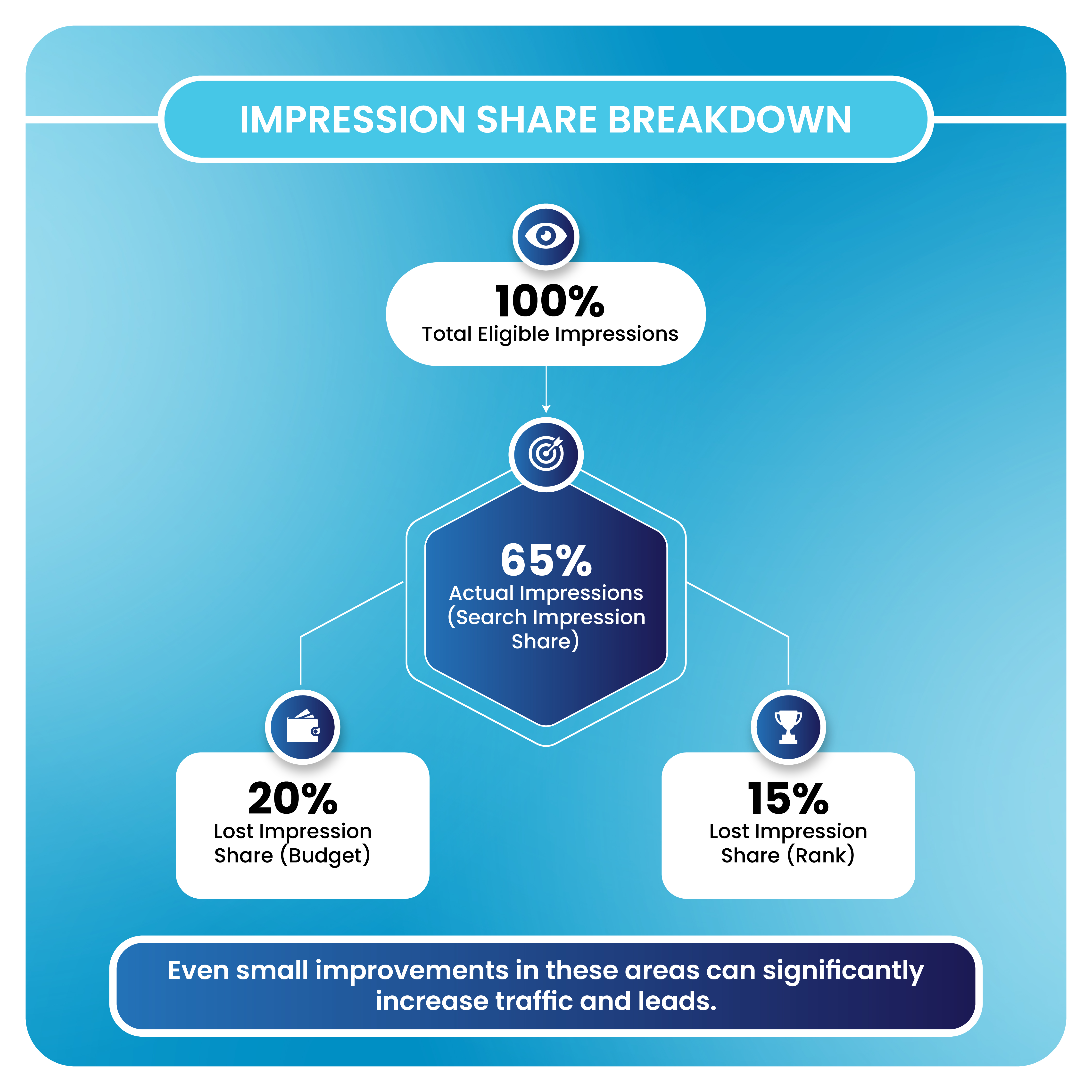
To truly understand the value of impression share, it’s important to look beyond its surface definition and examine what it reveals about campaign performance and missed opportunities. At its core, impression share reflects how often your ads are entering the auction and winning visibility compared to the total potential available.
Breaking it down into its key components gives a clearer picture:
- Search Impression Share: This shows the percentage of impressions your ads receive out of the total eligible impressions. It answers a simple but critical question: How visible are you when it matters?
- Lost Impression Share (Budget): This indicates how often your ads are not shown because your budget is too limited. Even well-optimized campaigns can underperform if they run out of budget too early in the day.
- Lost Impression Share (Rank): This reflects how often your ads miss impressions due to low ad rank, which is influenced by bid levels, ad relevance, and quality score.
Each of these metrics points to a different constraint, and together they provide a roadmap for improvement.
What makes impression share truly strategic is how directly it connects to business outcomes. When managed correctly, even small improvements can lead to meaningful gains:
- Higher impression share often translates into increased lead volume because your ads appear more frequently in relevant searches
- Stronger visibility builds brand familiarity, especially when users repeatedly see your ads in top positions
- Greater presence in search results helps push competitors further down the page, strengthening your market position
However, the goal is not to appear in every possible search. That approach quickly becomes inefficient and expensive. Instead, the real objective is to capture visibility in the moments that matter most. For instance, dominating branded keywords ensures you control your own traffic, while focusing on high-intent queries increases the likelihood of conversions.
This is where impression share shifts from being a simple metric to a decision-making tool. It helps agencies prioritize where to invest budget, which keywords to defend aggressively, and where to scale back.
Achieving this level of precision requires ongoing attention. Campaigns need to be monitored regularly, insights must be acted on quickly, and adjustments should be made before performance drops. This is the point where many agencies begin to experience pressure.
The Operational Bottleneck: Why Agencies Struggle to Scale PPC
Managing PPC campaigns effectively is not a one-time effort. It’s an ongoing cycle of analysis, testing, and refinement. Every campaign generates new data daily, and that data needs to be translated into actionable changes.
As agencies grow and take on more clients, this process becomes harder to sustain at a high level. Several common challenges start to emerge:
- A limited number of experienced PPC specialists handling multiple accounts
- Optimization cycles that take longer due to workload and competing priorities
- Gaps in monitoring, where campaigns are not reviewed as frequently as needed
These challenges may seem manageable at first, but over time, they lead to noticeable inefficiencies.
The consequences are significant:
- Missed Auction Opportunities: If bids are not adjusted in time, competitors can easily take higher positions
- Delayed Reactions to Performance Changes: Trends such as rising CPCs or shifting search behavior can go unnoticed for too long
- Underutilized Budgets: Campaigns may either overspend inefficiently or fail to capture available traffic
The data clearly highlights the impact of these inefficiencies. Google has reported that ads appearing in top positions can generate 2 to 3 times higher click-through rates (CTR) compared to those shown lower on the page. This means that even a slight drop in position can lead to a significant loss in traffic.
In addition, industry benchmarks from WordStream show that the average Google Ads CTR across industries is around 6.11% for search campaigns. When campaigns miss impressions, they are effectively giving up a share of that potential traffic and engagement.
What makes this more challenging is that these losses are often gradual and not immediately obvious. A campaign might still perform reasonably well, but it is quietly missing out on a large portion of available opportunities.
This is why scaling PPC successfully is not just about increasing budgets or adding more campaigns. It requires maintaining a high level of optimization consistency across all accounts.
The reality is straightforward. Agencies need a way to increase the frequency and quality of their optimizations without putting additional strain on their internal teams. Without that, growth eventually slows, and performance plateaus.
White Label PPC: A Strategic Growth Lever, Not Just Outsourcing
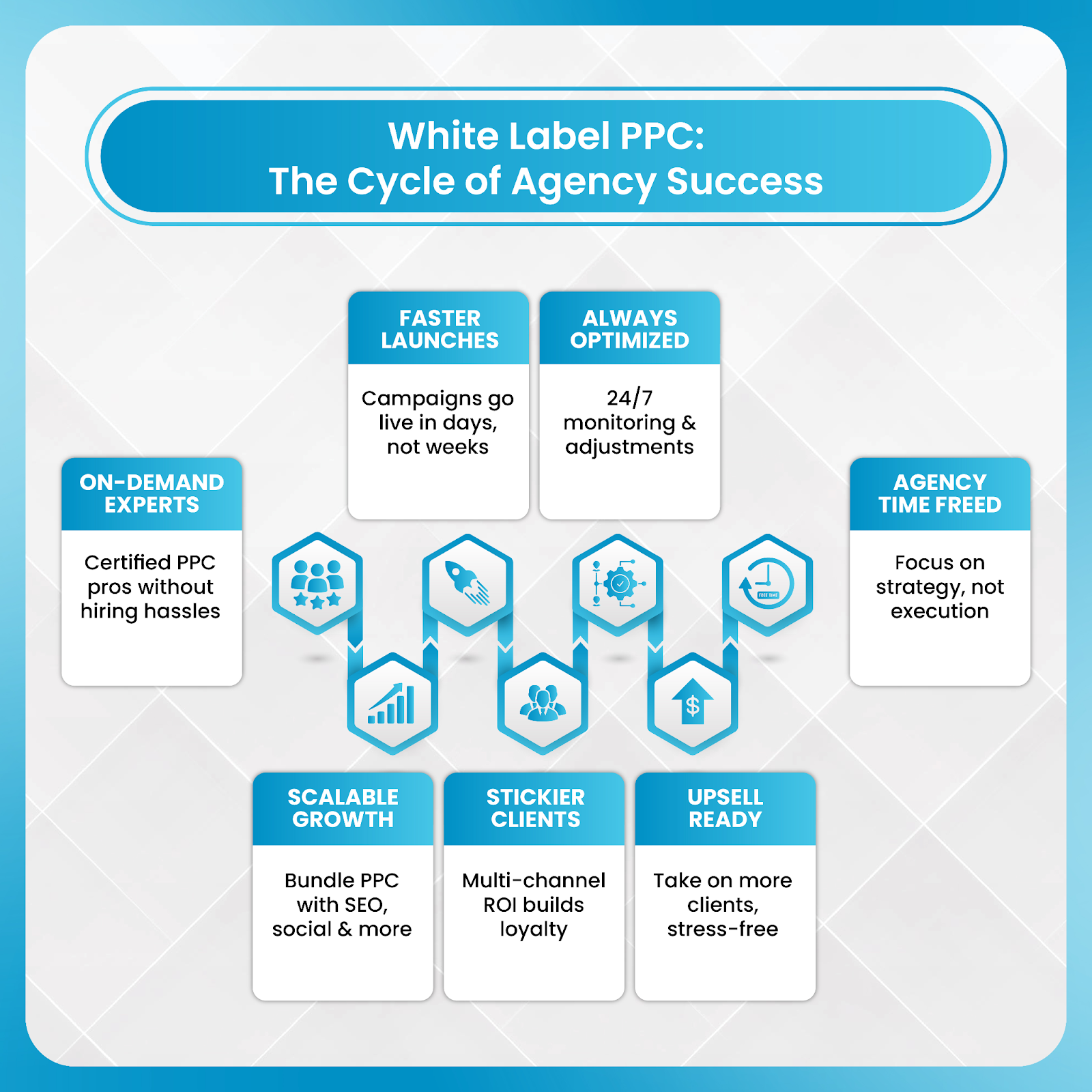
White label PPC is often seen as a way to offload work. In reality, it plays a much bigger role in how modern agencies scale performance. It acts as an execution engine that allows campaigns to run at a higher level of consistency and speed without increasing internal pressure.
Instead of simply assigning tasks, agencies gain access to a dedicated layer of expertise focused entirely on campaign performance. This shift changes how PPC is managed. It moves from reactive adjustments to proactive optimization.
A strong white label PPC partner typically brings:
- Advanced bid management strategies that adapt to real-time auction dynamics
- Continuous campaign optimization, ensuring no account is left unattended
- Access to premium tools and deeper data insights that may not be available in-house
The biggest advantage here is not just saving time or reducing costs. It’s optimization velocity. Campaigns are monitored more frequently, adjustments are made faster, and performance trends are acted on before they become problems.
This speed creates consistency. And consistency is what drives sustained improvements in impression share.
With execution handled at scale, agencies can redirect their attention to what matters most. Strategy, client communication, and growth planning become the focus instead of day-to-day campaign management.
Core Levers to Improve Impression Share Strategically
Improving impression share is not about pulling a single lever. It requires a combination of strategic decisions across budget, keywords, and bidding. When these elements work together, visibility increases in a controlled and profitable way.
Strategic Lever #1: Budget Optimization for Maximum Auction Coverage
Budget plays a direct role in how often your ads can enter auctions. Even well-performing campaigns can lose a significant share of impressions if budgets are exhausted too early.
Instead of simply increasing spend, the goal is to allocate budget more intelligently.
This includes:
- Prioritizing campaigns and keywords that drive the highest conversions
- Using dayparting to focus spending during peak performance hours
- Adjusting budgets based on geographic areas that deliver stronger results
For example, an agency might shift 20% of its budget away from low-performing campaigns and reinvest it into high-intent search terms. Within a month, this can lead to a noticeable lift in impression share, sometimes by 30% or more in targeted segments.
Data from Google Ads consistently shows that Lost Impression Share (Budget) is one of the most common reasons campaigns fail to reach their full visibility potential.
However, the budget alone cannot solve the problem. Even with sufficient spend, campaigns can still miss impressions if they are not targeting the right opportunities.
Strategic Lever #2: Keyword Expansion Without Wasted Spend
Keyword strategy determines where and how often your ads appear. Expanding keyword coverage can unlock new impression opportunities, but only when done with precision.
Effective expansion focuses on:
- Long-tail keywords that are less competitive but highly relevant
- Competitor terms that allow you to capture market share
- High-intent variations that indicate strong purchase or inquiry signals
One of the most overlooked areas is search term analysis. Campaigns generate valuable data every day, yet many agencies do not review it frequently enough. This leads to missed opportunities for both expansion and refinement.
For instance, introducing long-tail keywords into a campaign can lower CPC by around 15–20% while increasing impression share within niche segments. These keywords often bring in more qualified traffic as well.
The key is maintaining balance. Expanding reach should never come at the cost of relevance. More impressions only matter when they contribute to meaningful engagement.
Strategic Lever #3: Bid Strategy Alignment with Impression Goals
Winning impressions ultimately come down to bidding. Even with the right budget and keywords, ads will not appear consistently if bidding strategies are not aligned with campaign objectives.
Agencies typically choose between:
- Manual bidding, which offers more control over individual adjustments
- Automated strategies, such as Target Impression Share or Target CPA
Each approach serves a different purpose. For example:
- Target Impression Share is highly effective for branded campaigns where maintaining visibility is critical
- Target CPA works better for campaigns focused on cost efficiency and conversions
Beyond the overall strategy, fine-tuning bids based on specific variables can significantly improve performance:
- Device type, as user behavior varies across mobile and desktop
- Location, to prioritize regions with stronger results
- Audience segments, based on intent and engagement patterns
A practical example would be switching a branded campaign to a Target Impression Share strategy. This can quickly push ads into top-of-page positions, often achieving over 90% visibility and reinforcing brand authority.
The challenge is maintaining the right balance. Increasing bids can improve visibility, but it must be done without sacrificing return on investment.
When these three levers work together, impression share becomes more than just a metric. It becomes a controlled outcome driven by smart decisions and consistent execution.
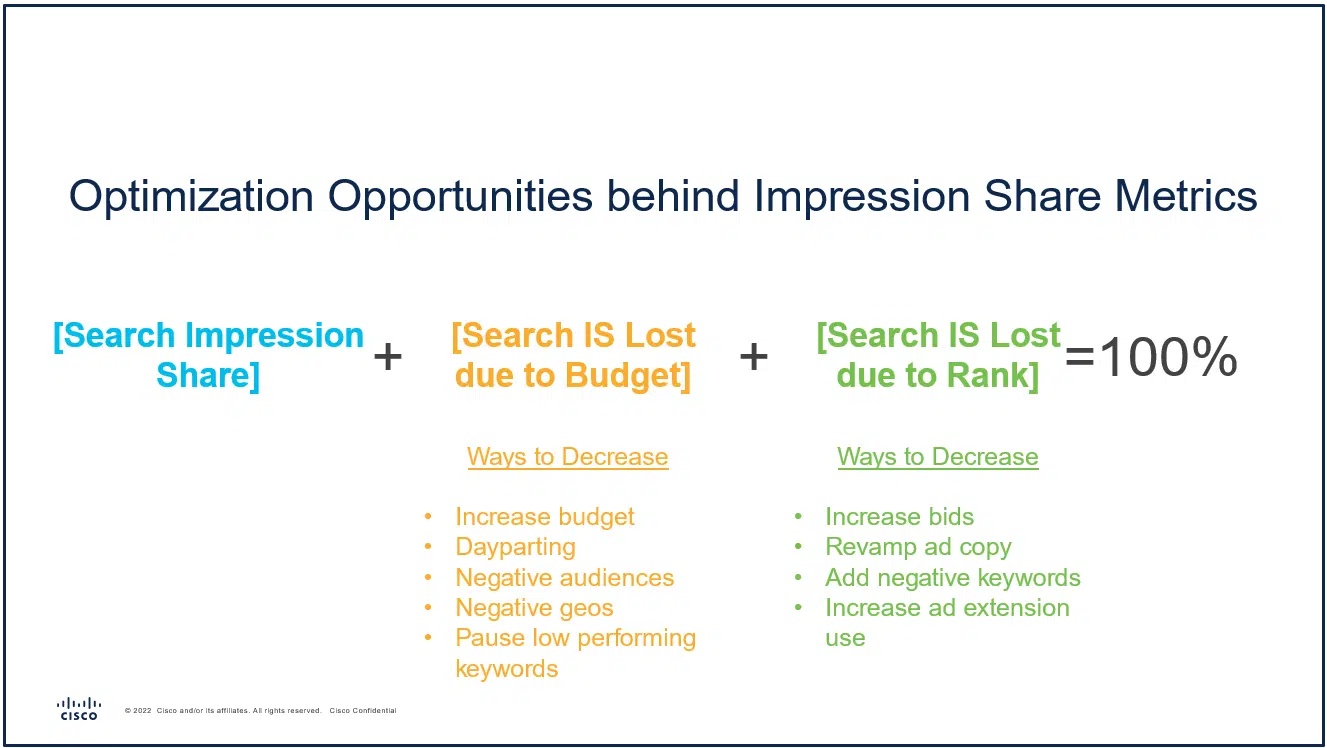
Image Source: SearchEngineLand
How White Label PPC Improves Optimization Velocity?
Execution speed is often the difference between average and exceptional performance.
White label PPC teams operate with:
- Daily optimization cycles instead of weekly reviews
- Real-time adjustments to bids and budgets
- Continuous testing of ad creatives
They also use:
- Automation scripts
- AI-driven insights
- Advanced analytics tools
This leads to faster reactions to auction changes. As a result, impression share becomes more stable and predictable.
Agencies no longer fall behind due to delays in execution.
Aligning Impression Share with Client Growth Objectives
Not every campaign needs maximum visibility. Smart agencies align impression share with business goals.
This includes mapping it to:
- Lead generation targets
- Revenue growth
- Market expansion strategies
There are also cases where increasing impression share is not ideal:
- Low-margin campaigns
- Poorly converting segments
- Broad keywords with low intent
More impressions only matter when they lead to meaningful outcomes.
This strategic alignment separates high-performing agencies from those chasing vanity metrics.
A Practical Framework for Agencies
To implement this effectively, agencies can follow a structured approach:
Step 1: Audit Impression Share Gaps: Identify where impressions are being lost and why.
Step 2: Identify the Constraint: Determine whether the issue is budget or rank.
Step 3: Deploy White Label Execution Support: Bring in a team to handle continuous optimization.
Step 4: Optimize Consistently: Focus on -
- Budget allocation
- Keyword expansion
- Bid adjustments
Step 5: Align With Client KPIs: Ensure visibility translates into measurable results.
This framework creates a repeatable system for growth.
How DashClicks Enables Agencies to Scale Impression Share
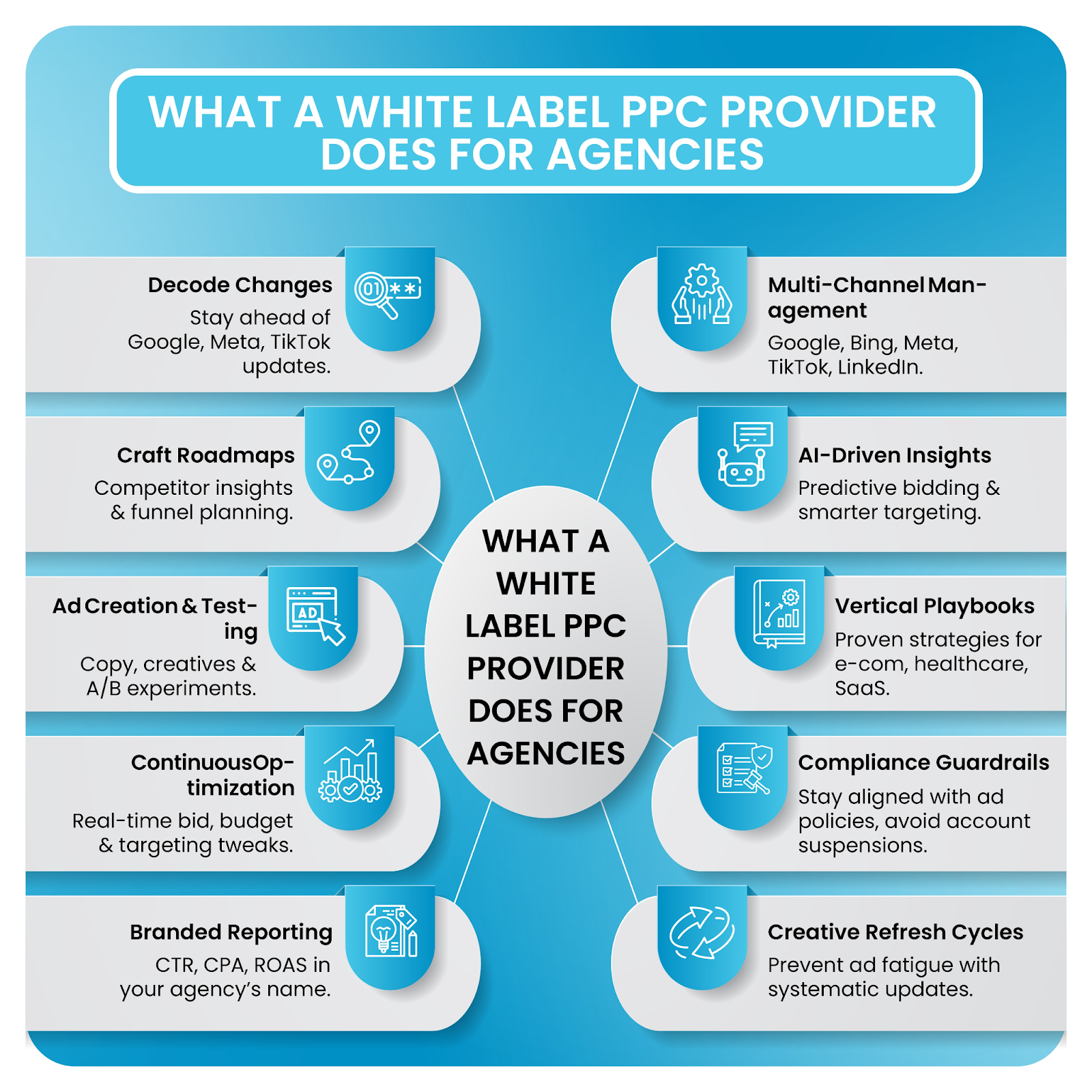
DashClicks provides a comprehensive white label PPC services designed to help agencies scale without increasing internal workload. Their platform combines campaign setup, ongoing optimization, and performance tracking into a single streamlined system.
Agencies working with DashClicks benefit from:
- Full-service PPC campaign management
- Continuous optimization of bids, budgets, and keywords
- Dedicated account managers who monitor performance closely
- Detailed reporting tools that provide clear insights into impression share and campaign effectiveness
What makes DashClicks particularly valuable is how it improves execution speed. Campaigns are monitored consistently, ensuring ads appear more often in high-value auctions.
Instead of replacing internal teams, DashClicks acts as an extension of the agency. It enhances capacity, allowing teams to focus on strategy while maintaining high optimization standards across all accounts.
This combination of scale and precision is what helps agencies achieve more consistent growth in impression share.
Conclusion: From Capacity Limits to Strategic Advantage
Improving impression share is not about increasing visibility blindly. It’s about making smarter decisions across budgets, keywords, and bidding strategies.
Agencies that succeed understand a few key principles:
- Impression Share directly impacts growth and competitiveness
- Execution speed determines performance outcomes
- Scalability requires systems, not just effort
White label PPC transforms what used to be a limitation into an advantage. It allows agencies to optimize faster, respond quicker, and maintain consistency across campaigns.
In a landscape where competition is constantly increasing, the ability to act quickly and strategically is what sets successful agencies apart.
If you're looking to scale your PPC performance without stretching your team thin, it may be time to explore a smarter approach.



.svg)


.svg)
.svg)
.svg)
.svg)
.svg)