

.svg)

.svg)
.svg)
.svg)
.svg)
.svg)
Client reporting has always been a core function for marketing agencies. It defines how performance is communicated, how decisions are justified, and how client relationships are maintained over time. Traditionally, reporting required manual data collection, spreadsheet handling, and static presentations. This approach was time-consuming and limited the depth of insights agencies could provide.
Artificial intelligence is restructuring this process. Instead of treating reporting as a routine task, agencies now use AI to build intelligent reporting systems that deliver real-time insights, predictive analysis, and automated narratives. This shift is improving both operational efficiency and the quality of client communication.
How Reporting Is Part of Daily Operations?
Along with these changes, reporting is also integrated into day-to-day work inside agencies. It is no longer limited to client updates at the end of a cycle. Teams use reporting systems to stay aligned internally, track progress across campaigns, and coordinate actions across different functions.
This reduces the gap between planning and execution. Instead of waiting for reports to guide decisions, teams work alongside live data. Over time, reporting shifts from a final output to a system that supports coordination across different functions.
The Impact of AI on Client Reporting Systems
AI is not just improving reporting speed. It is changing how marketing data is processed, interpreted, and delivered. Agencies are moving from static reports to dynamic systems that continuously analyze performance and generate actionable insights.
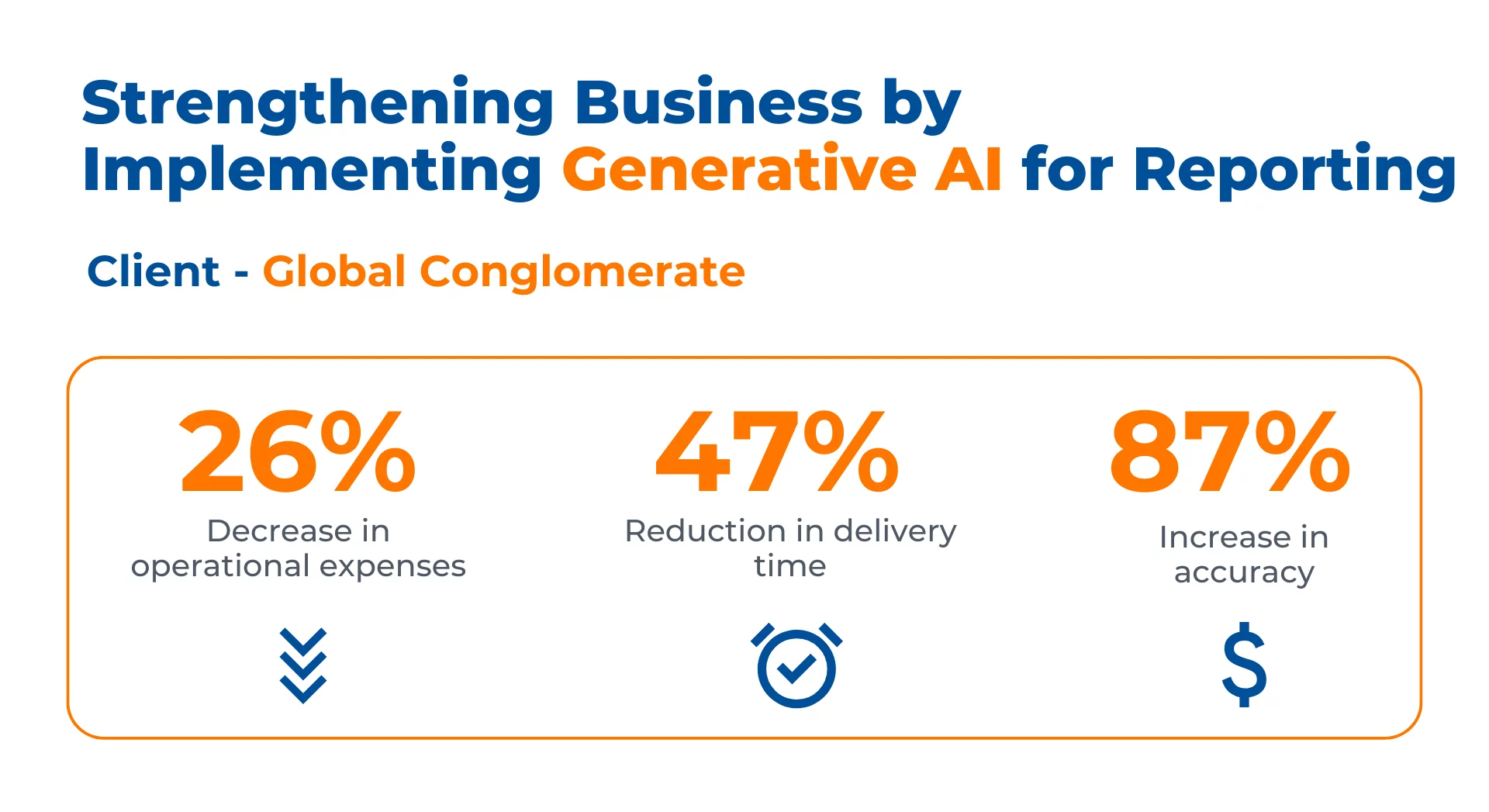
Image Source: Kanerika
1. Real-Time Data Integration and Unified Reporting
AI enables seamless integration of multiple data sources into a single reporting environment. Campaign data from advertising platforms, CRM systems, website to app converter analytics, and email tools is automatically collected and standardized.
This creates a unified dashboard where key metrics are updated in real time. Instead of waiting for weekly or monthly reports, agencies can monitor campaign performance continuously. This improves responsiveness and allows quicker adjustments to campaigns.
From a technical perspective, this is achieved through API integrations, automated data pipelines, and machine learning models that clean and normalize incoming data.
2. Automated Report Generation and Delivery
One of the most immediate benefits of AI is the automation of report creation. AI-powered systems generate structured reports based on predefined templates and performance metrics.
These reports include visualizations, summaries, and key performance indicators, all generated without manual input. Reports can also be scheduled and delivered automatically, ensuring consistency in communication.
This reduces the time spent on repetitive tasks and allows teams to focus on strategy and optimization rather than formatting and data compilation.
3. Predictive Analytics and Forward Planning
AI introduces predictive capabilities into reporting workflows. Instead of only presenting past performance, AI systems analyze historical data to forecast future outcomes. This allows agencies to anticipate -
- Changes in campaign performance
- Shifts in customer behavior
- Variations in conversion rates
This predictive approach is already transforming other sectors. In auto insurance, telematics technology collects real-time driving data to predict risk and adjust premiums accordingly. Agencies managing insurance clients can apply similar data-driven forecasting to optimize campaign spend and targeting.
With these insights, agencies can take proactive steps, such as reallocating budgets or adjusting targeting strategies before performance declines.
Predictive analytics is powered by machine learning models that identify patterns across large datasets, making reporting more strategic and forward-looking.
4. Insight Generation Through Natural Language Processing
One of the major challenges in reporting is translating complex data into understandable insights. AI addresses this through natural language processing.
AI systems can generate written summaries that explain performance trends, highlight key changes, and provide recommendations. This improves clarity, especially for clients who may not be familiar with technical metrics.
Instead of raw data, clients receive structured explanations that make reports easier to interpret and act upon. Tools use AI to read and categorize customer reviews, extracting sentiment, recurring themes, and churn-risk signals that feed directly into client dashboards. Layering these voice-of-customer insights onto campaign metrics helps agencies explain why performance shifts occur and prioritize next steps.
5. Personalized Reporting at Scale
Different clients require different reporting formats, metrics, and levels of detail. AI allows agencies to customize reporting without increasing manual workload. Reports can be tailored based on:
- Business objectives
- Industry type
- Campaign goals
- Preferred KPIs
This ensures that each client receives relevant insights while maintaining efficiency across multiple accounts. Personalization at this level enhances client satisfaction and strengthens long-term relationships.
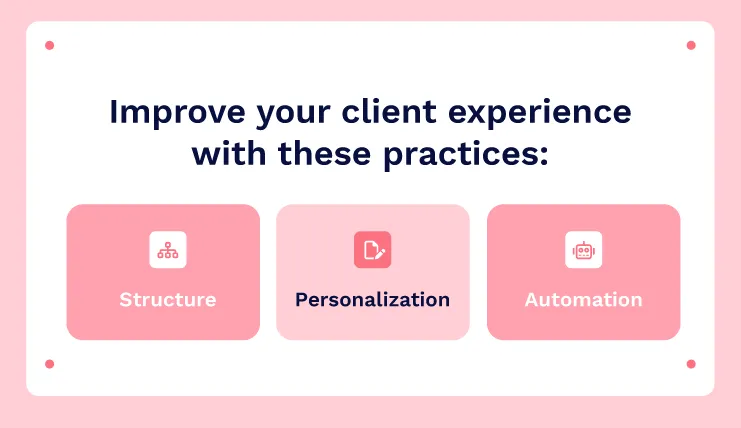
Image Source: AdClicks
6. Data Accuracy, Validation, and Deeper Analysis
AI reduces the risk of manual errors by automatically validating data. It detects inconsistencies, identifies anomalies, and ensures synchronization across platforms.
Beyond accuracy, AI also enables deeper analysis. Instead of focusing only on surface-level metrics, agencies can access insights such as the following. By leveraging AI development services, businesses can unlock more meaningful and actionable intelligence.
- Multi-channel attribution
- Customer journey tracking
- Behavioral segmentation
- ROI analysis across campaigns
This allows agencies to break down performance at a deeper level and understand what is actually driving results across channels.
Operational Efficiency and Scalability
AI significantly improves operational efficiency within agencies. Reporting tasks that previously required hours can now be completed in minutes.
This creates multiple advantages as mentioned below.
- Teams can manage more clients without increasing headcount
- Reporting frequency can be increased without additional effort
- Resources can be redirected toward strategy and campaign optimization
As a result, agencies can scale their operations while maintaining service quality.
Integration with Marketing Ecosystems
AI-powered reporting systems are not standalone tools. They are integrated into broader Marketing Mix Modeling ecosystems that connect campaign execution, data collection, and performance analysis.
This integration creates a continuous feedback loop in which insights generated from reports directly inform campaign adjustments. Campaigns become more adaptive, and decision-making becomes data-driven.
What’s Next for AI in Client Reporting?
The next phase of AI in reporting will focus on deeper automation and intelligence. Expected developments will be as follows.
- Fully automated reporting pipelines
- AI agents generating insights in real time — increasingly designed and deployed through dedicated AI agent consulting engagements
- Voice-based reporting interfaces
- Advanced predictive and prescriptive analytics
The AI in marketing market is projected to grow rapidly, reaching over $107 billion by 2028, indicating continued investment in these technologies.
Changing Client Expectations and Reporting Standards
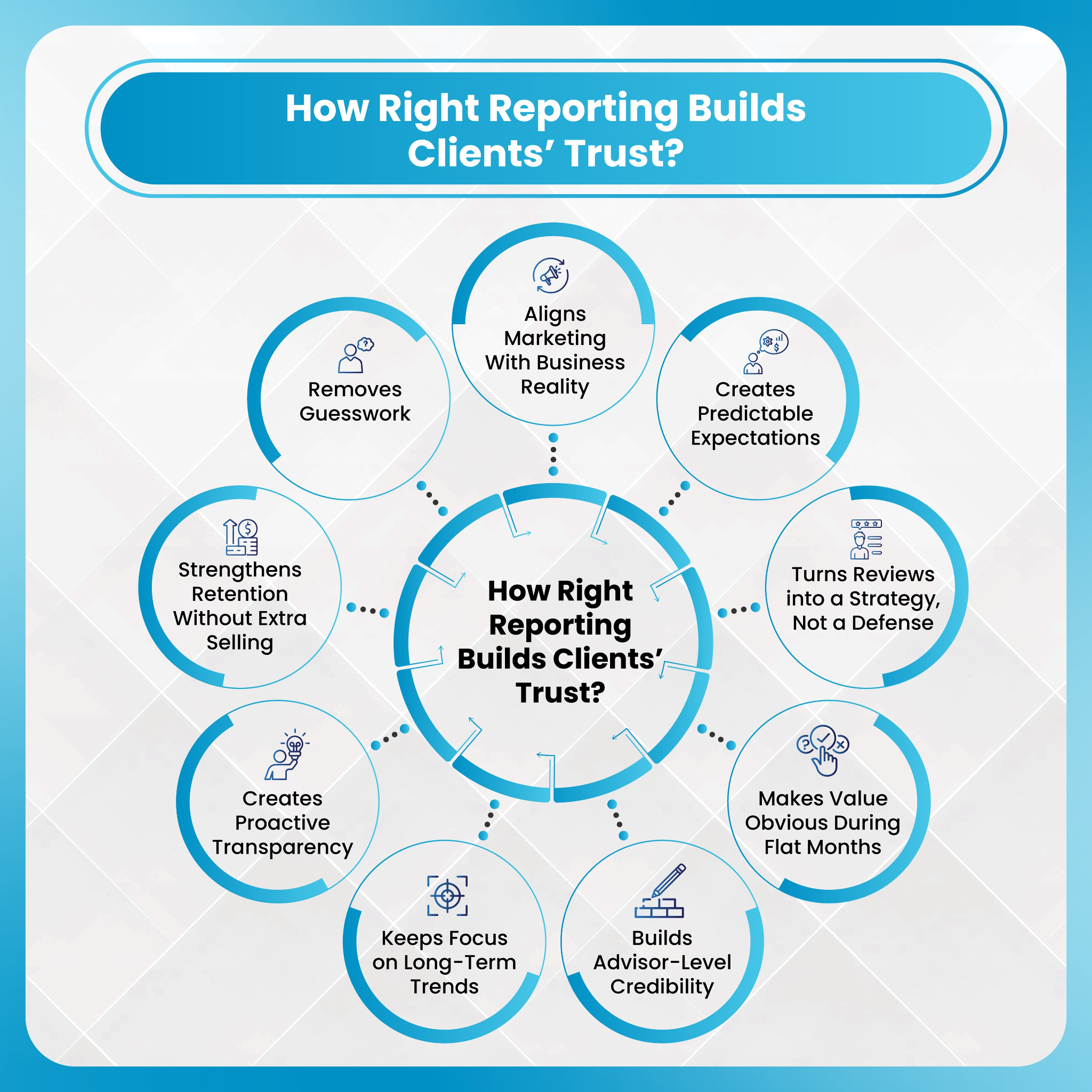
1. Clients Expect Clear Explanations, Not Just Data
As reporting systems improve, clients are becoming more data-aware. They are no longer satisfied with surface-level metrics or basic summaries. Instead, they expect clear explanations behind performance.
When results change, the first question is no longer what happened, but why it happened. This shifts reporting from simply presenting numbers to explaining decisions. Agencies need to connect data with context; otherwise, reports lose value quickly.
2. Faster Response Times Are Now Expected
Another shift is around speed. Clients do not want to wait for weekly or monthly reports to understand performance. They expect quick answers whenever questions come up.
This changes how teams operate internally. Reporting is no longer a scheduled task; it becomes an ongoing activity. Agencies are expected to respond quickly with clear answers whenever clients raise questions about performance. Slow responses now create more friction than missing data.
3. Reporting Is Focused More on Business Results
Clients are also focusing more on how marketing performance connects to actual business results. Metrics like clicks and impressions are no longer enough on their own.
There is increasing pressure to show how campaigns impact revenue, customer growth, and overall performance. This means reporting must clearly connect marketing performance to revenue, growth, and overall business impact.
Agencies that can clearly connect marketing efforts to outcomes will stand out, while those that stay limited to basic reporting will struggle to meet client expectations.
Challenges and Limitations of AI in Client Reporting
While AI improves reporting efficiency and insight generation, it also introduces challenges that agencies need to manage carefully. A structured approach helps ensure reporting remains accurate and reliable.
- Data Dependency and Quality Issues: While AI significantly improves reporting efficiency and insight generation, it also introduces practical challenges that agencies need to manage carefully. A structured approach to these limitations helps ensure that AI-driven reporting remains accurate, reliable, and strategically useful.
- Integration Complexity Across Platforms: Combining multiple tools into one system requires strong integrations. This can be technically complex and needs ongoing maintenance.
- Cost of Implementation: AI solutions involve upfront and ongoing costs. These include tools, infrastructure, and skilled resources.
- Risk of Over-Automation: Too much automation can reduce human input. Reports may lack context and strategic depth without proper oversight.
- Misinterpretation of AI-Generated Insights: AI insights are not always self-explanatory. They need to be reviewed and validated before use.
- Maintaining a Balanced Approach: A mix of AI and human expertise is essential. This ensures accuracy, context, and better decision-making.
DashClicks’ InstaReports for Client Reporting
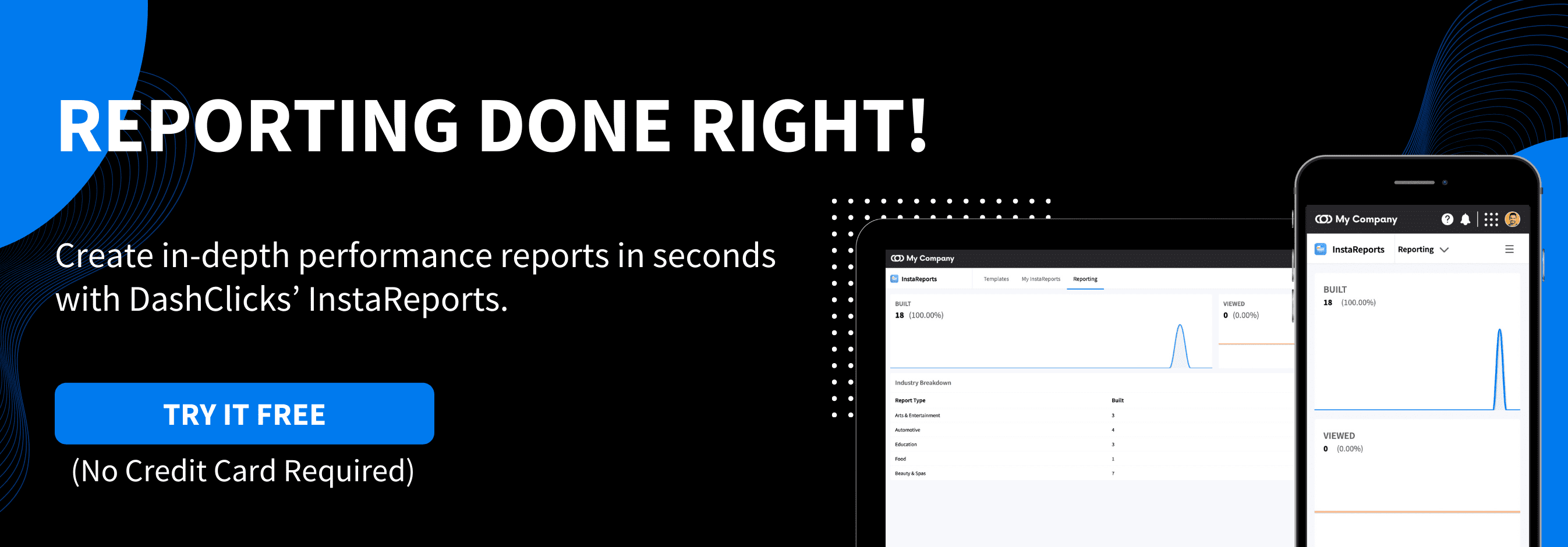
DashClicks’ InstaReports Software is built to streamline and simplify client reporting for marketing agencies. It brings together data integration, automation, and customization into a single system, helping agencies deliver clear and consistent reports with minimal manual effort.
- Unified Data Integration: InstaReports connects multiple marketing platforms into one dashboard. This allows agencies to view campaign performance across channels without switching between different tools.
- Automated Report Generation: Reports are created automatically using predefined templates. This reduces repetitive work and ensures consistency in how performance data is presented.
- White-Label Reporting: The platform supports full white-label customization. Agencies can brand reports with their own logo and identity, creating a more professional and seamless client experience.
- Real-Time Performance Tracking: Campaign data is updated continuously, enabling teams to monitor performance and make timely adjustments when needed.
- Client-Friendly Visualizations: Reports include clear charts, summaries, and structured data. This makes it easier for clients to understand performance without needing technical knowledge.
- Scalable Reporting for Agencies: InstaReports supports reporting across multiple clients efficiently. Agencies can scale their operations without increasing the time spent on reporting tasks.
This type of reporting solution aligns with the shift toward more efficient, automated, and client-focused reporting systems, where clarity, consistency, and speed play a central role.
Wrapping It Up
AI is transforming client reporting from a manual, time-intensive process into a structured and intelligent system. It enables real-time data integration, automated report generation, predictive insights, and personalized communication.
For marketing agencies, this transformation improves efficiency, enhances reporting quality, and strengthens client relationships. However, the most effective approach combines AI capabilities with human expertise.
Agencies that adopt this balanced approach will be better positioned to deliver meaningful insights and maintain a competitive advantage.


.svg)


.svg)
.svg)
.svg)
.svg)
.svg)