

.svg)

.svg)
.svg)
.svg)
.svg)
.svg)
High-demand SEO niches such as legal, healthcare, finance, and SaaS can be some of the most profitable segments for agencies. These clients usually understand the value of organic visibility because one qualified lead can be worth far more than a standard local service inquiry. That is why these niches often command higher retainers, longer contracts, and stronger client lifetime value.
Yet many agencies either avoid these markets or fail to retain clients once they enter them. The issue is rarely demanded. Legal firms, healthcare providers, financial service companies, and SaaS brands all need stronger search visibility. The real problem is execution capability under niche constraints.
Ranking in these spaces requires more than publishing blogs and updating metadata. It demands stronger authority, compliant content workflows, technical precision, and long-term SEO discipline. According to Ahrefs, 90.63% of pages get no organic traffic from Google, which shows how difficult it is to earn visibility without strong authority and execution.
The click opportunity is also heavily concentrated at the top. Backlinko reports that the #1 result in Google gets about 27.6% of all clicks, reinforcing the winner-takes-most dynamic in competitive niches.
For agencies, this creates a clear opportunity and a clear risk. High-demand niches can drive premium retainers, but only if the agency can execute at the level these markets require.
If the opportunity is so large, why do most agencies fail to capture it?
The Real Barriers in High-Demand SEO Niches
When agencies struggle in premium markets, they often blame algorithm updates or unrealistic client SEO expectations. However, the true obstacles are deeply rooted structural barriers, not surface-level issues.
1. Compliance-Driven Content Constraints
Publishing content for a dental clinic or a financial advisor requires a completely different workflow than writing for a local plumber. Industries like legal, healthcare, and finance operate under strict regulatory guidelines.
Content in these spaces must include specific disclaimers, undergo rigorous fact-checking, and often require review by subject matter experts. Google enforces its own strict standards here through its Experience, Expertise, Authoritativeness, and Trustworthiness (E-E-A-T) guidelines. If a piece of content lacks verifiable expertise, Google will suppress its ranking to protect users from harmful information. Furthermore, publishing inaccurate information in these sectors creates severe legal risks and permanently damages client trust. This is regulated publishing, not just basic SEO content creation.
2. Entrenched Topical Authority
In lucrative markets, your competitors are not just publishing individual articles. They have built massive, interconnected content ecosystems over many years. These ecosystems are supported by strong backlink profiles and intricate internal linking structures that signal immense topical authority to search engines.
Breaking through this wall of authority takes significant time and resources. Ahrefs research shows that only 5.7% of newly published pages rank in the top 10 within a year. When you try to rank a new personal injury client, you compete against entire ecosystems, not just individual keywords.
3. SERP Feature Saturation
In high-demand niches, the search engine results page (SERP) is incredibly crowded. Even if you secure a top organic ranking, your link might be pushed far down the page.
Users are presented with multiple paid advertisements, featured snippets, "People Also Ask" boxes, and highly competitive local map packs. Navigating this saturation requires a multi-faceted approach to search visibility. Even top organic rankings do not guarantee traffic if the SERP is dominated by other features.
4. Content Depth vs Conversion Intent
High-value clients want phone calls and form fills. Users searching for complex topics, however, want deep, highly informative answers before they ever consider converting.
Agencies must strike a delicate balance. If a page is too sales-heavy, it will not rank because it lacks informational depth. If it is too academic, it might rank well but fail to generate the leads the client is paying for. Balancing comprehensive authority with strong conversion intent is notoriously difficult.
So how do agencies enter these niches without years of hiring and massive overhead risk?
What Agencies Lose When They Can’t Serve These Niches?
Failing to penetrate high-demand markets restricts an agency to low-margin clients and stunts long-term growth.

When operational capabilities fall short, the financial and reputational consequences are severe.
- High-Ticket Client Churn: Premium clients have exceptionally high expectations. They track metrics closely and demand clear return on investment. When an agency attempts to use generic SEO strategies in a complex niche, the campaign inevitably stalls. The result is faster client churn, as high-ticket clients will not hesitate to move their substantial budgets to a more capable firm.
- Missed Premium Retainers: Agencies stuck in low-competition markets eventually hit a hard revenue ceiling. Niches like healthcare and enterprise software often pay two to five times more for marketing services than standard local businesses. By avoiding these sectors, agencies leave their most profitable opportunities on the table.
- Brand Positioning Stagnation: Agencies that serve everyone are often perceived as experts in nothing. Without high-profile case studies from competitive industries, an agency will struggle to elevate its brand. They become seen as generalists, which leads to lower perceived expertise and less pricing power in the market.
- Operational Strain: Trying to figure out complex SEO on the fly drains agency resources. Teams fall into a cycle of trial-and-error SEO, testing unproven theories on valuable clients. This wastes countless hours fixing mistakes and rewriting non-compliant content, ultimately destroying profit margins.
Execution alone is not enough. Positioning matters too.
How Agencies Use White Label SEO to Bridge the Gap?
To break into lucrative markets safely, agencies rely on the best white label SEO services to bridge their operational gaps. This partnership allows them to scale instantly without the massive payroll risks associated with building an elite in-house team.
- Instant Access to Niche Frameworks: A reliable fulfillment partner provides pre-built, battle-tested strategies tailored for legal, healthcare, and SaaS clients. This eliminates the guesswork entirely. The agency can immediately deploy advanced campaigns that are proven to work in highly competitive environments.
- Compliance + E-E-A-T Execution: Top-tier white label SEO teams operate like professional publishers. They utilize robust fact-checking workflows, ensure proper author attribution, and build necessary trust signals directly into the content. This level of rigor ensures that all deliverables meet strict industry regulations and satisfy Google's E-E-A-T requirements.
- Authority Building at Scale: Gaining traction in difficult niches requires aggressive authority building. White label SEO providers handle the heavy lifting of mapping out topic clusters, optimizing internal linking, and executing large-scale backlink acquisition. Backlinko data shows exactly why this matters, revealing that the #1 search result has an average of 3.8 times more backlinks than pages in positions two through ten.
- Faster Time-to-Competitiveness: Agencies cannot afford to spend six to twelve months figuring out a strategy while the client grows impatient. By leveraging proven frameworks provided by a white label SEO partner, agencies avoid lengthy trial cycles and start moving the needle much faster.
- Strategy vs Execution Separation: A successful partnership thrives on a clear division of labor. The client-facing agency handles relationship management, sales, and high-level brand positioning. The white label partner handles the granular SEO execution, content creation, and technical link building.
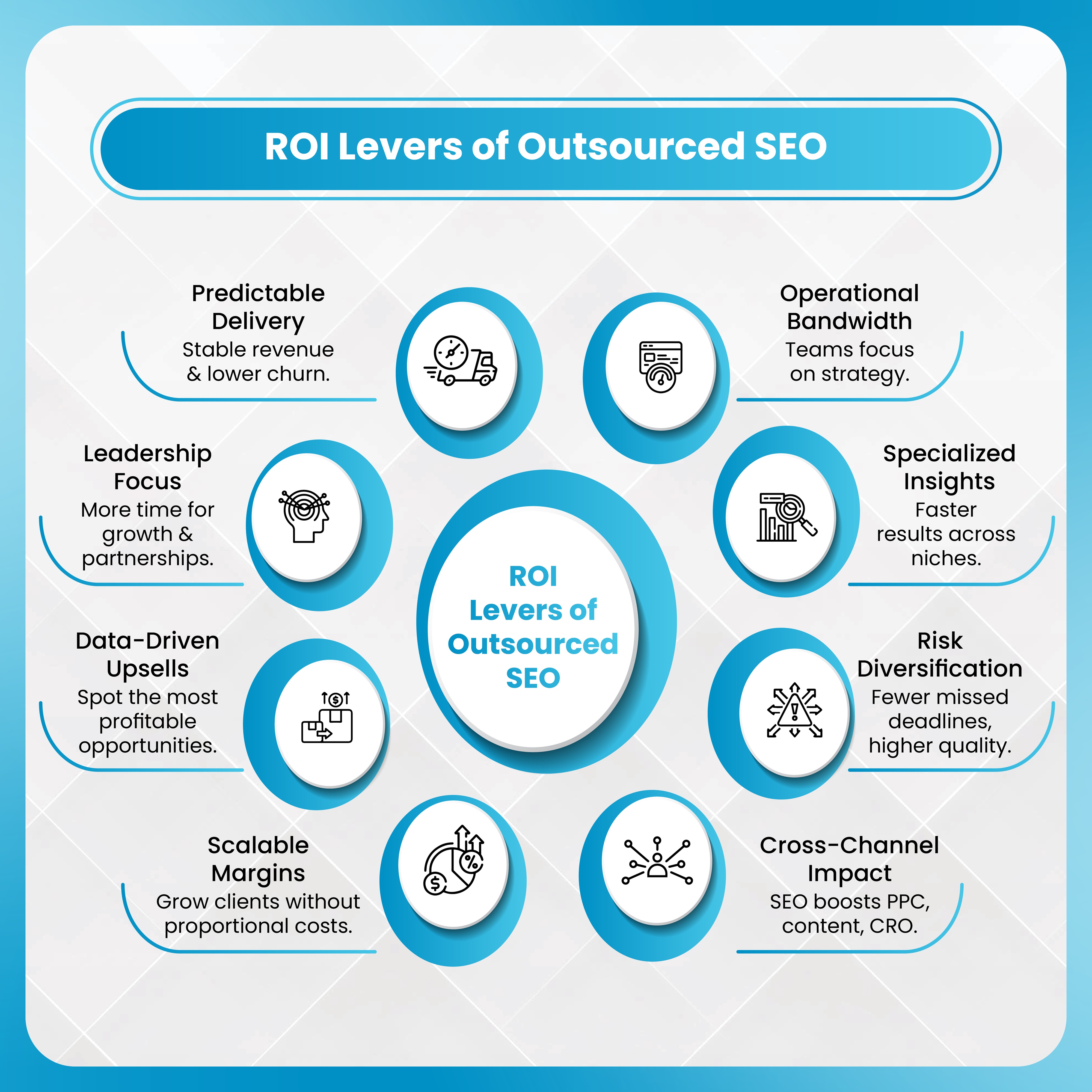
When executed well, impact goes beyond rankings.
How Agencies Position and Sell Niche SEO?
Having the right fulfillment engine in place is only half the battle. To win premium contracts, agencies must completely change how they sell their services.
- Selling Outcomes: Premium clients do not care about search volume or meta tags. Agencies must shift their sales pitch away from saying "We do SEO" and focus entirely on the end result. The messaging must be "We generate high-value cases, new patient bookings, or qualified enterprise leads."
- Setting Realistic Timelines: Honesty is critical in high-demand markets. Agencies must educate their prospects on the reality of competitive search environments. Setting expectations for three to six months to see initial traction, and six to twelve months for profitable scaling, builds trust and prevents early churn.
- Using Niche Proof Points: You cannot sell a plastic surgeon using a case study from a landscaping company. Agencies must utilize outcome-driven storytelling and highly specific case studies to prove they understand the unique dynamics of the prospect's industry.
- SEO as Long-Term Asset: In expensive markets, pay-per-click advertising costs can be astronomical. Agencies should position organic search as a compounding long-term asset that ultimately reduces the client's dependency on expensive paid ads, driving down their overall cost of acquisition over time.
Winning agencies are not bigger. They execute better.
The Compounding Advantage of High-Demand Niches
Once an agency learns how to execute and sell SEO for high-demand niches, the benefits build over time. The business model shifts from chasing many low-budget accounts to managing fewer, higher-value clients with stronger growth potential.
1. Higher Retention
SEO in industries like legal, healthcare, finance, and SaaS is rarely a short-term project. These clients need continuous work across content, technical SEO, authority building, local visibility, and conversion optimization.
Once the agency becomes part of that growth system, it becomes harder for the client to switch providers. The agency is no longer just “posting blogs.” It is helping the client build search visibility in a market where every qualified lead has serious business value.
This can lead to stronger retention because the client depends on ongoing execution, reporting, and strategy refinement.
2. Stronger Margins
High-demand niches usually support higher pricing because the value of each conversion is higher. A law firm may get one high-value case from organic search. A SaaS company may close one enterprise deal. A healthcare provider may secure recurring patient demand.
When agencies use white label SEO management for fulfillment, they can serve these clients without hiring a full internal team for content, technical SEO, link building, and reporting. This helps protect margins while still delivering a more advanced service.
The agency can focus on client strategy, communication, and account growth while the execution layer runs in the background.
3. Competitive Barrier
Difficult niches naturally create a barrier to entry. Not every agency can rank a finance brand, healthcare practice, or legal website because these markets demand higher content standards, stronger authority signals, and tighter technical execution.
Once an agency proves it can perform in these spaces, it becomes harder for smaller or less specialized competitors to replace it. The client is not just buying SEO tasks. They are buying niche understanding, execution reliability, and risk control.
That makes the agency’s positioning stronger.
4. Portfolio Growth
Success in one high-demand niche often creates momentum. A strong result for one personal injury law firm can help the agency approach other law firms with more confidence. The same applies to SaaS, healthcare, and finance.
These case studies become useful sales assets because they show that the agency understands the niche, not just generic SEO. Over time, one successful campaign can lead to referrals, similar client wins, and stronger credibility in that vertical.
This is where white label SEO becomes more than a fulfillment option. It helps agencies enter markets that would otherwise take years to build internally.
How DashClicks’ White Label SEO Services Support Niche Execution?
DashClicks provides a comprehensive white label SEO services designed to help agencies scale their execution in competitive markets. By utilizing their infrastructure, agencies can offer high-level SEO services including extensive keyword research, compliant content creation, strategic backlinks, and technical SEO optimization.
A major advantage of partnering with DashClicks is their scalable execution model. Agencies receive access to dedicated fulfillment teams that manage the intricate details of complex campaigns. This allows agency owners to focus entirely on client acquisition and relationship management while the backend execution is handled by specialists.
Additionally, reporting is streamlined through a fully integrated white label dashboard. The platform offers real-time reporting capabilities and automated workflows, making it incredibly simple for agencies to prove their value to high-ticket clients without spending hours compiling manual spreadsheets.
Niches are not inaccessible, just operationally demanding.
Conclusion: From Avoiding Niches to Owning Them
High-demand SEO markets represent the pinnacle of agency profitability. For years, many firms have viewed these niches as completely inaccessible. The reality is that these sectors are simply operationally demanding. The biggest constraint holding agencies back is entirely based on execution capability, not a lack of theoretical knowledge.
A reliable fulfillment partner fundamentally transforms how an agency operates. It shifts the business away from stressful, trial-and-error campaigns and moves it toward structured, predictable execution. By relying on established experts to handle the heavy lifting, agencies can confidently sell higher retainers, deliver compliant content, and build massive topical authority.
Agencies that embrace this model stop competing for scraps in low-value markets. Instead, they build highly profitable, scalable businesses that dominate the most lucrative industries on the internet.




.svg)


.svg)
.svg)
.svg)
.svg)
.svg)