

.svg)

.svg)
.svg)
.svg)
.svg)
.svg)
Click-through rate, or CTR, remains one of the most telling performance signals in Facebook advertising. It measures how often people click an ad after seeing it, calculated by dividing clicks by impressions. While it is not the final measure of success, CTR is often the first clear indicator of whether an ad is relevant, engaging, and aligned with audience intent. When CTR is healthy, it usually points to strong targeting, compelling creative, and efficient delivery within Meta’s ad auction.
Recent industry data shows that average CTRs on Facebook have improved as advertisers refine their strategies. Traffic campaigns often see CTRs around 1.6% to 1.8%, while lead generation campaigns frequently reach 2.5% or higher. Well-optimized campaigns with strong creative and audience alignment can push beyond the 3 percent mark. These numbers matter because higher CTRs often lead to lower cost per click, better quality scores, and more efficient budget use.
For agencies, however, maintaining or improving CTR across many client accounts is not easy. Audience fatigue, creative burnout, and constant platform updates can quickly drag performance down. When teams are stretched thin, CTR often becomes reactive rather than strategic. This is where white label Facebook ads services play a valuable role. By tapping into specialized expertise, agencies can improve CTR consistently while focusing on client relationships and growth.
Why Agencies Struggle to Sustain High CTR?
1. Targeting Complexity and Platform Shifts
Facebook’s targeting capabilities are powerful, but they have also become increasingly complex over time. Audiences evolve quickly, competition grows across nearly every industry, and privacy-focused updates have changed how user data is tracked and leveraged. Interest-based targeting that once delivered strong results can lose effectiveness as the same users are repeatedly targeted by multiple advertisers. As audience fatigue sets in, click-through rate naturally declines.
At the same time, Meta’s algorithm continues to shift toward signals that reflect genuine engagement and relevance. Ads are rewarded when they resonate with users, not simply when they reach a broad audience. This places more pressure on agencies to refine their targeting strategies continuously.
Many agencies, however, rely on broad audiences or outdated structures because they lack the time or resources to revisit targeting regularly. Ads may reach users who fit basic criteria but are not actively interested or ready to engage. As a result, CTR drops, costs rise, and campaigns require more spend to maintain performance. Modern targeting is no longer just about who sees the ad. It is about how the target audience is segmented, how they move through different stages of awareness, and how messaging aligns with intent at each step.
2. Creative Bottlenecks
Creative is one of the strongest drivers of CTR, yet it is also one of the most difficult areas for agencies to scale. Producing fresh visuals, compelling copy, and attention-grabbing hooks on a consistent basis demands time, creative talent, and a clear testing process. When teams are stretched thin, creative refresh cycles slow down.
Many agencies reuse the same ads for extended periods, which leads to creative fatigue. Users see the same visuals repeatedly and stop paying attention, even if the targeting is accurate. Engagement declines, organic click-through rate drops, and performance suffers.
Without a structured testing framework, agencies often rely on assumptions instead of data. They may test only one or two variations rather than experimenting with different hooks, formats, headlines, and visual styles. When creative testing becomes limited or inconsistent, opportunities to improve CTR are missed. Over time, performance plateaus or trends downward simply because the creative is no longer keeping pace with audience expectations.
3. Ad Placement and Format Complexity
Facebook and Instagram provide a wide range of ad placements, including feeds, stories, reels, in-stream placements, and the audience network. Each placement attracts users with different behaviors and content expectations. What works well in the feed may perform poorly in stories, and vice versa.
Short-form video placements such as Instagram Stories and Reels often generate higher engagement because they feel more native and immersive, particularly for mobile users. Feed placements, while valuable for reach, may require different creative approaches to earn clicks.
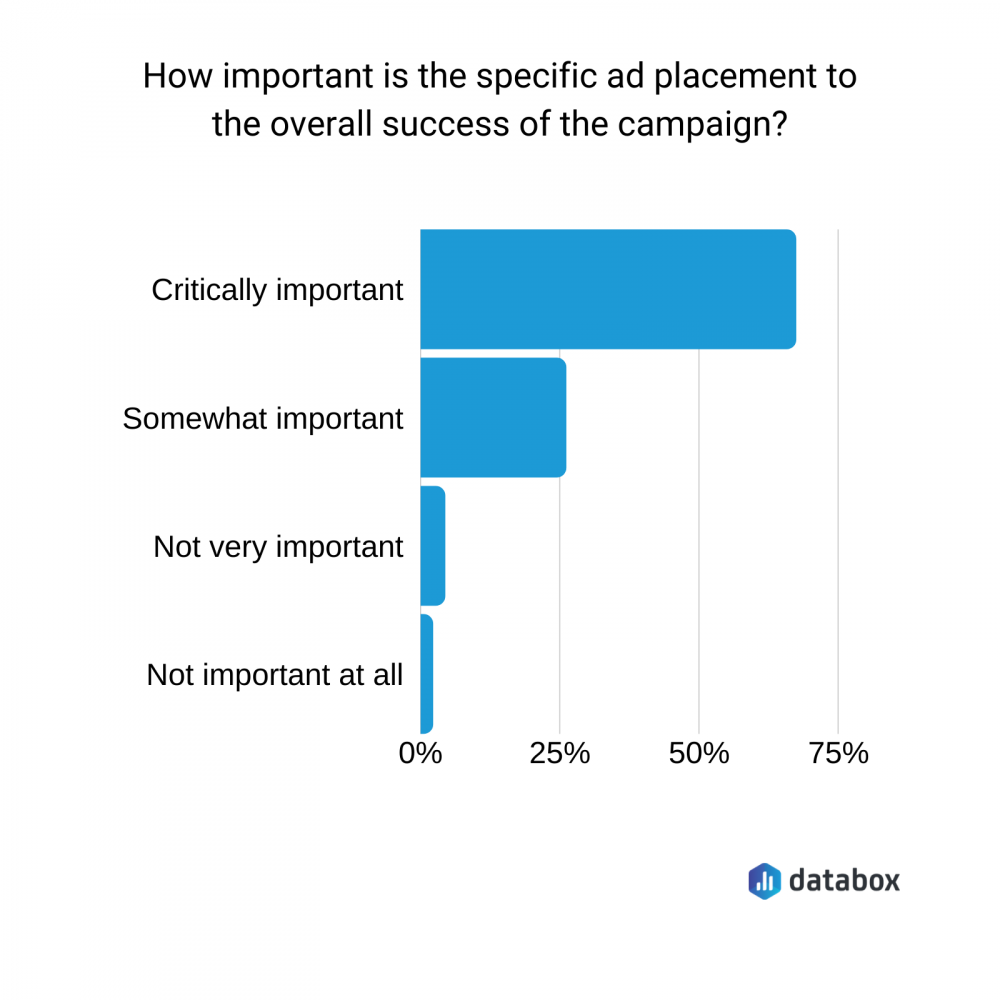
Image Source: Databox
Many agencies rely heavily on automatic placements without closely reviewing placement-level performance. While automation can save time, it can also dilute CTR if budget flows into placements that consistently underperform. Effective placement optimization requires ongoing analysis, creative adjustments by format, and strategic budget allocation. This level of detail is often overlooked by generalist teams managing multiple accounts.
4. Reporting Challenges
CTR can also become a source of confusion when it is misunderstood or misreported. Some reports focus on total clicks instead of link clicks, which inflates numbers without reflecting meaningful engagement. This can lead to poor optimization decisions and unrealistic client expectations.
When agencies struggle to explain why CTR has changed or how it connects to broader campaign performance, trust can erode. Clients may feel uncertain about the strategy or question whether campaigns are being actively managed.
Taken together, these challenges can make agencies appear reactive rather than strategic. White label Facebook advertising partners help address these issues by bringing focused expertise, proven frameworks, and clear reporting structures. This allows agencies to present stronger performance narratives, improve CTR consistently, and maintain client confidence over time.
How White Label Facebook Ads Improve Client CTR?
Targeting remains one of the most powerful levers for improving CTR. When ads are shown to people who are both relevant and ready to engage, clicks happen more naturally. White label partners focus heavily on audience strategy because CTR improves fastest when intent and messaging are properly aligned.
A. White Label Techniques That Improve CTR:
Advanced audience segmentation is usually the first step. Instead of relying on a single broad audience, white label teams break audiences into smaller, well-defined groups based on interests, behaviors, and previous interactions. For instance, a cold audience may be divided into micro-segments that combine interest categories with recent online behaviors, such as content engagement or shopping activity. Each segment receives messaging that speaks directly to its context, which increases relevance and encourages more clicks.
1. Progressive sequencing adds another layer of refinement. Rather than asking for a click right away, white label teams often warm users through video views, page engagement, or social interactions. Someone who has watched part of a video or interacted with a post is far more likely to click a follow-up ad. Retargeting these warmed users with clear, click-focused messaging builds familiarity and trust, which consistently leads to higher CTR than targeting cold audiences alone.
2. Lookalike and custom audiences are also optimized using higher-intent data sources. Instead of building lookalikes from basic actions like page views or ad reach, white label specialists focus on conversion-based signals such as initiating checkout, lead form submissions, or completed purchases. These audiences more closely resemble users who are inclined to take action, which improves click engagement and overall campaign efficiency.
3. Retargeting and funnel-aware optimization further strengthen CTR performance. Retargeted users already recognize the brand, making them more comfortable engaging with ads. Industry benchmarks often show retargeting CTRs that are two to three times higher than those of cold audiences. White label teams design structured funnels that guide users from awareness to consideration and finally to action, maintaining strong CTR at every stage instead of relying on a single campaign approach.
Once the right audiences are in place, the focus shifts to giving users a compelling reason to click. This is where creative strategy plays a decisive role.
B. Creative Testing and Optimization
Even the most refined targeting will struggle without strong creative. The best white label Facebook ads services treat creative as an ongoing process rather than a one-time setup, allowing CTR to improve over time instead of peaking early.
White Label Creative Tactics That Boost CTR:
1. Systematic A/B testing sits at the center of this approach. Multiple variations are tested at once, including different hooks, visuals, headlines, and formats. Hooks may highlight a common problem, a clear outcome, curiosity, authority, or social proof. By testing five to ten variations at a time, white label teams can quickly identify which combinations drive the strongest CTR and scale them efficiently.
2. Data-driven decisions replace guesswork throughout the process. Metrics such as thumb-stop rate, CTR by creative, and engagement signals help guide optimization. Dynamic creative tools allow Meta to automatically pair the strongest elements together, improving performance as the algorithm learns which combinations resonate most with each audience.
3. User-generated and native-style creative has proven especially effective in driving clicks. Ads that resemble organic content tend to feel more authentic and less disruptive. In several industries, studies have shown that user-generated style ads can lift CTR by more than 20% compared to highly polished brand visuals.
4. Placement-aware creative ensures that ads feel natural wherever they appear. Vertical videos with clear opening hooks perform better in Stories and Reels, while feed placements can support longer copy and more detailed messaging. White label teams design creative specifically for each placement, which helps maintain consistent CTR across the entire campaign.
5. Iterative optimization keeps performance from stalling. Creative is refreshed every five to seven days to avoid fatigue and keep audiences engaged. In many cases, white label partners have achieved CTR improvements of 15 to 30% by shifting from static images to short-form vertical video with strong opening messages.
With targeting and creative aligned, the final step is ensuring ads appear in the right places and under the right conditions.
C. Ad Placement and Optimization
Ad placement has a direct impact on how users interact with Facebook and Instagram ads. White label teams closely monitor placement-level performance to ensure ads are delivered where they generate the most engagement.
White Label Optimization Tactics:
1. Feed, Stories, and Reels strategies are tailored to campaign goals. Feed placements offer scale and consistency, while Stories and Reels often deliver higher CTR due to their immersive, mobile-first experience. Short-form video placements have become particularly effective as user behavior shifts toward quick, scroll-friendly content.
2. Device optimization is another critical factor. Since the majority of Facebook traffic comes from mobile devices, white label teams design ads with mobile users in mind. Clear calls to action, readable text, and fast-loading landing pages all contribute to stronger CTR on smaller screens.
3. Placement exclusion and budget prioritization help eliminate wasted spend. Low-performing placements, such as certain audience network positions, may be excluded altogether. Budget is then redirected toward placements that consistently produce higher CTR, improving engagement without increasing overall spend.
4. Objective alignment also plays an important role. Lead generation campaigns often achieve higher CTR than traffic campaigns because users expect to take action directly within the platform. White label Facebook advertising experts select objectives that support both strong click engagement and meaningful downstream results.
5. Campaign structure optimization ties everything together. Separating campaigns into cold, warm, and retargeting stages allows each segment to be optimized independently. Agencies working with white label partners often see noticeable CTR gains after restructuring campaigns this way, as each audience receives the right message, in the right format, at the right time.
How DashClicks Helps Agencies Improve Client CTR?
DashClicks supports agencies by providing structured, expert-driven white label Facebook advertising designed to improve engagement and CTR. Their approach focuses on the core elements that influence click performance, including audience strategy, creative testing, and placement optimization.
The platform builds refined audience frameworks that separate cold, warm, and retargeting users. This ensures ads are shown to people based on their readiness to engage, which naturally improves CTR. Their team continuously tests creative elements such as hooks, visuals, and formats to identify what resonates most with each audience segment.
Placement optimization is another key strength. Their team reviews performance across feeds, stories, and reels, adjusting budgets toward placements that deliver stronger click engagement. Agencies receive white-labeled reports that clearly highlight CTR trends, creative performance, and optimization actions, making it easier to communicate value to clients.
By handling execution and optimization, DashClicks allows agencies to deliver consistent results through best white label Facebook ads practices while maintaining full control over client relationships.
Conclusion
Improving CTR on Facebook is not about quick fixes. It requires thoughtful targeting, continuous creative testing, and smart placement decisions. As competition increases and user behavior shifts, agencies need specialized systems to maintain strong engagement across accounts.
White label Facebook ads services give agencies access to focused expertise without adding internal strain. By partnering with teams that understand audience segmentation, creative performance, and platform nuances, agencies can present clearer strategies and stronger results to clients.
Agencies looking to improve CTR should start by auditing current performance against industry benchmarks. Setting realistic goals, often between 1.8 and 3 percent depending on campaign type, creates a clear direction. From there, structured targeting, regular creative testing, and weekly optimization cadences help sustain progress.




.svg)


.svg)
.svg)
.svg)
.svg)
.svg)