

A prospect discovering a brand on Facebook needs something different from someone who has compared competitors and is ready to book a call. Yet many agencies run nearly identical campaigns for both audiences, using the same creative, objectives, and success metrics. The result is confused messaging, inflated expectations, and reporting that fails to address clients’ actual goals.
This is a key challenge for agencies managing Facebook Ads across multiple clients. Clients often expect one advertising program to deliver brand awareness, consistent lead generation, and closed sales. However, awareness, consideration, conversion, and retention require different campaign objectives, creative approaches, and performance metrics. Treating these stages as interchangeable can cause campaigns to underdeliver.
For agencies managing growing account portfolios, Facebook Ads outsourcing offers a practical way to expand execution capacity without hiring an entire paid social team in-house. A white label Facebook advertising agency can handle technical setup, audience implementation, and ongoing optimization, while the retaining agency maintains control over strategy, client relationships, and business decisions.
Scale matters, too. Meta reported an average of 3.58 billion daily active people across its family of apps in December 2025. This figure covers Meta’s entire app ecosystem, not Facebook alone, and highlights the potential reach available to advertisers. However, not every user is relevant or reachable for every campaign.
The real opportunity lies in aligning campaign objectives with audience readiness and business goals, rather than assuming scale alone guarantees results.
Why Funnel-Stage Alignment Matters in Facebook Ads?
Advertising activity and business progress are not the same thing. A click shows interest. A video view shows attention. An engagement shows a moment of curiosity. None of these actions, on their own, confirm purchase intent, lead quality, or revenue impact. Agencies that treat clicks or impressions as proxies for business results risk reporting numbers that look good but don't reflect what the client actually needs.
This disconnect often starts with the campaign objective. If an agency selects a traffic objective when the client's real goal is qualified leads, Meta's delivery system will optimize for cheap clicks rather than meaningful conversions. The campaign may generate plenty of website visits and still fail to produce a single usable inquiry. The objective and the business goal have to match, or the data that comes out the other end will mislead everyone involved.
A simple framework can help agencies make more deliberate decisions before a campaign ever launches:
Business goal → Audience readiness → Campaign objective → Success metric
Start with what the client actually needs: brand recognition, a full pipeline, completed sales, or repeat purchases. Then assess how familiar the target audience already is with the brand. From there, choose the campaign objective that matches both the goal and the audience's readiness. Finally, define the metric that will actually tell you whether the campaign worked, rather than defaulting to whatever number is easiest to report.
It's worth noting that real customer journeys rarely move in a straight line. A prospect might see an awareness ad, ignore it, encounter a retargeting ad weeks later, visit the website twice, and convert only after a third or fourth touchpoint. Funnel stages are a planning tool for structuring campaigns and messaging, not a rigid sequence that every customer follows in order.
Match Facebook Ads Strategy to Each Funnel Stage
Campaign objectives, creative messages, audience selection, and success metrics should all reflect the stage of the journey a campaign is designed to serve and the business outcome the client is trying to achieve.
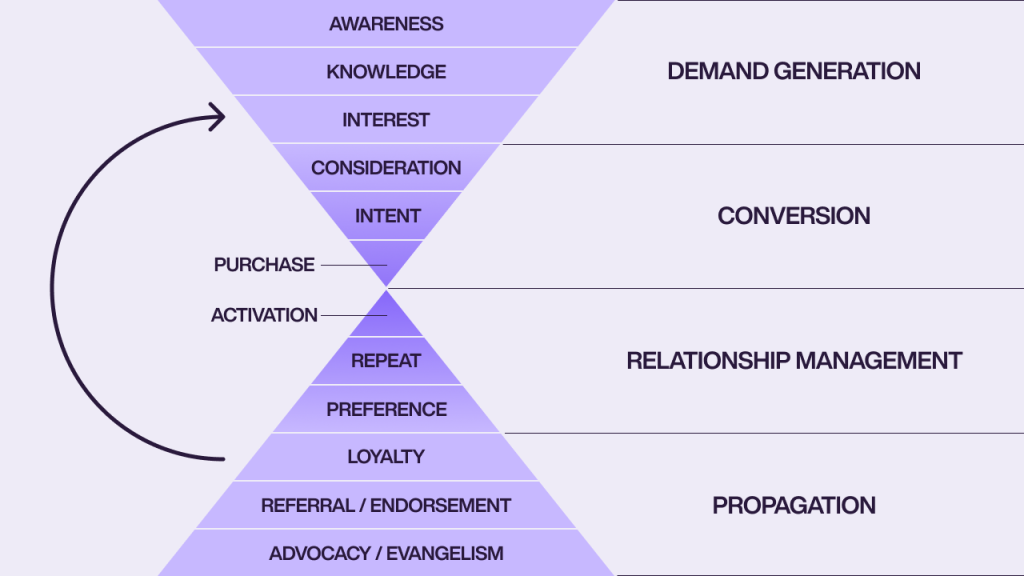
Image Source: Adspace
A. Awareness: Reach the Right People Before They Are Ready to Buy
Awareness campaigns introduce a brand, product, or service to people who are relevant to the business but not yet ready to take action.
- Goal: Build awareness among a relevant, potential customer base.
- Campaign approach: Use awareness-focused delivery settings with audience signals that are broad enough to find new prospects but still relevant to the client's ideal customer. Short-form video or other scroll-stopping creative that communicates one clear value proposition tends to perform well here, since the audience hasn't yet engaged with the brand.
- Creative angle: Lead with a recognizable problem, a useful insight, or a clear product benefit. Save the hard sell for later stages, when the audience has more context.
- Measurement: Reach, frequency, video engagement, and incremental branded interest (where it can be measured reliably) are reasonable indicators at this stage.
Agencies should resist the temptation to judge awareness campaigns by direct leads or last-click conversions. These campaigns are designed to build familiarity that can support consideration and conversion down the line, not to generate immediate inquiries. At the same time, reach and engagement numbers alone don't prove brand lift or guarantee future sales. They're directional signals, not proof of outcome.
B. Consideration: Give Interested Prospects a Reason to Take the Next Step
Consideration campaigns target people who have already shown some interest and are now in the process of evaluating whether the brand fits their needs.
- Goal: Help interested prospects learn more and evaluate the product or service.
- Campaign approach: Educational content, product demonstrations, authentic and authorized testimonials, and comparison-style messaging all work well here. Retargeting can also play a role, provided the audience size and available consent support it.
- Creative angle: Address a likely objection, demonstrate a specific benefit, or show how the offering solves a particular problem the prospect is facing.
- Measurement: Landing-page views, meaningful engagement, return visits, and other actions tied to the chosen campaign objective give a clearer read on consideration performance than surface-level metrics alone.
It helps to draw a clear line between curiosity and buying intent. Someone watching a video or revisiting a website is engaged, but that alone doesn't confirm they're ready to buy. Consideration campaigns move people closer to a decision; they don't guarantee one.
C. Conversion: Turn Intent Into Leads, Bookings, or Sales
Conversion campaigns ask prospects to complete a defined, valuable action, whether that's submitting an inquiry, booking an appointment, or making a purchase.
- Goal: Generate leads, bookings, purchases, or another defined conversion event.
- Campaign approach: The objective should match the client's actual conversion path. For lead generation, that often means testing instant forms against website-hosted forms to see which produces better-qualified results for that particular business.
- Creative angle: Make the offer, the supporting proof, and the next step unmistakably clear. Reduce friction wherever possible, both in the ad and on the destination page.
- Measurement: Conversion rate, cost per lead or acquisition, lead quality, and revenue (where tracking allows) are the metrics that matter most here.
A low cost per lead can look impressive in a report, but it doesn't automatically mean the campaign is working. If the client's sales team can't qualify or close those leads, the campaign isn't delivering real business value, regardless of how the cost-per-lead number looks on paper.
For context, WordStream's 2026 Facebook Ads benchmark reports an 8.54% median conversion rate and a $27.39 median cost per lead for lead campaigns across its analyzed industries. These figures are useful as directional references, not universal targets.
Actual performance varies based on industry, offer, audience, campaign setup, how conversions are defined, and how they're measured. No individual account should be expected to hit these numbers automatically.
D. Retention and Expansion: Support Repeat Business After the First Conversion
For clients whose business model depends on repeat purchases, renewals, referrals, or complementary services, advertising doesn't have to stop at the first conversion.
- Goal: Encourage repeat purchases, renewals, referrals, reactivation, or adoption of complementary services.
- Campaign Approach: Where consent, available data, and applicable requirements allow, customer audiences and relevant follow-up campaigns can support ongoing engagement.
- Creative Angle: Highlight onboarding assistance, complementary products, loyalty benefits, or a logical next service the customer might need.
- Measurement: Repeat purchases, customer reactivation, upsell conversions, and customer value are the relevant indicators, where reliable data exists.
Retention campaigns aren't necessary for every client. Their value depends heavily on the client's business model, purchase frequency, customer lifecycle, and the data available to support targeting. A one-time service business may have little use for retention advertising, while a subscription or repeat-purchase business may find it one of the most valuable parts of the funnel.
How Agencies Can Keep Funnel Stages Connected?
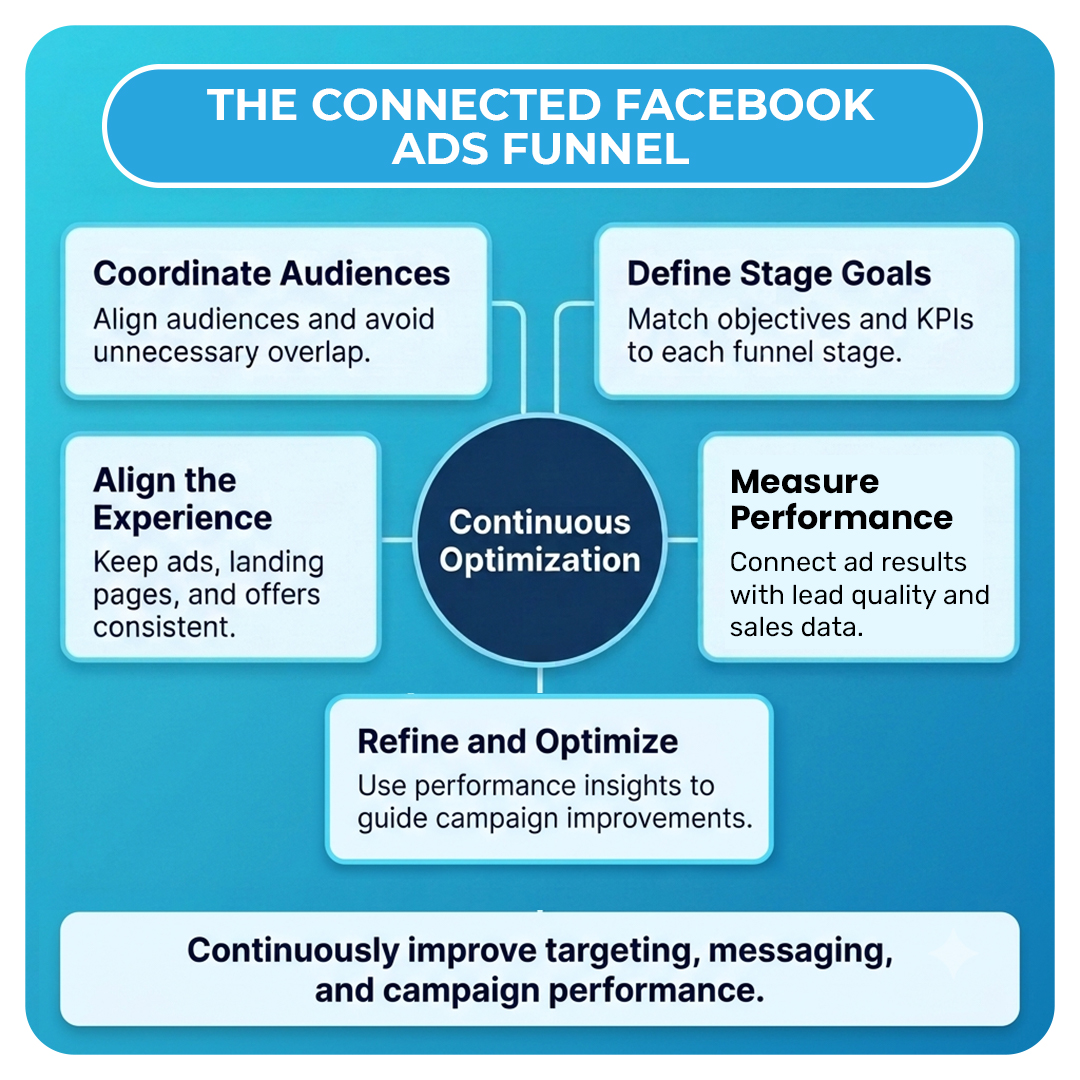
Awareness, consideration, conversion, and retention campaigns work best when they're coordinated rather than run as four disconnected efforts. A connected approach keeps messaging consistent and gives agencies a clearer view of how prospects are actually moving through the journey.
1. Use Shared Audience Logic
Prospecting, consideration, and conversion audiences should be built with some coordination in mind, accounting for overlap, audience size, relevance, and the data available for each stage. Messaging should evolve as prospects learn more about the brand, rather than repeating the exact same ad regardless of where someone is in the journey.
2. Set Stage-Specific Expectations
Awareness campaigns may support conversions that happen weeks or months later without generating immediate leads. Consideration campaigns may produce strong engagement without driving immediate purchases. Agencies should communicate the intended role of each campaign stage to clients and choose metrics that reflect that role.
This distinction isn't an excuse for weak performance. Every campaign, regardless of its stage, still needs a clear objective and a reasonable way to evaluate whether it's working.
3. Connect Ad and Landing-Page Messaging
The promise made in an ad needs to carry through to the destination page. If the creative, offer, headline, and next step don't align with what the prospect sees after clicking, that inconsistency creates confusion and can undermine the entire conversion path, regardless of how strong the ad itself was.
4. Track the Full Path Where Possible
Combining Meta's reporting with CRM or sales data gives agencies a clearer picture of whether leads actually progress to qualified opportunities and revenue. Attribution is rarely perfect, and platform-reported conversions may not capture the full incremental impact of a campaign. Agencies that only look at in-platform numbers are working with an incomplete picture.
5. Establish Clear Optimization Decision Rules
Having documented rules for responding to performance signals helps agencies make more consistent, defensible decisions:
- Refresh or reassess creative when engagement weakens, after accounting for audience fatigue, delivery changes, and other relevant factors.
- Review landing-page relevance, load times, and conversion friction when clicks aren't translating into meaningful actions.
- Investigate lead quality and sales follow-up before increasing budgets based solely on a low cost per lead.
- Review tracking and attribution setup when reported results don't line up with CRM or sales data.
These rules should prompt investigation, not trigger automatic changes made without context. A sudden drop in a single metric rarely tells the whole story on its own.
Where White Label Facebook Ads Fulfillment Supports the Process?
Best white label Facebook Ads gives agencies a way to manage campaign execution across every funnel stage without expanding their own team for every new skill set required.
1. Specialist Execution Across Funnel Stages
Fulfillment support can cover campaign setup, audience implementation, creative testing, and ongoing optimization for awareness, consideration, conversion, and retention campaigns, depending on what the engagement calls for. That execution should always follow the agency's strategy, approved objectives, client requirements, and agreed scope of work. Not every fulfillment provider offers the same services or works the same way, so agencies should confirm scope and capabilities before relying on a partner for a given account.
3. Repeatable Quality Checks
Consistent checks for tracking validation, campaign naming conventions, budget pacing, audience settings, and regular performance reviews help reduce avoidable errors. Documented processes make delivery more predictable across a growing client roster. That said, quality checks improve reliability; they don't guarantee campaign performance, which still depends on strategy, market conditions, and the client's own business factors.
4. Flexible Delivery Capacity
Facebook Ads outsourcing can help agencies manage multiple clients and campaign types without building every execution capability internally. Additional capacity can ease workload pressure, provided the agency maintains clear workflows, appropriate oversight, and realistic service commitments with both the fulfillment partner and the client. Outsourcing execution doesn't automatically reduce costs or increase profitability; those outcomes depend on how well the arrangement is structured and managed.
5. Keep Strategy and Client Relationships With the Agency
Regardless of who executes the campaigns, the agency remains responsible for funnel planning, understanding the client's business context, client communication, budget recommendations, and final strategic decisions. Fulfillment teams carry out approved plans and surface useful performance data. It's the agency's job to decide how that data should shape the broader account strategy.
6. Maintain Consistent Client Reporting
Reporting should carry the agency's own branding and connect campaign metrics back to what the client actually cares about. That means clearly distinguishing awareness metrics, engagement signals, leads, qualified opportunities, and revenue, rather than presenting every number as equally meaningful. A client who sees "10,000 engagements" without context has no way to judge whether that's a good result.
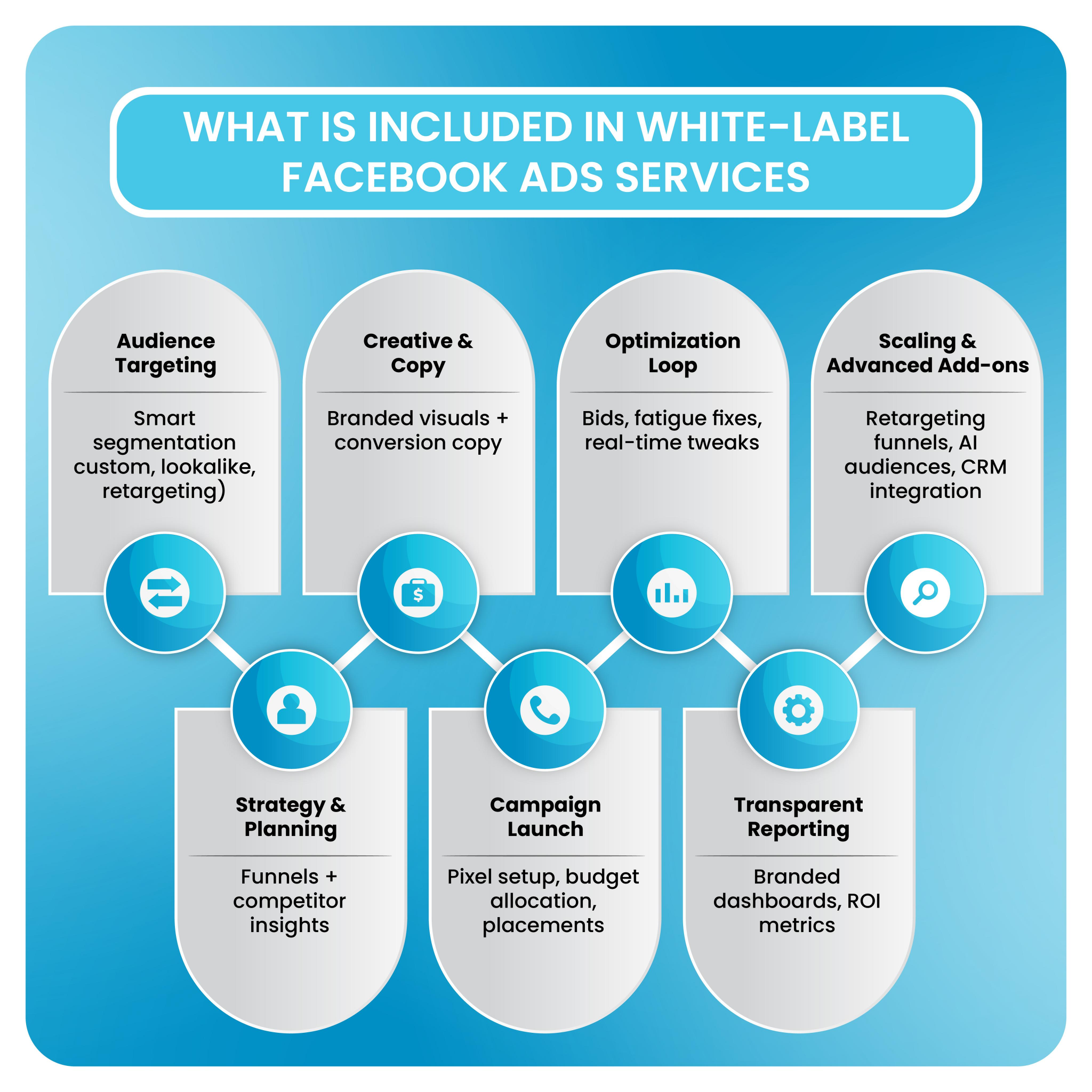
DashClicks offers best white label Facebook Ads services as one fulfillment option for agencies that need support executing and managing campaigns while keeping their own client-facing relationships intact. When evaluating any fulfillment partner, including DashClicks, agencies should look closely at service scope, execution needs, workflow compatibility, quality check processes, and reporting requirements to confirm the fit makes sense for their accounts.
Common Mistakes Agencies Should Avoid
Funnel-based planning only works when agencies interpret performance data carefully and keep execution tied to the client's actual business goals. A few recurring mistakes can undermine that alignment.
- Using the Same Creative and Offer for Every Funnel Stage: Cold audiences and high-intent prospects need different messages. Awareness creative should build relevance and recognition, while conversion creative needs to make the offer and the next action unmistakably clear. Match messaging to audience readiness instead of running identical ads across every stage without a clear reason for doing so.
- Treating Inexpensive Clicks or Leads as Proof of Business Impact: Cheap traffic or cheap leads can be a false signal if visitors aren't relevant or if leads don't qualify and convert. Campaign performance should be measured against the outcome the client actually needs, including lead quality and downstream results wherever that data is available.
- Retargeting Without Reviewing Audience Quality and Privacy Requirements: Retargeting audiences that are too small, overlapping with other segments, outdated, or poorly matched to the campaign can waste budget and produce unreliable results. Agencies should review audience relevance, available consent, applicable privacy requirements, and current platform policies before launching any retargeting campaign.
- Changing Budgets or Creative Too Frequently: Making frequent, unstructured changes makes it harder to read performance trends or evaluate whether a test actually worked. Agencies should work from documented hypotheses, allow suitable review periods, and gather enough relevant data before adjusting course, while still responding promptly to genuine tracking or delivery problems when they appear.
- Reporting Platform-Attributed Conversions Without Context: Platform attribution reflects Meta's own measurement methodology and may not capture the full customer journey or the true incremental impact of a campaign. Combining platform metrics with CRM, sales, or other business data gives a more complete picture, and agencies should be upfront with clients about where measurement gaps exist.
- Scaling Before Confirming Lead Quality and Tracking: Before increasing budgets substantially, agencies should verify that conversion tracking is accurate, evaluate whether leads are genuinely qualified, and confirm the client can actually handle the additional volume. Sales capacity, response times, fulfillment constraints, and conversion quality all affect whether more advertising spend translates into more business value.
Match Campaigns to Customer Readiness
Effective Facebook Ads services come down to matching campaigns to where customers actually are in their decision-making process, rather than applying one strategy to every prospect regardless of readiness. That means stage-specific creative, campaign objectives chosen deliberately rather than by default, metrics that reflect the intended outcome, connected reporting, and optimization decisions grounded in real data rather than guesswork.
White label Facebook Ads can help agencies execute and manage these activities across a growing number of client accounts, but it works best as support for a clearly defined strategy, not a replacement for one. The agency still owns the client relationship, the business context, and the final call on what happens next. Specialist fulfillment simply gives that strategy more room to scale.