

.svg)

.svg)
.svg)
.svg)
.svg)
.svg)
Client pressure for immediate Facebook Ads results is one of the most common agency challenges. Agencies that set structured expectations before launch, evaluate performance across multiple signals, communicate optimization decisions clearly, and build scalable fulfillment systems are better positioned to retain clients and deliver consistent outcomes.
A Facebook Ads campaign goes live on Monday morning. By Thursday afternoon, the client sends a message: "Why aren't we getting results yet?"
Every agency managing Facebook Ads services has been in this situation. The campaign is technically functioning. The ads are delivering. But the client is watching their ad spend and expecting leads to flow in immediately.
The reality is that agencies are managing two things at once: the advertising campaign and the client's expectations. Both require active, deliberate effort.
Facebook Ads performance should be evaluated through data collection, testing, optimization, and measurement, not simply by the number of leads generated in the first 48 hours. Agencies that understand this can guide clients through the early phase of a campaign without making promises they cannot keep or telling clients to simply "wait and trust the process." A structured approach to expectations, evaluation, and communication makes all the difference.
Why Clients Expect Immediate Results From Facebook Ads?
Clients do not expect slow results because they are unreasonable. They expect fast results because Facebook Ads appear to work instantly in several visible ways.
- Ad Visibility is Immediate: Campaigns go live quickly, and clients can see their ads running within hours of launch. This creates the impression that results should follow just as quickly.
- Spend is Visible From Day One: Clients see budget being allocated and naturally expect a measurable return to appear alongside it.
- Early Engagement Metrics can Look Promising: Impressions, clicks, and even some early engagement can appear within the first few days, which sets an expectation that leads and sales should follow shortly after.
- Comparison with Google Search: Clients who have run Google Search campaigns sometimes expect a similar intent-driven response. Facebook Ads operate on an interruption model, which requires a different evaluation timeline.
- Previous Experiences or Competitor Claims: A client may have heard that another agency delivered leads within the first week, or a previous campaign may have produced early results under different conditions.
Fast ad delivery does not equal instant business results. Delivery and performance are separate things.
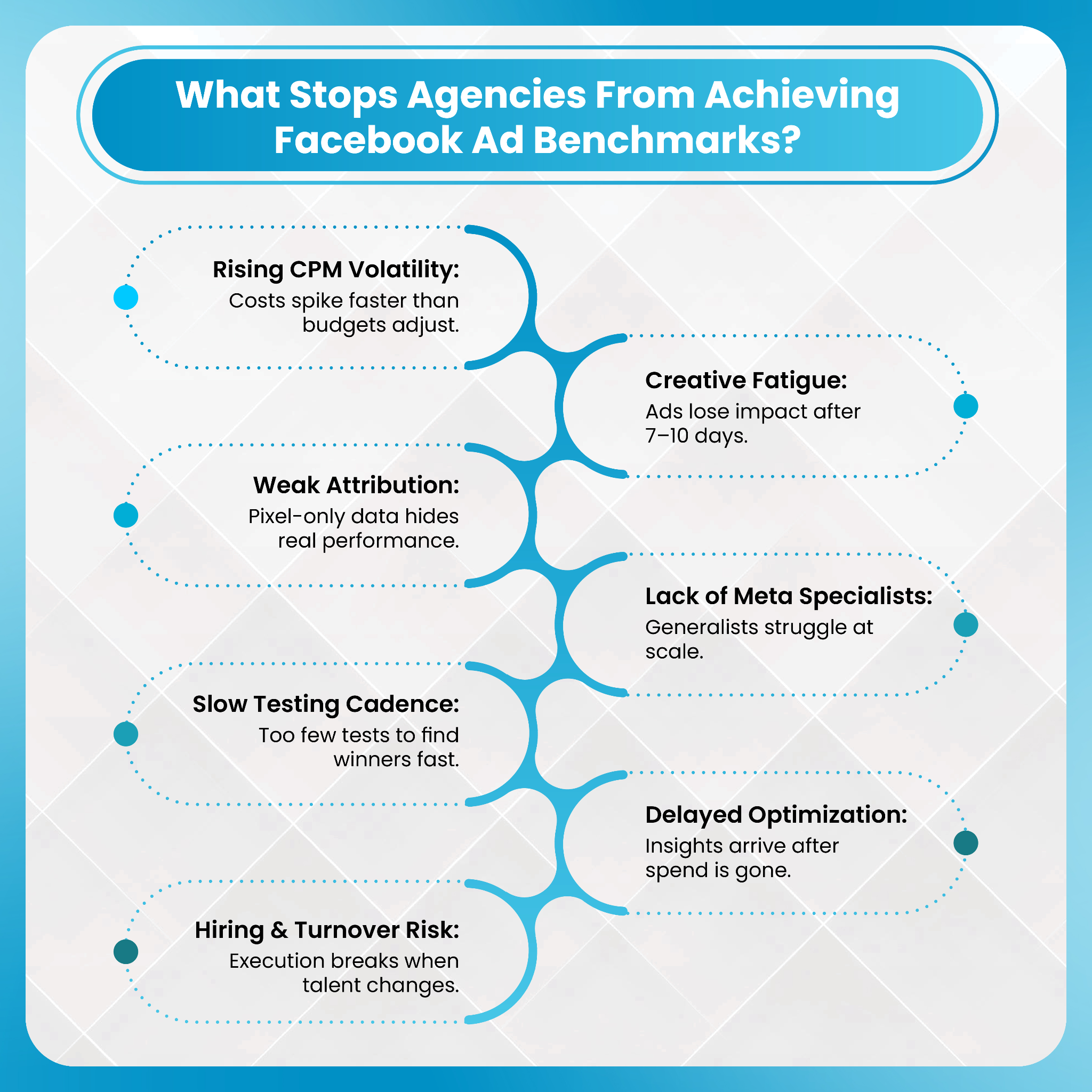
Even after a campaign launches cleanly, the agency still needs to determine:
- Which creative attracts the right target audience
- Which audience segments actually respond
- Whether the offer is compelling enough to generate action
- Whether users convert after clicking through
- Whether the leads coming in are qualified
Set Expectations Before the Campaign Goes Live
The most effective time to manage client expectations is before the campaign launches, not after the client sends that first concerned message.
Agencies should establish the following during the onboarding or pre-launch phase:
- Campaign Objective: Confirm what the campaign is designed to achieve and align this with the client's actual business goal.
- Primary KPI: Identify the one metric that will define success for this campaign: leads, purchases, cost per acquisition, or something else.
- Secondary Performance Indicators: Set additional metrics that will be monitored alongside the primary KPI to give a fuller picture of performance.
- Budget Expectations: Clarify how the budget will be allocated and why the initial period may not produce the lowest possible cost per result.
- Testing Approach: Explain that early campaigns often involve creative and audience testing, and that this is deliberate, not a sign of poor performance.
- Reporting Frequency: Agree on when and how the client will receive updates, so they are not checking Ad Manager daily and drawing conclusions from incomplete data.
- Optimization Process: Explain what the agency will be looking at and what conditions would trigger a change.
- Meaningful Performance Signals: Help the client understand which early signals are worth paying attention to and which are too early to interpret.
What Meta's Guidance Actually Says?
Meta recommends that advertisers budget over at least seven days to give the system enough time to learn how to allocate spend effectively. This is not a guarantee of results within seven days. It is guidance about allowing the system sufficient time and data to optimize delivery before drawing strong conclusions about performance.
Agencies should explain this clearly upfront. Clients who understand why the early phase looks the way it does are far less likely to request changes before there is enough data to support them.
Don't Judge a Campaign by Leads Alone
Lead volume is the metric clients focus on most, but it is only one layer of campaign performance. Agencies that evaluate campaigns across all four levels below will make better optimization decisions and have more productive conversations with clients.
1. Ad-Level Signals
These metrics tell you how the ad itself is performing within the feed.
- CTR (click-through rate): Indicates whether the ad is generating enough interest to earn a click. A consistently low CTR suggests the creative or message may need review.
- CPC (cost per click): Reflects how competitively the campaign is performing in the auction relative to the audience being targeted.
- Engagement: Reactions, comments, and shares can signal resonance with the audience even before conversion data is available.
- Creative Response: Look at which ad variations are generating more meaningful interaction versus those being skipped.
2. Post-Click Signals
These metrics tell you what happens after someone clicks the ad.
- Landing Page Engagement: Time on page and scroll depth can indicate whether users are finding the page relevant.
- Bounce or Drop-off Behaviour: If users are leaving the landing page immediately, the problem may sit in the post-click experience rather than the ad itself.
- Conversion Rate: The percentage of visitors who take the desired action reveals how well the offer and page are working together.
3. Conversion Signals
These are the metrics clients tend to focus on most directly.
- Lead Volume: The raw number of leads generated within the reporting period.
- CPL (cost per lead): The average cost to acquire each lead, which should be evaluated relative to the client's margin and sales process.
- Lead Quality: Whether the leads coming through match the target customer profile, which often requires input from the client's sales team.
4. Business Signals
These are the downstream metrics that ultimately determine whether the campaign is delivering commercial value.
- Qualified Opportunities: How many leads progress through the client's sales funnel.
- Sales and Revenue: The actual business outcome generated from campaign leads.
- ROAS (return on ad spend): Relevant for e-commerce campaigns where purchase data is available and trackable.
WordStream's analysis of 726 U.S. lead campaigns from April 2024 through June 2025 reported median figures of 2.59% CTR, $1.92 CPC, 7.72% conversion rate, and $27.66 CPL.
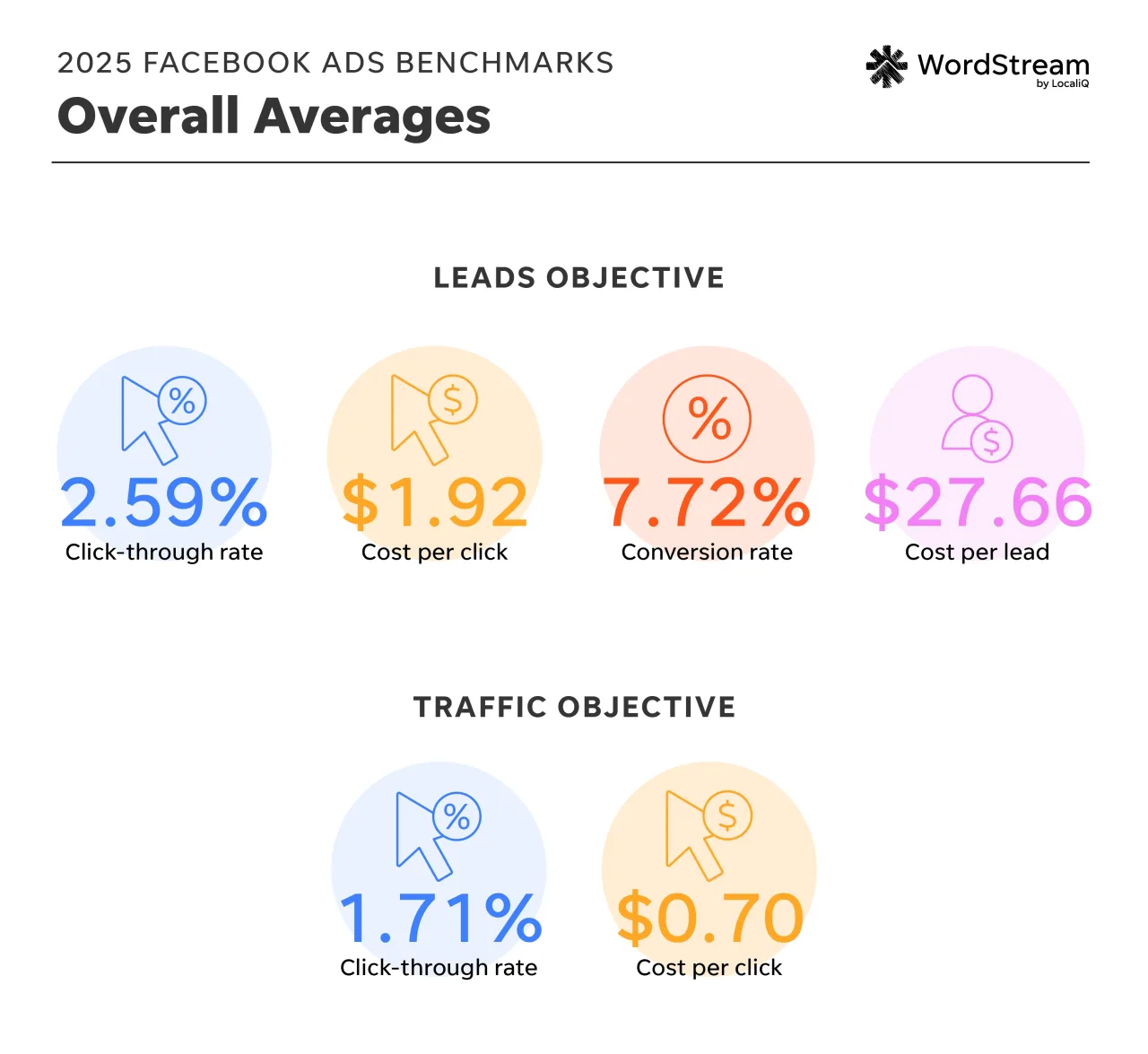
Image Source: WordStream
These are benchmarks, not targets. Results vary significantly by industry, offer, audience, funnel structure, and campaign objective. An agency should not tell a client that a campaign is underperforming simply because its CPL sits above an industry median. The more relevant question is whether the CPL is sustainable relative to the client's customer lifetime value and sales conversion rate.
Use Data to Decide What Changes, Not Client Pressure
One of the most damaging things an agency can do is make repeated campaign changes in response to client anxiety rather than performance data.
Constant changes to targeting, creative, budget, optimization events, or campaign structure disrupt the system's ability to build reliable delivery patterns. Significant edits can cause an ad set to re-enter the learning phase, making performance less stable while the algorithm readjusts. This often extends the period before the campaign produces reliable results.
A Practical Decision Process Before Making Any Change
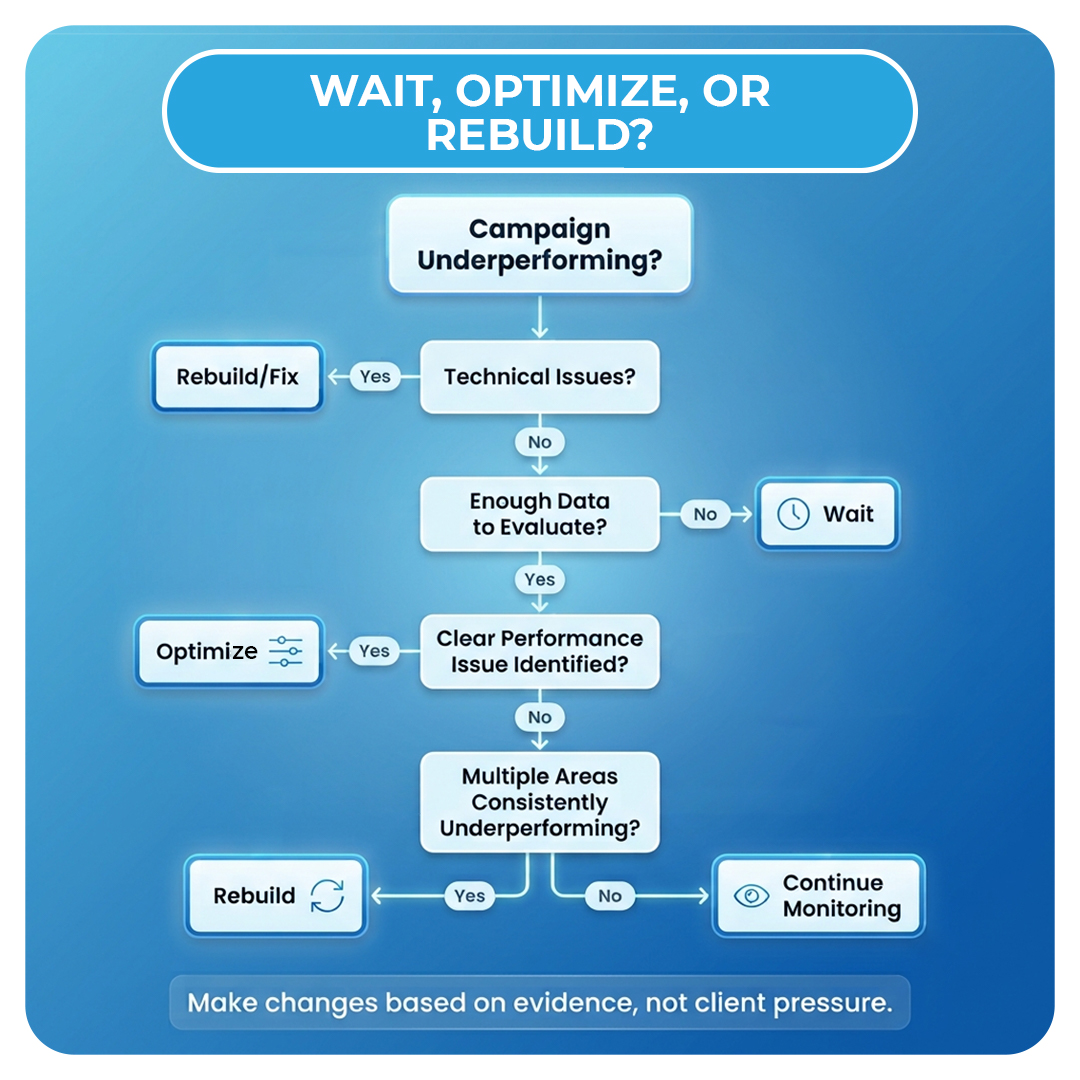
Before changing anything in a campaign, work through these questions in order:
- Is the campaign technically functioning? Check that ads are approved, the pixel is firing, and delivery is active.
- Is tracking accurate? Confirm that conversions are being recorded correctly and attributed to the right campaign.
- Are users engaging with the ads? Review CTR, CPC, and engagement metrics to determine whether the creative is resonating.
- Are users reaching the intended destination? Verify that landing pages are loading correctly and that the post-click experience matches the ad.
- Are users converting? Examine landing page conversion rate to identify whether the offer or the page itself needs attention.
- Are conversions qualified? Gather feedback from the client about lead quality before assuming a targeting problem.
- Is there enough evidence to justify a major change? Consider the volume of data available before drawing conclusions.
The principle here is straightforward: optimize because the data gives you a reason, not because the client is anxious.
Turn Optimization Into a Story Clients Can Understand
Telling a client "we're optimizing the campaign" communicates almost nothing useful. Clients who do not understand what is being done or why are more likely to become anxious and request changes.
Structure every optimization update around four elements:
- What We Observed: Describe specifically what changed in the data. For example: CTR has remained stable at around 3%, but the landing page conversion rate has dropped from 9% to 4% over the past seven days.
- What It Means: Explain the likely bottleneck or opportunity based on what the data shows. In this example: users are engaging with the ad, but something in the post-click experience is reducing conversions. The likely issue is on the landing page rather than in the audience or creative.
- What We're Changing: Describe the specific action being taken. For example: testing an alternative headline and form placement on the landing page to reduce friction and improve conversion rate.
- What We'll Measure Next: Explain which metric will determine the next decision. For example: if the landing page conversion rate returns above 7% within the next seven days, the change will be considered effective.
This structure turns a technical process into something a client can follow and trust. It also reduces the number of reactive conversations, because clients can see that the agency is already acting on the data.
Build a Communication System That Prevents Client Panic
Client anxiety about campaign performance often increases not because the results are genuinely bad, but because the client does not know what the agency is doing, why performance changed, when they will next receive an update, or what happens next.
A predictable communication system addresses this before panic sets in.
- Weekly or Agreed Performance Updates: Send a structured update at a consistent time each week, covering key metrics, observations, and any changes made or planned.
- Monthly Strategic Reviews: Use a monthly session to step back from daily or weekly fluctuations and evaluate overall campaign direction and progress toward the primary goal.
- Clear Optimization Summaries: When a change is made, document it in writing: what changed, why, and what will be measured next.
- Defined Escalation Criteria: Establish upfront what would trigger an urgent conversation outside the normal cadence, such as a significant tracking problem or a sudden drop in delivery.
- Focus on Trends Rather Than Daily Numbers: Help clients understand that individual daily figures can be misleading and that patterns over time are more meaningful.
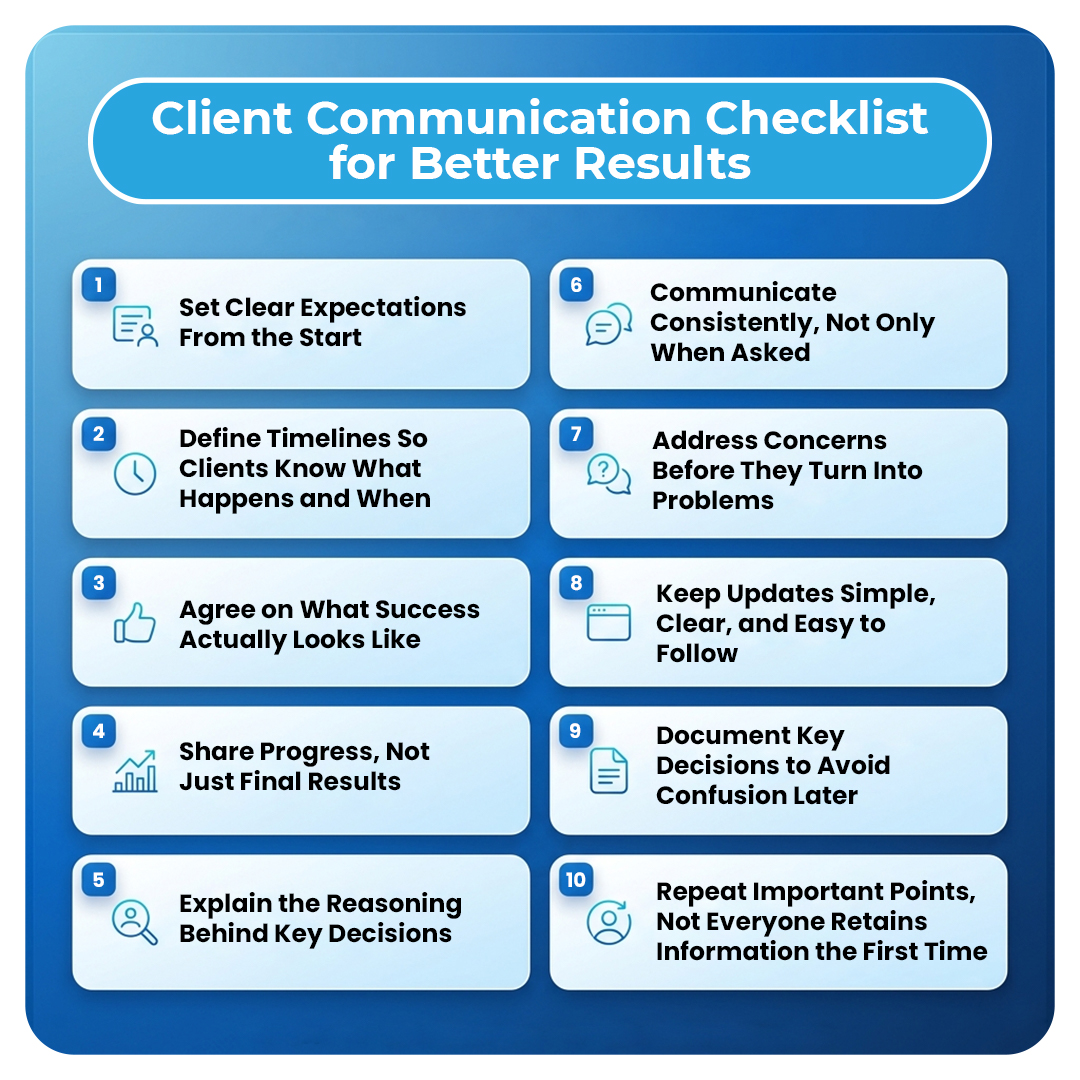
The goal is not to communicate more. It is to communicate predictably. Clients who know exactly when they will hear from the agency and what that update will contain are far less likely to send concerned messages between check-ins.
Know When a Client's Concern Is Actually Valid
Not every client's concern reflects impatience. Some concerns are completely justified, and agencies need to distinguish between the two.
Red Flags That Require Immediate Investigation
- Tracking Problems: If the pixel is not firing correctly or conversions are not being recorded, optimization decisions will be based on inaccurate data.
- Leads Not Reaching the Client: If form submissions or enquiries are not being delivered to the client's CRM or email, the campaign may be generating results that are simply not visible.
- Spending Without Meaningful Engagement: If a significant budget has been deployed and the campaign is producing near-zero clicks or engagement, something is structurally wrong.
- Campaign Objective Misaligned with the business goal: If the campaign is optimizing for traffic but the client needs leads, no amount of additional budget will fix the problem.
- Clearly Misaligned Targeting: If the audience is obviously too broad, too narrow, or incorrectly defined for the offer, early intervention is warranted.
- Landing Page Technical Problems: If the page is loading slowly, breaking on mobile, or not submitting forms correctly, the issue requires immediate attention.
- Consistently Poor Lead Quality: If the client's sales team reports that none of the leads match the target customer profile, the campaign needs review rather than patience.
- Budget or Settings Restricting Delivery: If the campaign is not spending or reaching the intended audience due to overly restrictive settings, this should be corrected promptly.
Good expectation management does not mean telling clients to wait. It means knowing when waiting makes sense and when action is genuinely required.
How Agencies Maintain Consistent Facebook Ads Fulfillment as Client Demand Grows?
Managing one Facebook Ads account internally is straightforward. Managing 10, 20, or 50 accounts is a different challenge entirely. As an agency's client base grows, the operational requirements of campaign management expand rapidly.
Each account requires:
- Campaign monitoring: Reviewing delivery, spend, and performance signals regularly across multiple accounts.
- Creative testing: Developing and rotating new ad creative to maintain performance and avoid audience fatigue.
- Audience management: Reviewing, expanding, and refreshing audience sets based on performance data.
- Budget adjustments: Reallocating spend across campaigns and ad sets based on results.
- Performance analysis: Interpreting data across multiple accounts simultaneously and identifying what each campaign needs next.
- Optimization: Making evidence-based changes to targeting, creative, bidding, and structure across every active account.
- Reporting: Producing clear, accurate performance updates for each client on a consistent schedule.
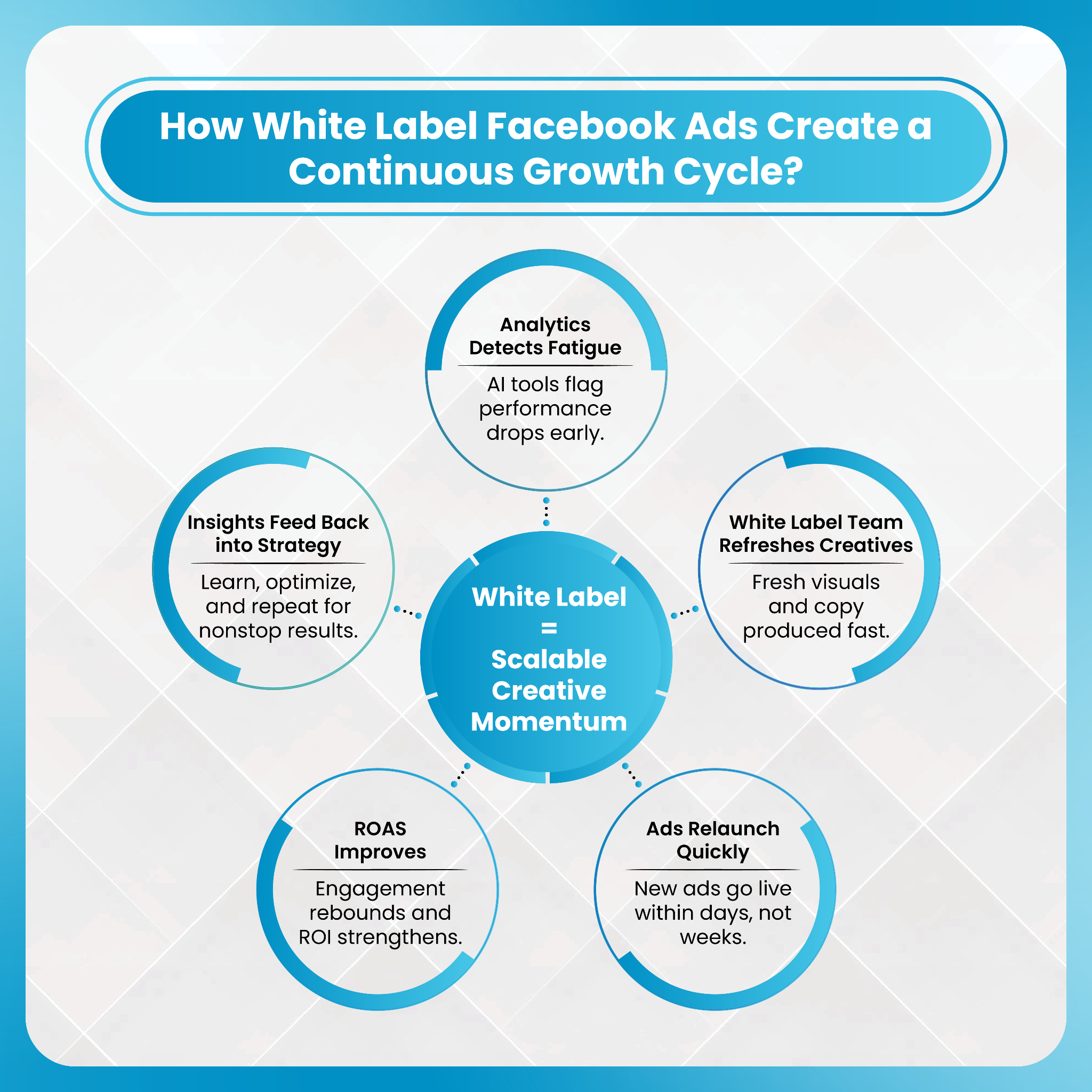
At a certain point, the challenge is not advertising knowledge. It is fulfillment capacity.
White label Facebook Ads fulfillment allows agencies to extend their execution capacity without rebuilding every operational function internally.
The agency retains full ownership of the client relationship, strategy, business context, expectations, and final recommendations. The fulfillment partner handles campaign execution, monitoring, testing, optimization, and reporting.
This model works because it does not remove the agency from the process. It gives the agency more capacity to manage more accounts at a consistent level of quality, without hiring an entirely new internal team for each stage of growth.
Further Reading: Managing 50+ Accounts Using White Label Facebook Ads Services
How DashClicks Helps Agencies Manage Facebook Ads Fulfillment?
As agencies take on more Facebook Ads accounts, maintaining consistent campaign management, optimization, testing, and reporting can put increasing pressure on internal teams. DashClicks' white label Facebook Ads services give agencies additional fulfillment capacity without requiring them to build a larger in-house advertising team.
Agencies can use DashClicks to support the ongoing execution of Facebook Ads campaigns, including campaign management, audience targeting, optimization, performance monitoring, and reporting. This allows agencies to maintain a consistent fulfillment process even as the number of client accounts and campaign requirements grows.
The agency remains in control of the client relationship, strategy, and communication, while fulfillment is handled behind the scenes. This gives agencies more capacity to focus on client expectations, strategic decisions, and growth while maintaining consistent Facebook Ads delivery across their accounts.
A Simple Framework for Handling Clients Who Want Faster Results
Most client pressure situations can be managed with a repeatable five-step process: Explain, Evaluate, Optimise, Communicate, and Repeat.
First, explain the process before the campaign launches. Set realistic expectations around the campaign objective, KPIs, testing approach, and reporting schedule so clients understand how performance will be evaluated.
Next, evaluate performance beyond lead volume. Review ad engagement, post-click behaviour, conversion data, and business outcomes to identify where the campaign is performing well and where changes may be needed.
Then, optimise based on evidence rather than client pressure. Any changes to targeting, creative, budget, or campaign structure should be supported by sufficient data.
Agencies should also communicate what the data shows, what it means, what actions are being taken, and what will be measured next.
Finally, repeat the process. Facebook Ads optimisation is an ongoing cycle of testing, measuring, and refining. Agencies cannot control exactly when results will improve, but they can control the quality of their process and communication—two factors that help build client trust over time.


.svg)


.svg)
.svg)
.svg)
.svg)
.svg)