

Local search has become one of the clearest paths between a business and its next customer. For agencies, that creates an obvious opportunity, but also an operational question that rarely gets enough attention: how do you deliver local SEO consistently as your client list grows?
Most agencies start local SEO the same way. A client asks for help showing up in local search results, the agency handles a round of optimizations, and the work quietly becomes a one-time project rather than an ongoing service. That approach works for a handful of accounts. It breaks down fast once an agency is managing local search for fifteen, thirty, or fifty clients at once.
Local search visibility isn't a single task to check off. It's an ongoing requirement that spans business listings, keyword research, website optimization, citations, reviews, content, and reporting. Each of these needs regular attention, and each additional client adds to the workload.
This is where white label local SEO services for agencies come into play. Rather than building every specialist function in-house, agencies can work with a partner to extend their delivery capacity while keeping their branding, client relationships, and strategic direction intact.
Turning local search visibility into a scalable agency service requires more than acquiring clients. Agencies need structured service packages, repeatable fulfillment processes, quality control, and the right operational support to back it all up. This article walks through what that looks like in practice.
Why Local Search Visibility Is a Valuable Service Opportunity for Agencies
Local search is where a large share of purchasing decisions begin for businesses that depend on nearby customers. Understanding the channels involved helps clarify why this is such a substantial, ongoing service opportunity.
- Google Search: Local businesses can appear for location-based and service-related queries, putting them in front of customers actively looking for what they offer nearby.
- Google Maps: Customers use map results to discover nearby businesses, compare ratings and distance, and find essential details like hours and contact information.
- Local Organic Results: Location-relevant website pages and useful content help businesses attract organic traffic from people searching in their service areas.
- Business Directories: Accurate, consistent listings across relevant directories support discoverability and reinforce the credibility of a business's information online.
Why Local SEO Requires Ongoing Attention
Local SEO isn't something an agency finishes and moves on from. It requires continuous work across several fronts:
- Keeping business information accurate as locations, hours, or services change.
- Updating Google Business Profiles with current details and relevant activity.
- Monitoring local keyword visibility to track how a business ranks over time.
- Maintaining citations and correcting inconsistencies as they appear across directories.
- Managing reviews and responding to customer feedback.
- Improving location pages and local content to stay relevant to search intent.
- Monitoring organic traffic, profile interactions, and conversions.
- Responding to shifts in local competition and changing business priorities.
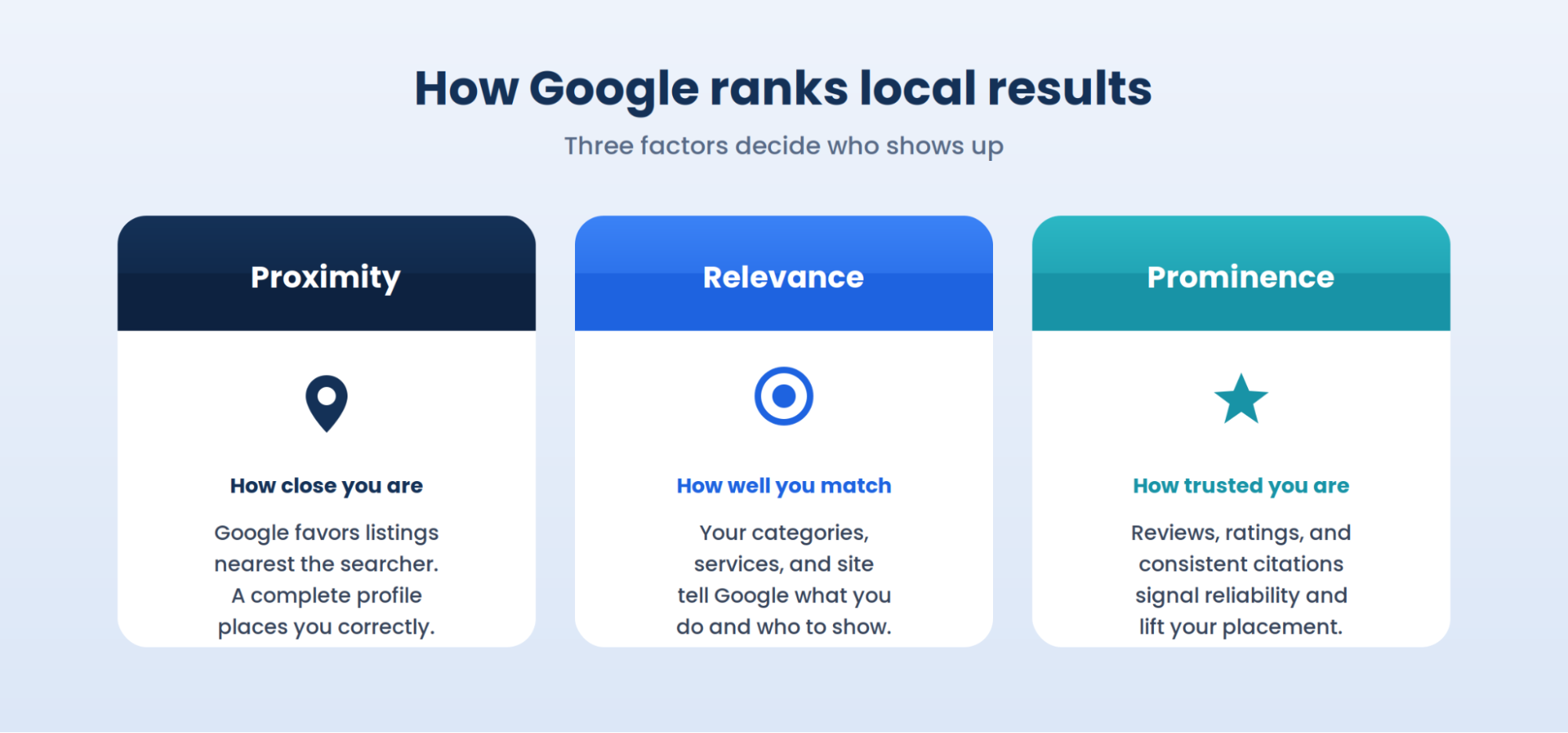
Image Source: Adaired
According to BrightLocal's 2026 research, 84% of consumers searched for a local business in the past three months. The same research found that 96% of consumers consider active online presence management important for local businesses. Together, these figures point to how central local search has become to how people find and evaluate nearby businesses, and why a consistently maintained online presence matters.
The Agency Opportunity
The ongoing nature of local SEO is precisely what makes it valuable as a service line. Agencies can build:
- Monthly local SEO retainers built around clearly defined deliverables.
- Additional services layered onto existing SEO or web clients.
- Long-term client relationships grounded in measurable, recurring work.
- Service expansion across multiple business locations.
- Recurring revenue tied to consistent execution rather than one-off projects.
Local SEO is valuable as an agency offering precisely because it never really finishes. That ongoing need is what creates room for continuous service delivery.
What Agencies Can Include in a Local SEO Service Offering
A comprehensive local SEO offering combines several deliverables that work together to improve visibility, relevance, and trust. Here's how agencies typically structure that work.
1. Google Business Profile Optimization
Agencies can support clients by:
- Reviewing and updating business information, including hours, services, and contact details.
- Selecting appropriate primary and secondary categories that reflect what the business actually offers.
- Adding relevant services and business details to give the profile more depth.
- Reviewing and updating business photos to keep the profile current and engaging.
- Maintaining profile information and publishing relevant updates where appropriate.
Accurate, complete, and relevant profile information directly affects whether a business shows up for the right local searches and whether customers trust what they find.
2. Local Keyword and Website Optimization
This area covers:
- Location-based keyword research to identify terms customers actually use.
- Identifying relevant service-area search terms beyond the main business location.
- Optimizing existing website pages for local search intent.
- Creating dedicated location pages where they provide genuine value.
- Improving page titles, headings, content, internal links, and other on-page elements.
Location pages should offer useful, location-specific information rather than simply repeating similar content with different city names swapped in.
3. Citation Management
Citation work includes:
- Business listing audits across relevant directories.
- NAP consistency checks, referring to name, address, and phone number accuracy.
- Duplicate listing identification and cleanup.
- Correction of outdated or incorrect business information.
- Citation building across directories relevant to the client's industry and location.
Consistent local citation management supports accurate business information across the web, which matters for both search engines and potential customers.
4. Review and Reputation Management
This includes:
- Review monitoring across relevant platforms.
- Response workflows that keep communication timely and consistent.
- Identifying recurring customer feedback themes that point to operational insights.
- Ethical review-generation strategies that encourage genuine feedback.
- Maintaining consistent communication around customer feedback over time.
Agencies should avoid buying reviews, fabricating customer feedback, or using misleading review-generation tactics, since these practices carry real reputational and platform risk.
5. Local Content and Link Building
Agencies can build local relevance through:
- Location-relevant website content that addresses real customer questions.
- Useful service-area resources tied to the business's actual offerings.
- Locally relevant backlinks from credible, related sources.
- Community-focused link opportunities, such as local organizations or partnerships.
- Content that speaks directly to local customer needs.
Low-value location pages or irrelevant links pursued purely for volume tend to do more harm than good, so this work should stay focused on genuine relevance.
6. Performance Monitoring
Ongoing monitoring should cover:
- Local keyword rankings over time.
- Google Business Profile performance, including views and interactions.
- Organic website traffic from local search.
- Relevant search visibility trends.
- Website enquiries and conversions.
- Progress against client-specific business goals.
Ranking and profile metrics should always be interpreted alongside meaningful business outcomes, not treated as standalone indicators of success.
How Agencies Can Package Local SEO Into Recurring Services
Selling local SEO as disconnected, one-off tasks makes it harder for clients to understand the value of ongoing work, and it leaves agencies constantly re-selling instead of building retainers. A better approach is packaging related deliverables into recurring service plans with clear responsibilities and measurable outputs.
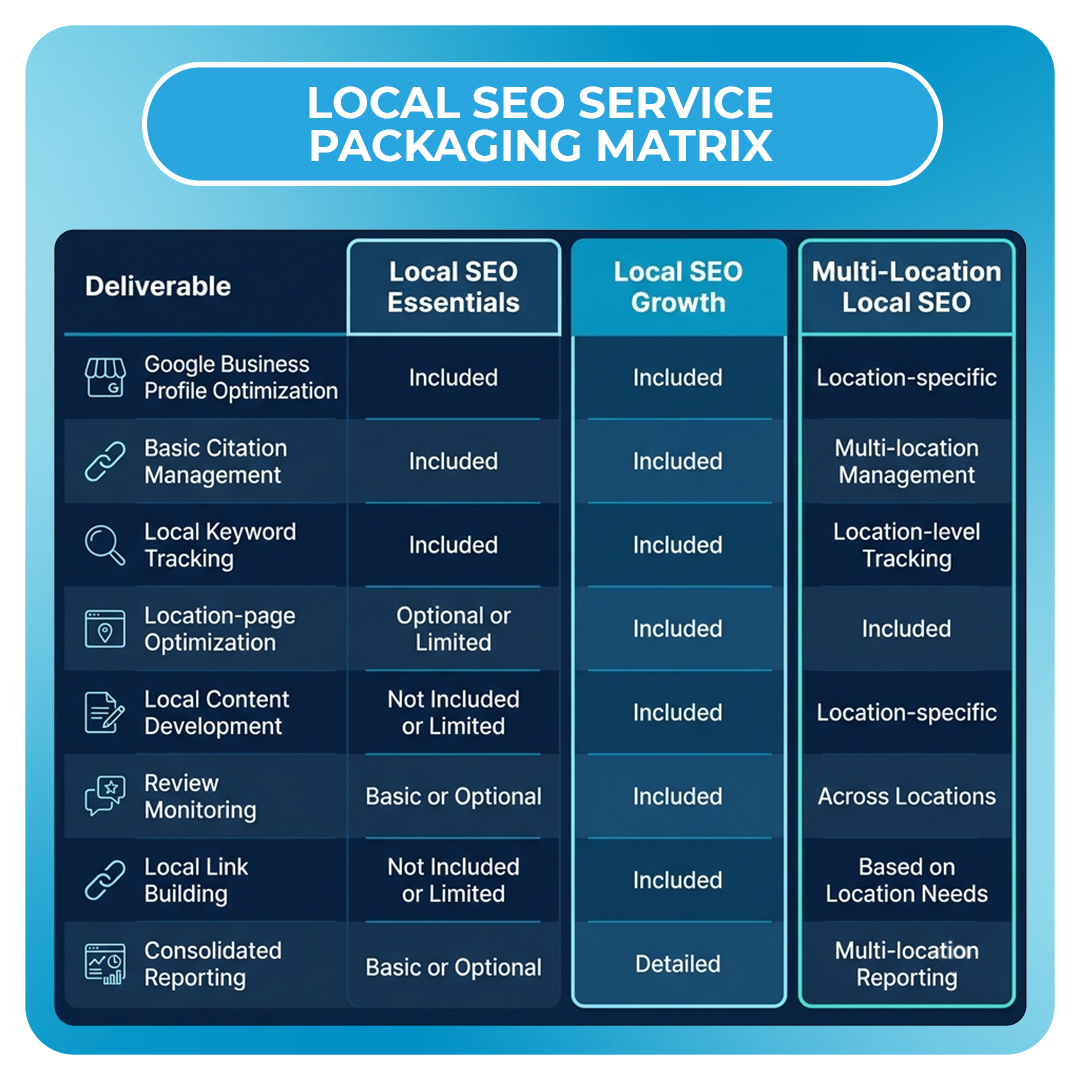
Here are three illustrative service tiers agencies can adapt.
1. Local SEO Essentials
An entry-level service for businesses that need foundational local search support. Potential inclusions:
- Google Business Profile optimization.
- Basic citation management.
- Local keyword tracking.
- Business information accuracy checks.
- Regular performance updates.
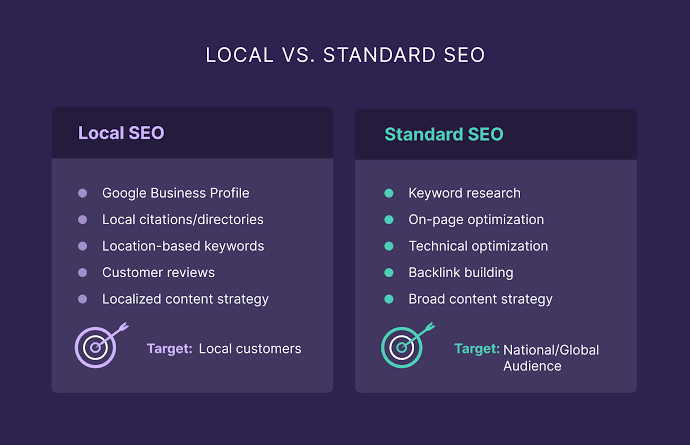
Image Source: Backlinko
This tier suits businesses that need a structured local SEO foundation and ongoing maintenance without a large monthly investment.
2. Local SEO Growth
A more comprehensive offering for businesses that need additional website and local visibility improvements. Potential inclusions:
- Everything covered in Local SEO Essentials.
- Location-page optimization.
- Local content development.
- Review monitoring.
- Additional citation work.
- Relevant local link-building activities.
- More detailed performance reporting.
This package supports businesses that need consistent optimization across both their website and local presence, not just profile maintenance.
3. Multi-Location Local SEO
A service built for businesses operating across multiple locations or service areas. Potential inclusions:
- Location-specific optimization strategies.
- Business listing management across locations.
- Location-page optimization.
- Location-level keyword tracking.
- Consistent business information management.
- Consolidated performance reporting.
- Location-specific optimization priorities.
Multi-location campaigns require careful coordination and reporting. Treating every location as an identical copy of the main business tends to produce weaker results across the board.
4. Customize Packages According to Client Requirements
These tiers are illustrative service structures, not universal packages every agency must follow. When building packages, consider:
- Business size: A small local business may need a different level of support than an established, multi-service company.
- Competition: Businesses in highly competitive markets often require more extensive, ongoing optimization.
- Number of locations: Multi-location businesses typically need more coordination, listing management, and location-specific reporting.
- Existing SEO performance: Agencies should identify existing strengths and optimization gaps before recommending a package.
- Business goals: Deliverables should reflect whether the client wants more enquiries, calls, appointments, store visits, or another specific outcome.
Whatever structure an agency builds, defining clear deliverables, reporting frequency, turnaround expectations, and service boundaries up front prevents scope confusion down the line.
What Makes Local SEO Difficult to Scale In-House
Delivering local SEO for a handful of clients is manageable with a small internal team. Supporting a growing portfolio is a different challenge entirely, one that requires structured operations and specialist capacity most agencies haven't built yet.
1. Growing Account Workloads
Every additional client introduces recurring work across:
- Business listing updates.
- Keyword and ranking monitoring.
- Website optimization.
- Citation audits.
- Review monitoring.
- Content development.
- Reporting and client communication.
These responsibilities accumulate quickly. What felt manageable at ten accounts can feel unmanageable at thirty.
2. Specialist Skill Requirements
Local SEO spans several distinct areas of expertise, including:
- Google Business Profile management.
- Technical and on-page SEO.
- Local keyword research.
- Citation building and management.
- Local content development.
- Link building.
- Performance analysis.
Maintaining deep knowledge across every one of these functions is difficult for a small internal team, and gaps in any single area tend to show up in results.
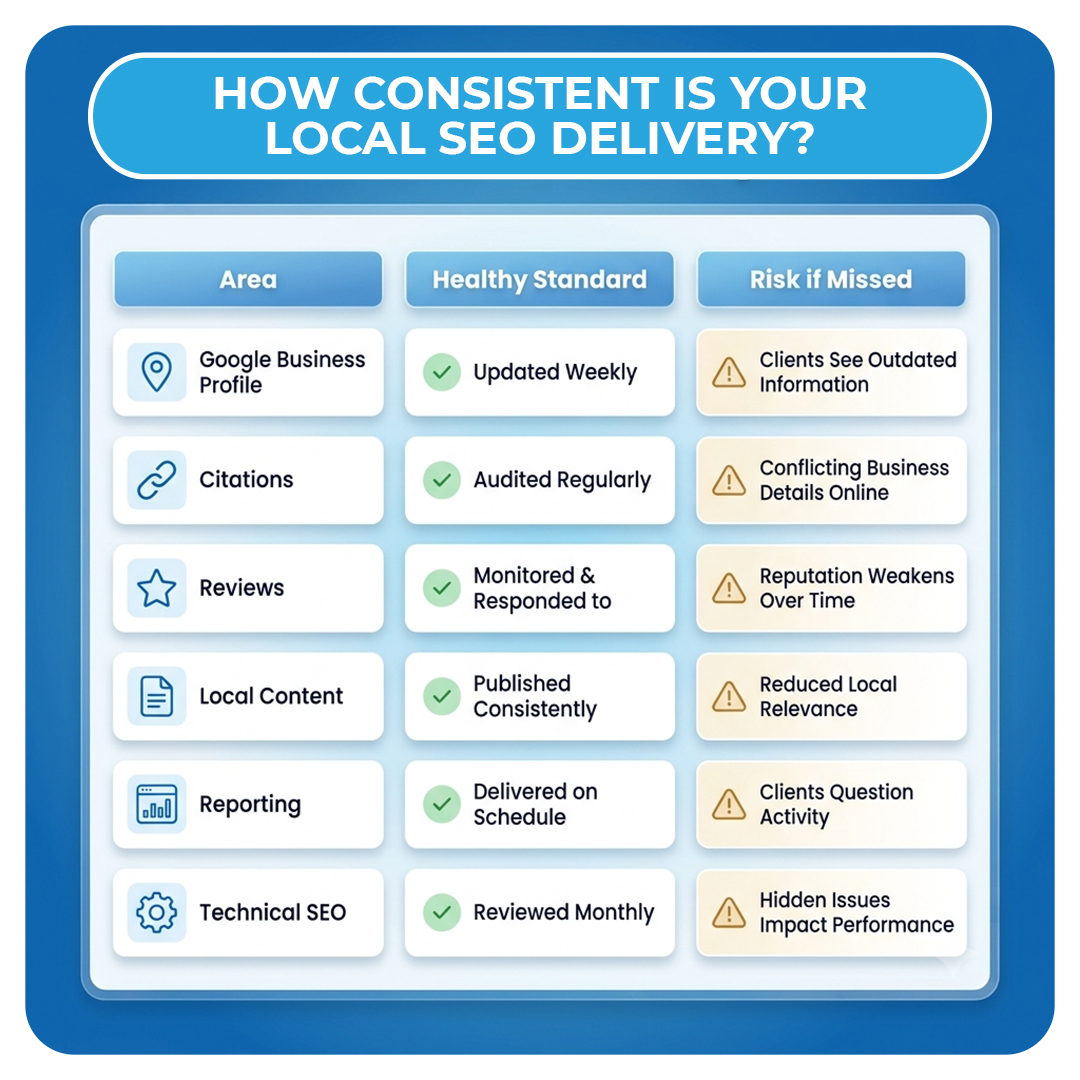
3. Inconsistent Fulfillment
Without documented workflows, differences start to appear across:
- Optimization schedules.
- Listing accuracy checks.
- Content quality.
- Reporting practices.
- Account management.
- Quality assurance.
Inconsistent delivery affects client confidence, and it makes a growing portfolio progressively harder to manage well.
4. Rising Operational Costs
Expanding an internal team involves real financial and management commitments:
- Hiring specialists for each function.
- Training new employees on tools and processes.
- Purchasing and maintaining SEO software.
- Supervising additional workloads.
- Managing delivery and quality control.
These costs need to be weighed against the agency's expected client volume and revenue, not added reactively as new accounts come in.
5. Limited Capacity for Growth
When internal teams are fully occupied fulfilling existing contracts, there's less room for:
- Business development.
- Client acquisition.
- Strategic planning.
- Service expansion.
- Client relationship management.
Scaling local SEO requires more than acquiring clients. Agencies need a delivery model that can accommodate additional accounts without compromising execution quality.
How White Label Local SEO Helps Agencies Scale Their Service Offering
White label local SEO fulfillment addresses many of the operational challenges above directly. In this model, an agency works with an external fulfillment partner to support service delivery under the agency's own brand, while the agency retains responsibility for client relationships and strategic direction.
1. Access to Specialist Expertise
Working with a white label local SEO firm gives agencies access to support across multiple functions without hiring dedicated specialists for each one, including:
- Google Business Profile optimization.
- Citation management.
- Local keyword and website optimization.
- Local content development.
- Link building.
- Performance reporting.
The exact expertise and deliverables available depend on the fulfillment provider's actual service scope, so agencies should confirm this upfront.
2. Repeatable Fulfillment Processes
Documented workflows, clear task ownership, delivery schedules, and quality checks help agencies maintain more consistent execution across multiple accounts. Outsourcing doesn't automatically guarantee consistency, though. Agencies should evaluate a fulfillment partner's actual processes before assuming otherwise.
3. Flexible Delivery Capacity
White label local SEO services help agencies accommodate additional client accounts without proportionally increasing internal headcount. This flexibility is particularly useful when account volume changes, or demand fluctuates seasonally. It doesn't, however, eliminate the need for internal account oversight. Agencies still need to manage strategy and quality on their end.
4. More Comprehensive Service Offerings
By incorporating additional fulfillment support, agencies can expand their local SEO packages to include:
- Business profile optimization.
- Citation management.
- Location-page optimization.
- Local content.
- Relevant link building.
- Ongoing performance reporting.
These capabilities map directly onto the three package tiers discussed earlier, giving agencies a practical path to deliver Growth and Multi-Location tiers without building every function internally first.
5. Greater Focus on Client Relationships
Outsourcing execution frees up agency teams to focus on:
- Client communication
- Strategic recommendations
- Business goals
- Performance reviews
- Account growth
- Identifying additional opportunities
The agency remains responsible for understanding the client's business and communicating the value of the work being delivered, regardless of who executes it.
DashClicks' White Label Local SEO Services
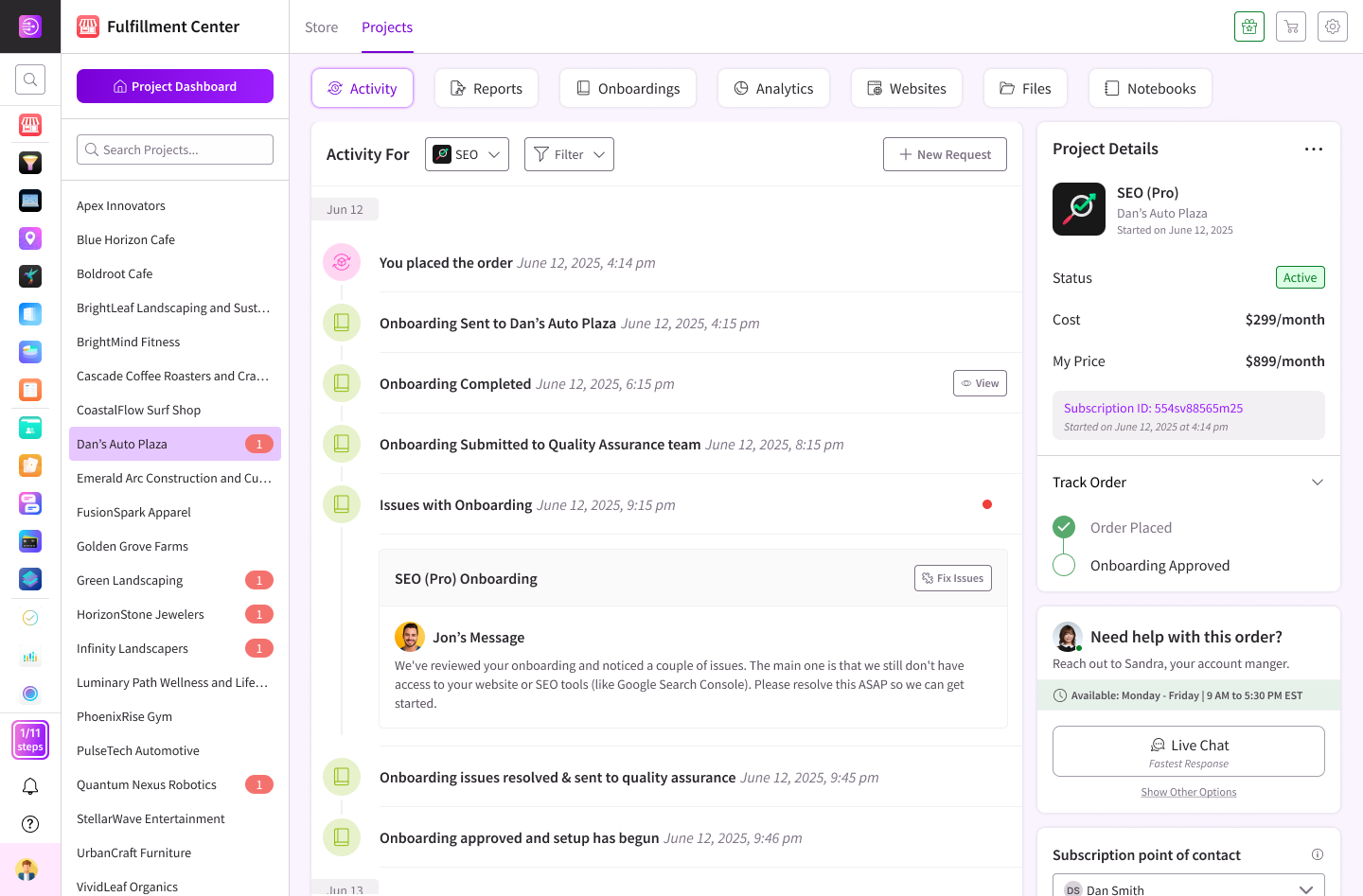
DashClicks is one example of a white label local SEO fulfillment partner for agencies. The platform’s white label local SEO services can help agencies outsource ongoing optimization and fulfillment while continuing to offer local SEO under their own brand.
In practice, this kind of partnership can look like:
- DashClicks works as an extension of the agency's team on local SEO execution.
- White label fulfillment supporting agencies that need additional local SEO execution capacity.
- Agencies retain their branding and direct client relationships throughout.
- Agencies maintain strategic control and ownership of the client relationship.
- Fulfillment support helps agencies manage ongoing local SEO work and account delivery.
Agencies working with white label local SEO firm, like DashClicks, should establish clear responsibilities for strategy, execution, quality checks, reporting, and client communication from the outset.
White label local SEO allows agencies to expand fulfillment capacity while keeping their client relationships, brand identity, and strategic direction in-house.
Building a Local SEO Service That Grows With Your Agency
Local SEO offers agencies an opportunity to build recurring services through ongoing optimisation of business listings, websites, citations, reviews, and content. However, scaling delivery requires specialist expertise, structured workflows, and consistent quality checks.
White label local SEO fulfilment helps agencies expand their execution capacity without building every function in-house, while retaining control of their branding, client relationships, and strategy.