

Digital marketing agencies managing SEO for multiple clients eventually hit the same wall: too many service pages, not enough hours to optimize them properly. A team that can carefully research and optimize ten pages a month suddenly needs to handle fifty, then a hundred, without doubling headcount or sacrificing the quality that earned client trust in the first place.
The instinct is often to speed things up by applying the same template to every page. Swap a service name here, a city name there, and move on to the next URL. This approach creates new problems: repetitive content, weak search intent alignment, and pages that do not actually serve the clients they are meant to represent.
The better path is to standardize execution, not the content itself. Agencies can build repeatable systems for research, optimization, implementation, and quality assurance while still giving every page the page-specific attention it needs. This blog explains how to build that kind of system, covering prioritization, repeatable workflows, content differentiation, automation, quality assurance, and performance monitoring.
1. Build a Prioritized Service Page Inventory
Before making bulk changes or creating new pages, agencies need a clear picture of what already exists. An audit of current service URLs establishes a baseline: what each page covers, how it performs, and where optimization effort is likely to pay off.
This inventory becomes the foundation for every decision that follows. Without it, teams end up guessing which pages matter most, which often means the highest-priority work gets delayed while less important pages consume time and attention.
Several factors should inform how pages get prioritized:
- Business Value: Some service pages represent the client's core offerings or highest-margin services. These pages generally warrant closer attention than pages covering secondary or rarely requested services.
- Search Demand: Pages targeting terms with meaningful search volume and relevant intent typically justify more optimization effort than pages targeting narrow or low-demand terms.
- Current Organic Performance: Pages that already rank reasonably well may need lighter touch improvements, while pages with poor visibility may need a more thorough review.
- Conversion Potential: Pages tied to services that reliably generate leads or revenue for the client deserve priority over pages with limited commercial relevance.
- Optimization Effort: Some pages need minor metadata fixes, while others require substantial content rework. Understanding the effort involved helps teams plan realistic timelines.
Using these factors, agencies can sort pages into categories: those needing improvement, those that might benefit from consolidation, those requiring clearer differentiation, those needing a technical review, and those that do not need immediate changes. Not every page deserves the same priority, and treating every URL as equally urgent wastes resources that could go toward pages with real business impact.
An inventory should document, at minimum, each URL's current status, its specific optimization needs, the assigned owner, its priority level, and its implementation progress. This gives the team a shared reference point and prevents work from falling through the cracks as the page count grows.
2. Create a Repeatable On-Page SEO Framework
Once priorities are set, agencies need a consistent way to execute the work itself. This is where documented standard operating procedures, checklists, and implementation guidelines come in. The goal is to make sure every team member approaches on-page SEO the same way, regardless of who is handling a particular page.
A solid on-page SEO framework should address the core elements that appear on nearly every service page:
- Title Tags: Define length guidelines, keyword placement expectations, and branding requirements.
- Meta Descriptions: Set expectations for length, clarity, and whether a call to action should be included.
- H1s: Clarify how the H1 should relate to the page's primary keyword and search intent.
- Heading Hierarchy: Establish rules for how H2s and H3s should organize supporting content.
- URL Structure: Document naming conventions that keep URLs clean and consistent across the site.
- Internal Links: Specify how service pages should link to related pages, location pages, or supporting content.
- Image ALT Text: Set minimum requirements for descriptive, relevant alt text.
- Relevant Structured Data: Identify which schema types apply to service pages and how they should be implemented.
An effective SOP defines minimum requirements while leaving room for client-specific exceptions. A client in a heavily regulated industry might need additional disclaimers or different heading structures than a client in home services, for example. Reusable templates can improve consistency across the board without forcing every service page into an identical structure or forcing the same information onto pages that do not need it.
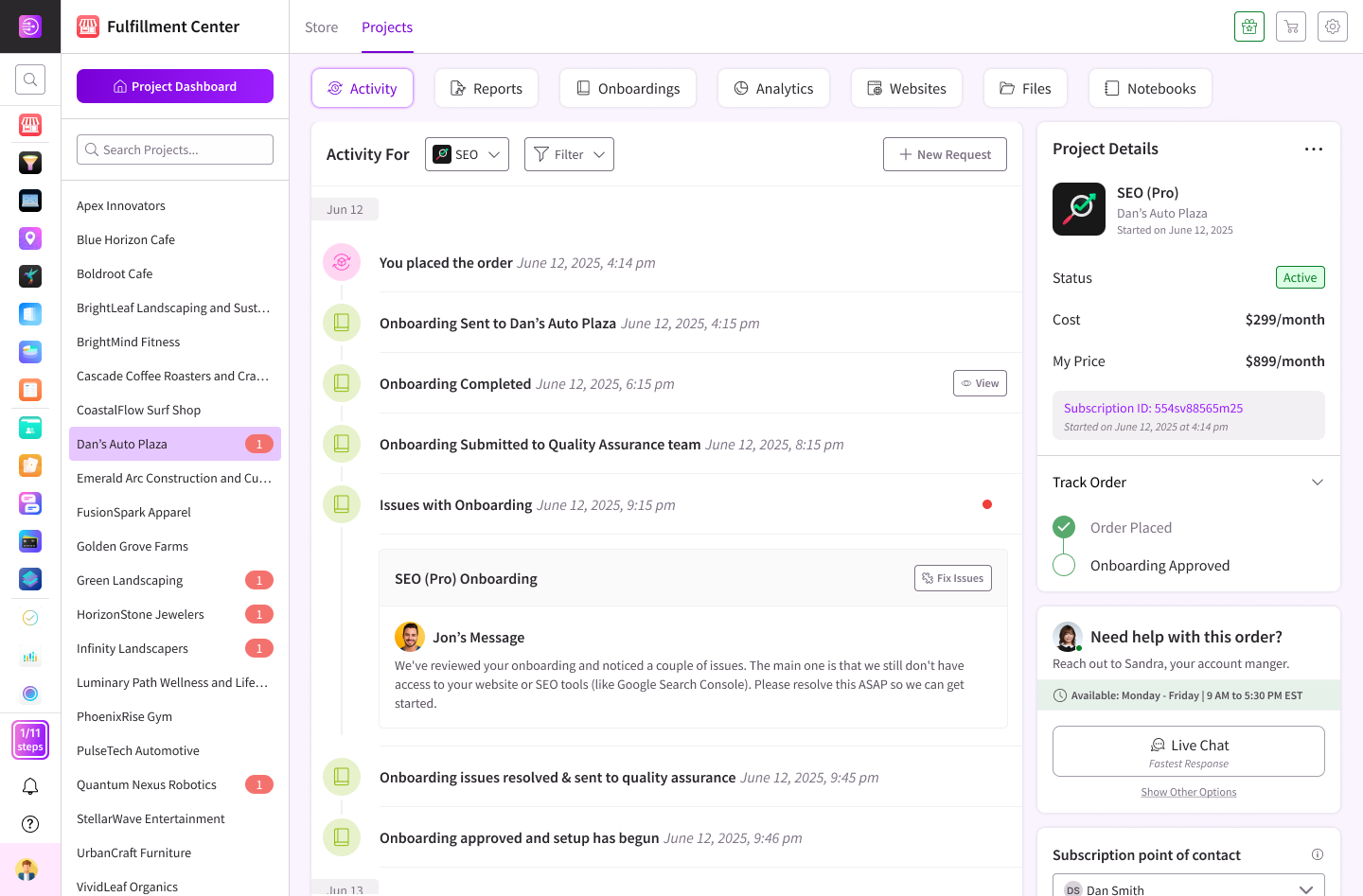
Documentation matters just as much as the optimization work itself. Teams should track client approvals, content revisions, implementation status, assigned responsibilities, outstanding issues, and final QA status for every page that moves through the pipeline. This record keeps work organized as volume increases and gives the agency a clear audit trail if a client asks about the status of a particular page.
Standardization in this context means building a reliable process, not eliminating page-level judgment. The checklist tells the team what to check. It does not tell them what the content should say.
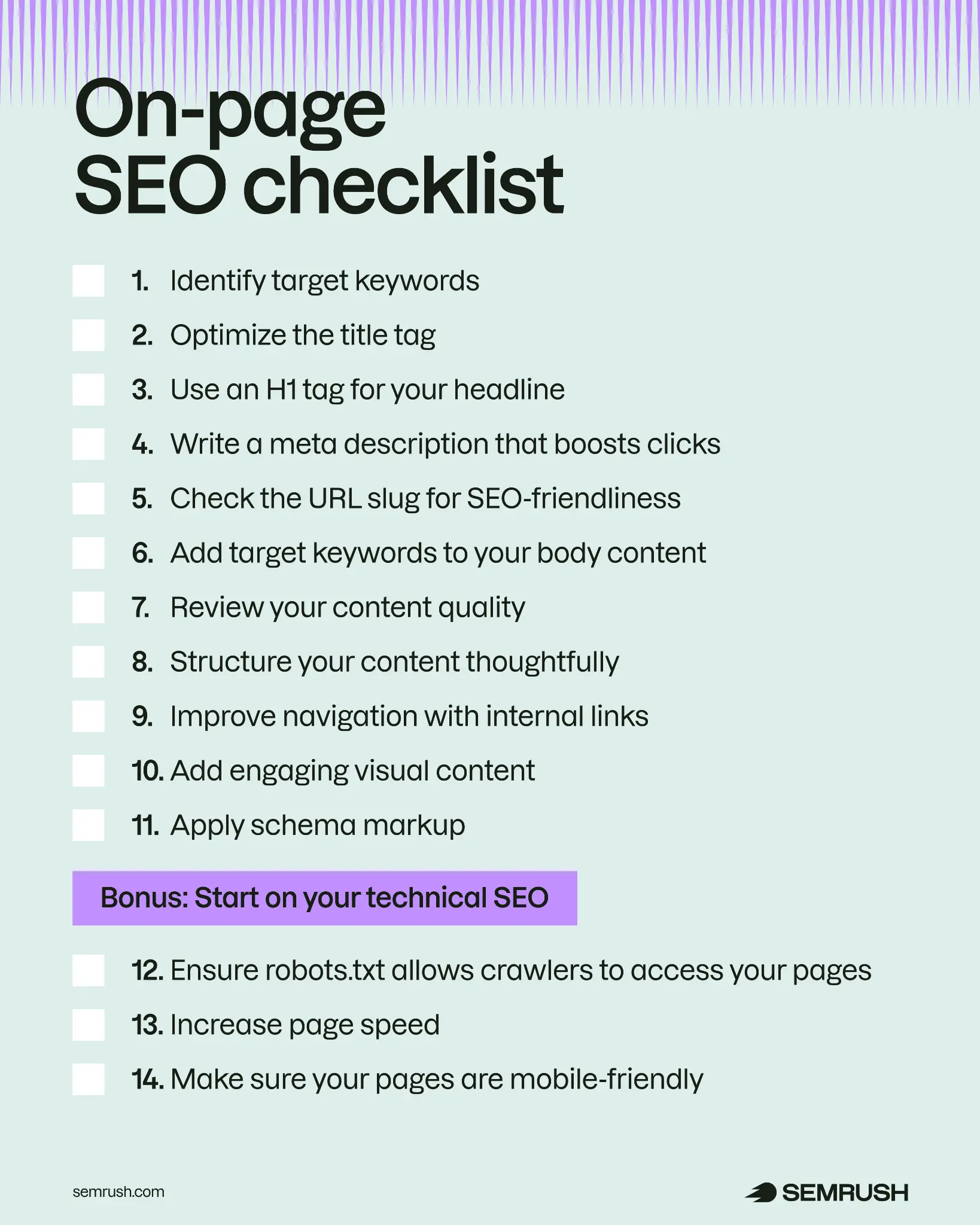
Image Source: Semrush
3. Prevent Duplicate Content and Search Intent Overlap
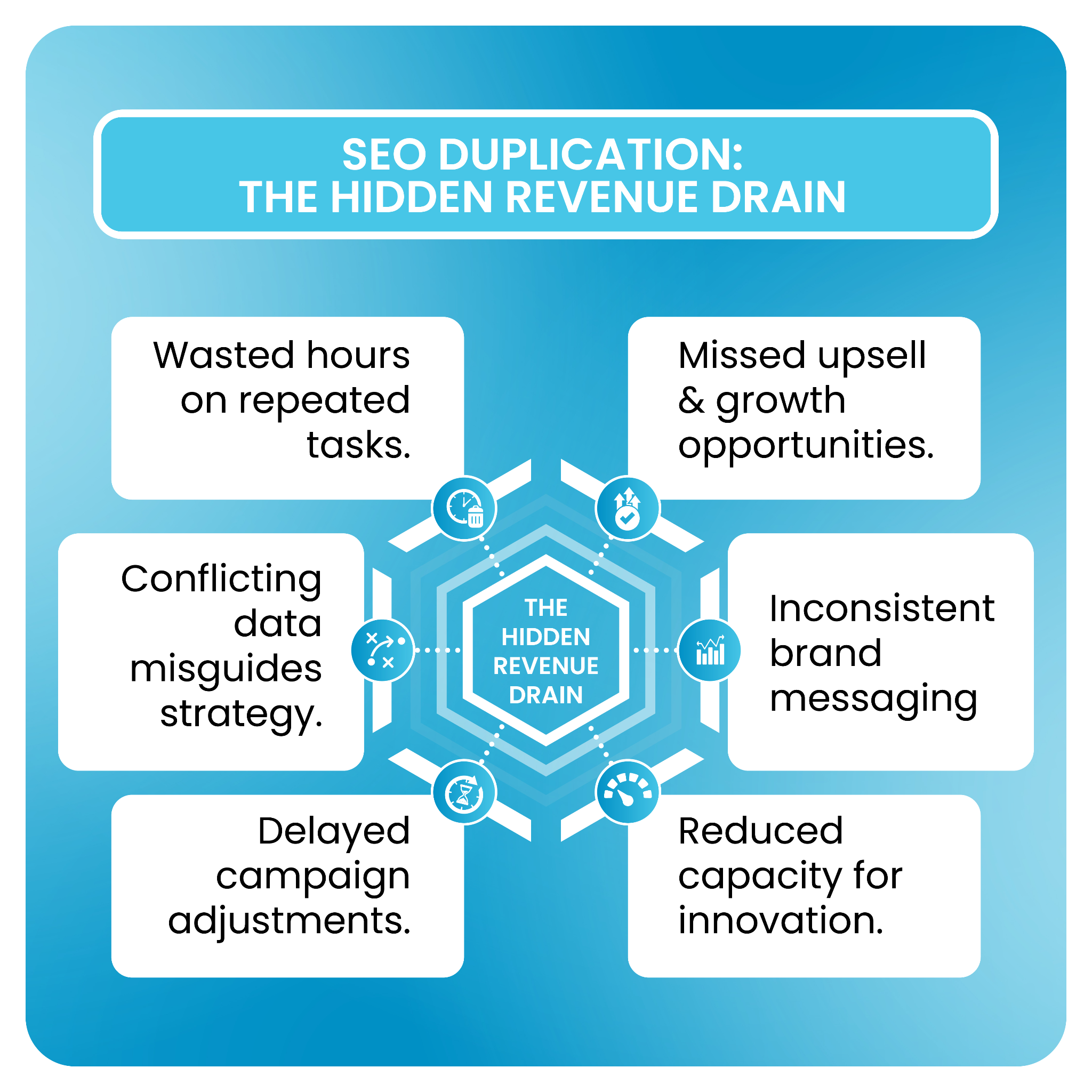
One of the most common problems in large-scale service page production is content that looks different on the surface but serves no distinct purpose. This typically happens when pages get built from a single template with minor word swaps, resulting in pages that compete with each other for the same search terms instead of each serving a specific need.
Before optimizing pages at scale, agencies should establish a clear purpose for each URL. This involves:
- Mapping Primary Keywords to Individual URLs: Each service page should have a defined target keyword or keyword cluster that is not duplicated across other pages on the same site.
- Understanding Search Intent: A page targeting "emergency plumbing repair" serves a different intent than a page targeting "plumbing maintenance plans," even though both fall under the same general service category.
- Differentiating Service Pages: Pages covering similar services should be reviewed to confirm they address genuinely different needs rather than restating the same information.
- Identifying Keyword Cannibalization: When multiple pages compete for the same query, search engines may struggle to determine which page to rank, which can dilute visibility for all of them.
- Reviewing Near-duplicate Location Pages: Agencies managing multi-location clients should check whether location pages contain meaningful local differences or simply repeat the same content with a city name changed.
- Detecting Overlapping Service Descriptions: Pages describing similar services should be compared directly to identify repeated phrasing or redundant explanations.
Differentiating pages requires more than cosmetic changes. Meaningful differentiation comes from service-specific details, a clear understanding of customer needs, descriptions of the actual process involved, relevant FAQs, proof points where the client has them available, and local context where it genuinely applies. Changing a city name or service name within an otherwise identical template does not meet this bar.
When pages overlap too closely, agencies face a decision: improve the existing page, consolidate competing pages into one stronger page, or confirm that a separate URL is warranted. This decision should depend on the purpose of each URL, the search intent involved, the site's overall structure, and what the client actually offers. Consolidation and new page creation are not default solutions. They are choices that depend on the specific situation.
4. Use Automation Without Losing Editorial Control
As the number of service pages grows, manual tracking becomes impractical. Automation can help agencies manage repetitive tasks across large sites, freeing up time for the work that actually requires human judgment.
Useful tools and processes include website crawlers, spreadsheets, SEO platforms, metadata checks, heading consistency checks, broken link detection, missing element identification, URL inventory management, and routine status tracking. These tools are most valuable for gathering data, flagging repeatable issues, organizing priorities, and confirming that approved changes were actually implemented.
The key distinction agencies need to maintain is between tasks that automation can reliably support and decisions that still require human review.
Tasks Automation Can Support
- Identifying missing title tags or meta descriptions across a large batch of pages.
- Flagging inconsistent heading structures that deviate from the SOP.
- Detecting broken internal or external links.
- Collecting page-level SEO data for review.
- Tracking optimization status across many URLs at once.
- Identifying pages that may need further human review based on flagged issues.
Tasks Requiring Human Judgment
- Evaluating whether a page actually matches the search intent behind its target keywords.
- Checking the factual accuracy of claims made about a client's services.
- Preserving the client's brand voice throughout the content.
- Assessing whether differentiation between similar pages is meaningful or superficial.
- Deciding whether a page serves a genuinely distinct purpose on the site.
- Reviewing whether a recommendation actually fits the client's business and goals.
Agencies should test any new automated process or bulk change on a small batch of URLs before rolling it out across an entire site. This limits the damage if something goes wrong and gives the team a chance to catch issues early. Automation should support editorial decisions, not make every final content decision on its own. Automated checks can tell a team that a meta description is missing. They cannot reliably judge whether the page content actually serves the reader.
5. Establish Quality Assurance Before Publishing
Quality assurance needs to be part of the regular workflow, not a step that gets squeezed in only when time allows. Without a consistent QA process, errors accumulate across dozens or hundreds of pages, and fixing them after the fact costs far more time than catching them before publication.
A pre-publication checklist should cover metadata, heading hierarchy, keyword alignment, internal links, mobile usability, factual accuracy, page-specific content, content differentiation, technical implementation, and any client-specific requirements. Running through this checklist consistently, for every page, reduces the chance that avoidable mistakes make it live.
It helps to separate two distinct types of review:
- Content Approval: This confirms that the page accurately represents the service, aligns with the intended search intent, follows the client's brand requirements, and contains genuinely useful page-specific information.
- Technical Implementation Checks: This verifies that approved metadata, headings, links, and other required elements were actually implemented correctly, and that no new technical issues were introduced during the process.
Reviewing every single change in full detail becomes impractical as volume scales.
Agencies can manage this by reviewing all high-priority or high-risk changes in full, sampling completed pages to identify recurring errors, checking that approved revisions match what was actually published, tracking repeated issues to improve the underlying SOPs, and using QA findings to reduce rework over time.
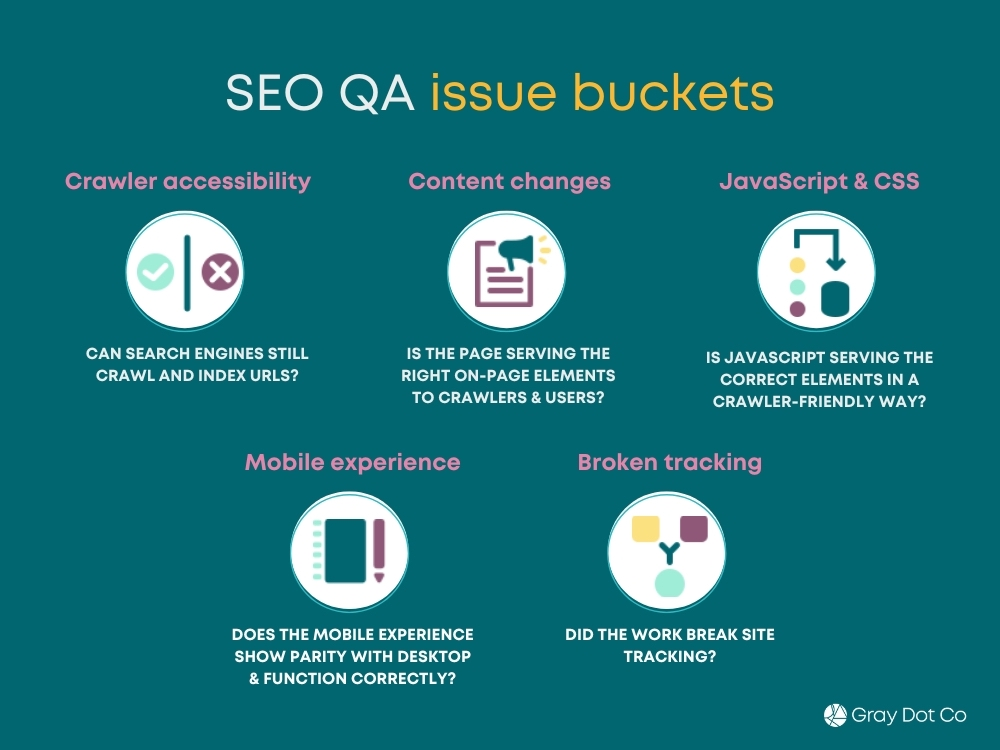
Image Source: Gray Dot Co
Sampling is a useful efficiency tool, but it is not a substitute for full review on pages that carry significant business value or risk.
6. Measure Results and Improve the Workflow
Service page optimization does not end when changes go live. Agencies should treat the period after implementation as an opportunity to learn what worked and refine the process for future pages.
Useful signals to monitor include impressions, clicks, relevant query visibility, organic conversions, and indexing status. Tools such as Google Search Console and standard analytics platforms are well suited to tracking these signals over time.
When reviewing results, agencies should compare performance against the page's baseline and account for outside factors such as seasonality, shifting search demand, competitive changes, and other updates happening on the site at the same time. Attributing every change in performance solely to on-page edits overlooks these other variables and can lead to incorrect conclusions about what actually worked.
A straightforward ongoing process looks like this:
- Record baseline performance before making changes.
- Implement the approved changes.
- Verify that the changes are live and functioning as intended.
- Monitor the relevant performance signals over a reasonable period.
- Identify recurring patterns across multiple pages or clients.
- Refine the workflow and prioritization process based on what the data shows.
It is also worth distinguishing between monitoring individual page performance and evaluating the efficiency of the agency's fulfillment process itself. Repeated metadata errors across multiple pages likely point to an SOP or implementation issue that needs fixing.
A broader shift in organic performance might call for a wider review involving technical SEO, content strategy, or competitive factors beyond any single page. No single optimization process guarantees a specific ranking or traffic outcome, and agencies should set client expectations accordingly.
7. Scale Fulfillment Without Overloading the Agency Team
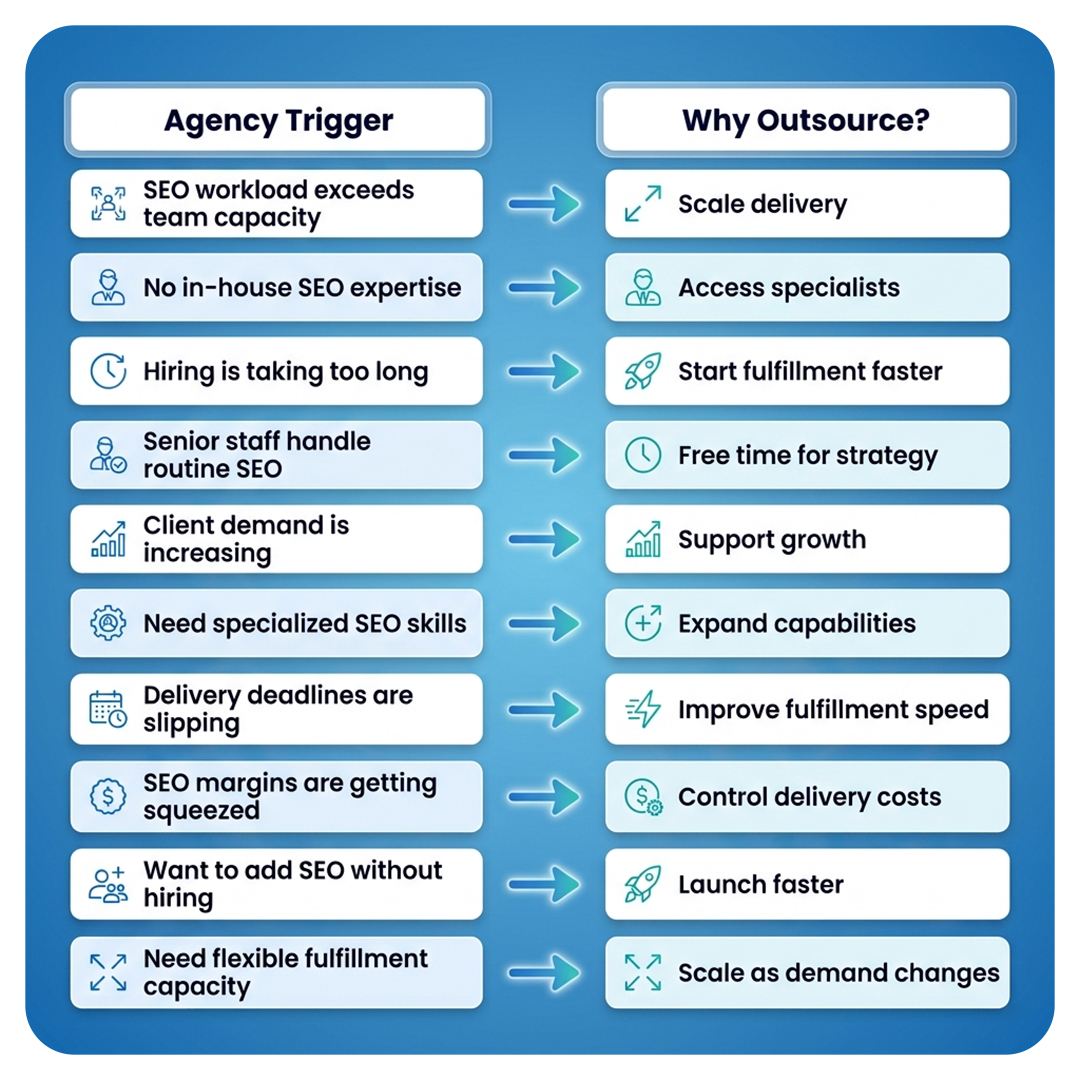
As agencies take on more clients, the workload across research, page inventory management, content optimization, implementation, QA, and performance monitoring grows. Teams that once managed this work comfortably can quickly become stretched across competing priorities and deadlines.
White label SEO services can help agencies add execution capacity without expanding internal headcount. DashClicks supports fulfillment while agencies retain ownership of client relationships and strategic direction.
A white label SEO company can support documented workflows, on-page optimization, technical SEO, quality checks, and ongoing monitoring and reporting. A partner extends the agency's team rather than replacing its role. The agency still sets priorities, defines client goals, approves recommendations, and manages relationships.
Outsourcing does not guarantee rankings or quality, nor does it replace strategic judgment. It can, however, help agencies apply a consistent optimization process across more pages. Prioritization, standardized workflows, content differentiation, and QA remain the foundation, while added fulfillment capacity helps teams maintain those standards as client volume grows.
Conclusion
Scaling service page optimization starts with one principle: standardize execution, not the content itself. Copying templates across pages may save time initially, but repetitive content can weaken relevance and search performance.
Prioritization helps teams focus on the pages that need attention most, while page-level differentiation ensures each URL serves a distinct search intent. Automation can organize repetitive tasks, but human review remains essential for checking intent, accuracy, and content quality.
QA should be part of the workflow before publication, and performance monitoring should guide ongoing improvements without attributing every change to on-page edits. As client portfolios grow, white label SEO fulfillment can add execution capacity while agencies retain control of strategy and client relationships.
Sustainable scaling combines repeatable processes with page-specific judgment. With the right systems in place, agencies can optimize more service pages without sacrificing their usefulness, accuracy, or relevance.