

Managing Facebook Ads for a handful of clients may be straightforward, but handling dozens of accounts requires a more structured approach. Agencies need consistent, evidence-based decisions rather than reactive adjustments whenever performance changes or clients raise concerns.
Facebook Ads management is an ongoing process, not a matter of launching campaigns and checking results weeks later. Performance can fluctuate due to seasonality, audience saturation, tracking issues, or landing page problems. Treating every dip as an emergency or every successful week as an opportunity to scale can lead to costly mistakes.
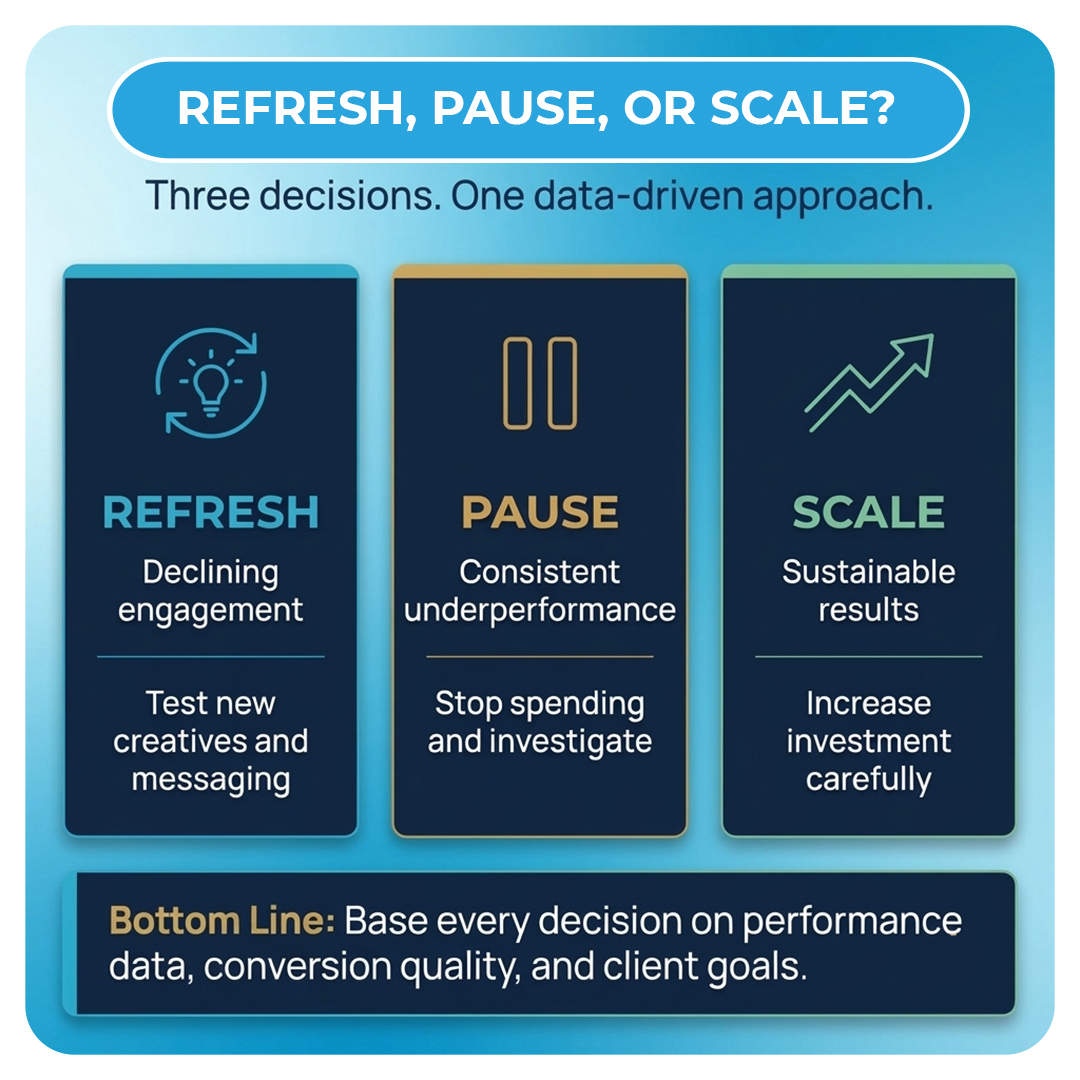
Agencies regularly face three critical decisions:
- Refresh: When should an ad's creative or messaging be updated because it is losing effectiveness?
- Pause: When should spending stop on an ad that consistently fails to meet performance expectations?
- Scale: When should investment increase in a campaign delivering sustainable results?
Each decision carries financial implications. Refreshing too early can disrupt a campaign that is still performing well. Continuing to fund underperforming ads wastes client budgets, while scaling prematurely can increase acquisition costs. Similarly, pausing a campaign after one poor day may mean abandoning an opportunity that needed more time to deliver results.
The key is to make Facebook Ads decisions using performance data, client-specific goals, and business conditions rather than short-term fluctuations or client pressure. A consistent decision-making framework helps agencies manage multiple accounts efficiently, protect advertising budgets, and improve campaign outcomes regardless of who handles the account.
Establish Performance Benchmarks Before Making Changes
An ad can't be evaluated fairly without knowing what success actually looks like for that specific client. A $40 cost per lead might be excellent for one business and unacceptable for another. Before deciding whether to refresh, pause, or scale anything, agencies need a reliable baseline.
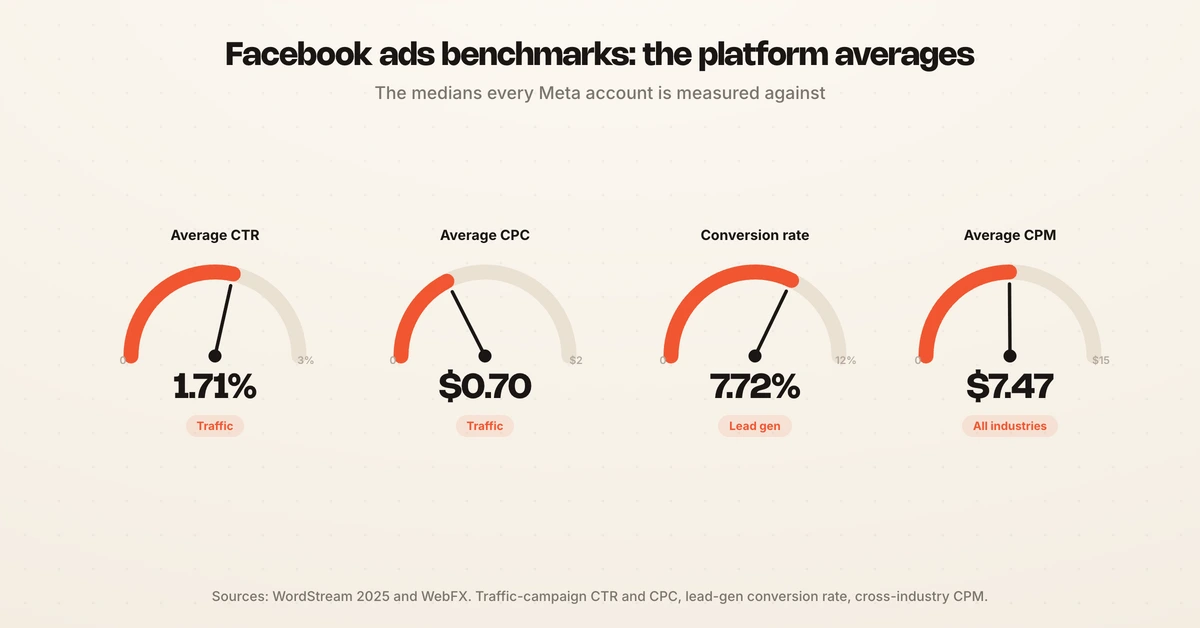
Image Source: Hawky AI
1. Define Client-Specific Goals
Performance expectations should reflect the client's business model and campaign objective, not a generic industry number.
- Target CPA: Establish the acceptable cost of acquiring a customer or conversion based on the client's margins and lifetime value.
- ROAS: Define the expected return on advertising spend for campaigns with reliable revenue tracking.
- CPL: Establish the acceptable cost per lead for lead-generation campaigns, factoring in sales close rates.
- Conversion Volume: Determine how many conversions are needed before performance data is reliable enough to act on.
These targets should come from client economics, historical performance, and business objectives, not an arbitrary industry average pulled from a blog post.
2. Evaluate Performance Over Time
Agencies should compare results across meaningful periods rather than reacting to daily swings. A single poor day doesn't mean an ad is failing. Look instead at:
- Performance trends across weeks, not days.
- Changes in conversion volume over time.
- Movement in acquisition costs across comparable periods.
- Differences between recent performance and historical benchmarks.
- Whether enough data actually exists to support a confident decision.
3. Consider the Full Conversion Journey
CTR and CPC tell part of the story, but platform engagement isn't the same as a meaningful business outcome. Agencies should examine:
- Click-through rate.
- Cost per click.
- Landing-page engagement.
- Conversion rate.
- Lead volume.
- Lead quality.
- Qualified opportunities.
- Actual customer acquisition.
4. Account for Campaign Conditions
Performance changes should always be read in context. Consider:
- Seasonality and shifts in customer demand.
- Audience changes or potential saturation.
- Recent budget adjustments.
- Creative or campaign edits made in the prior week.
- Attribution delays that distort real-time reporting.
- Changes to offers or landing pages.
According to WordStream's 2026 Facebook Ads Benchmarks, which analyzed more than 1,800 campaigns, the average CTR for Facebook lead campaigns is 2.70%, the average conversion rate is 8.54%, and the average cost per lead is $27.39.
These figures are useful industry reference points, not universal performance targets. Actual results vary widely by industry, campaign objective, audience, offer, budget, and conversion conditions, so agencies shouldn't treat every client's campaign as underperforming simply because it falls short of these averages.
When Should Agencies Refresh a Facebook Ad?
Refreshing an ad should be a deliberate response to performance evidence, not a routine change made just because the ad has been live for a set number of days.
- Declining Engagement: Falling CTR, reduced engagement, and weakening audience response can signal that a creative is losing its pull. Evaluate declining engagement alongside conversion performance rather than treating it as automatic proof of fatigue.
- Rising Frequency: Frequency measures how often the same person sees the ad. Repeated exposure can contribute to fatigue, but it should be assessed alongside CTR trends, engagement patterns, conversion performance, audience size, and campaign duration, not judged against a single universal threshold.
- Increasing Costs: Rising CPC or CPA can indicate weakening ad performance, but costs can also climb due to competition, audience conditions, or budget changes. Investigate the underlying cause before assuming the creative is the problem.
- Creative Relevance: Evaluate whether the message, offer, visuals, and format still resonate with the intended audience, whether the offer remains relevant, and whether the opening hook still captures attention in the first few seconds.
What Agencies Can Refresh?
- Visuals, videos, and ad formats: Introduce new images, video concepts, or formats to present the offer differently.
- Opening hooks and primary ad copy: Test alternative openings and angles that communicate the value proposition more clearly.
- Headlines and calls to action: Experiment with clearer headlines and CTAs aligned to the intended conversion action.
- Offers and messaging angles: Test different presentations of the client's offer while staying consistent with the approved strategy.
- Creative variations: Develop additional variations to compare audience response and identify what's working.
Controlled Creative Testing
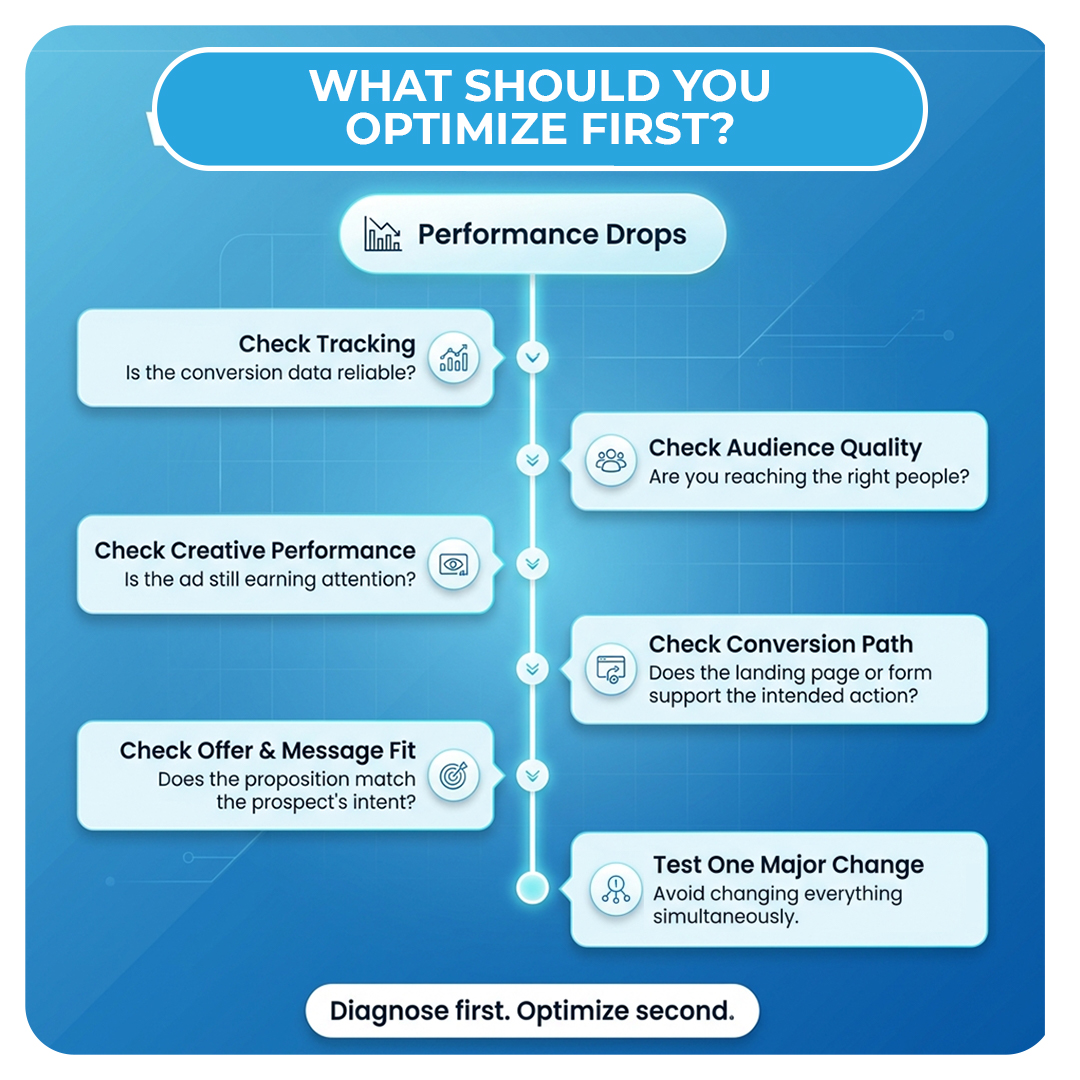
Change one major variable at a time where practical. Adjusting the visual, headline, offer, and audience simultaneously makes it nearly impossible to know what actually moved the needle.
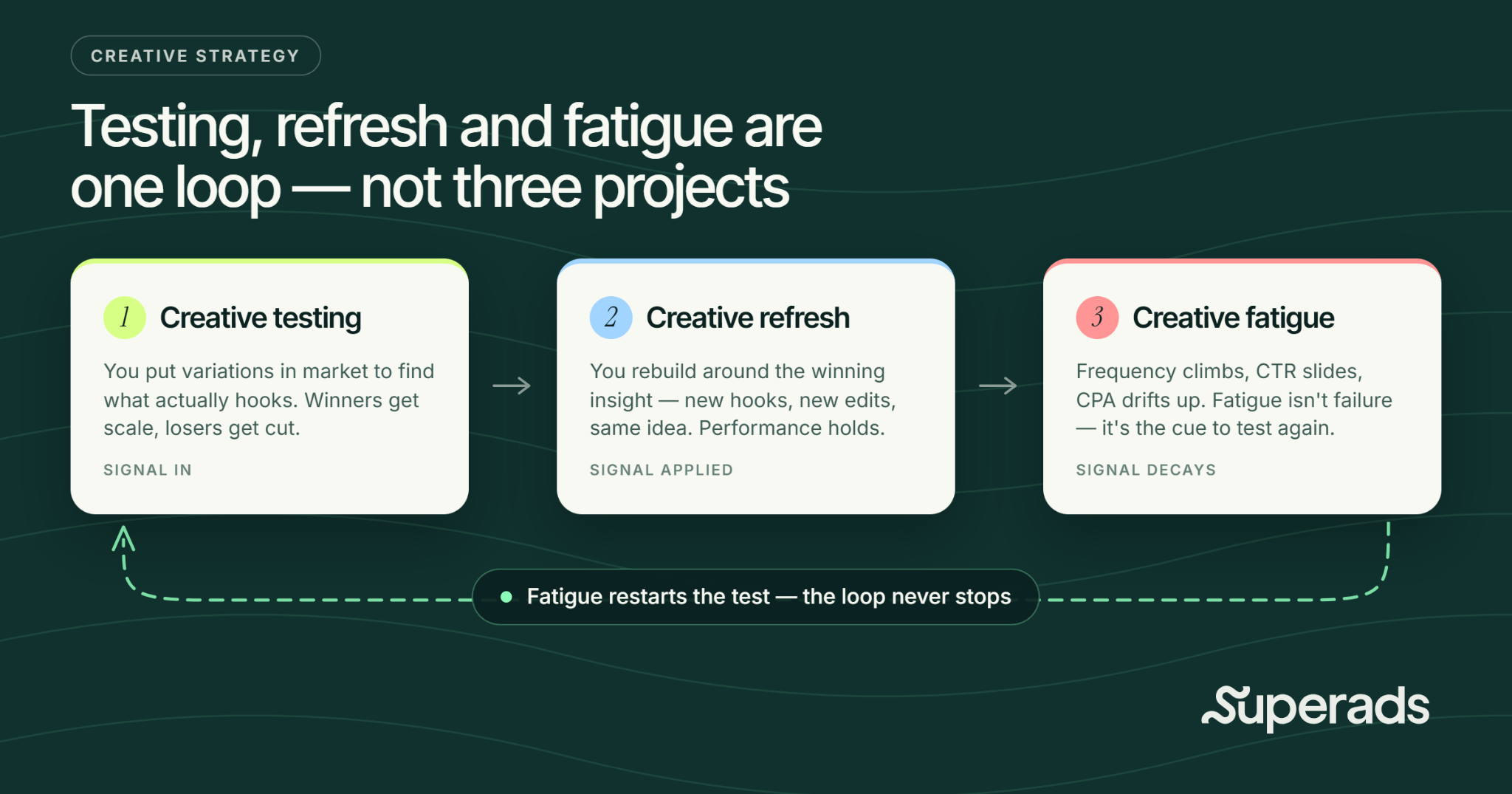
Image Source: Superads
When Should Agencies Pause a Facebook Ad?
Pausing should be based on consistent underperformance, reliable measurement, and client-specific expectations, never a single disappointing day.
1. Consistent Underperformance
Identify ads that repeatedly miss client-specific CPA, ROAS, or conversion objectives, with sufficient data to support the conclusion. Examine performance trends, acquisition costs, conversion volume, available budget, and historical results. Avoid relying on an arbitrary number of days or clicks as a universal rule.
2. Budget Spent Without Meaningful Results
Weigh spending against expected conversion volume and the client's acceptable acquisition cost. Continued spending rarely makes sense when an ad consumes a meaningful share of the budget without generating useful outcomes.
3. Poor Lead Quality
A low CPL isn't automatically a win. Watch for leads that don't meet the client's qualification criteria, prospects outside the service area, low purchase intent, or a sales team that can't convert the volume being generated.
4. Offer or Landing Page Problems
Weak conversion performance isn't always the ad's fault. Check for an unclear offer, a confusing landing page, a broken form, slow load times, or a mismatch between the ad's promise and the landing page's content.
5. Audience Saturation or Relevance Issues
Review whether the current audience is still appropriate and whether repeated exposure is weakening response among the people most likely to convert.
6. When to Pause an Ad, Ad Set, or Entire Campaign
- Pause a single ad when one creative variation underperforms while others in the set remain effective.
- Pause an ad set when an audience is consistently producing poor results.
- Pause the entire campaign only when broader, campaign-level problems justify it, to avoid disrupting other elements that are still performing.
7. Avoid Reacting to One Poor Day
Isolated daily fluctuations are rarely sufficient evidence. Confirm there's enough data and accurate measurement before acting.
8. Troubleshoot Before Pausing
Check conversion tracking, landing-page functionality, conversion events, form submissions, technical errors, and attribution before concluding an ad is genuinely underperforming. A campaign that looks unsuccessful might just have a broken measurement setup.
When Should Agencies Scale a Facebook Ad?
Scaling isn't simply raising the budget on an ad that did well yesterday. Agencies need to confirm the campaign can support additional spending while maintaining acceptable outcomes.
- Consistent Performance: Look for repeated results against client-specific CPA, ROAS, CPL, and conversion goals, backed by reliable tracking and measured over meaningful periods.
- Sufficient Conversion Data: A campaign with very few conversions may not provide enough evidence to predict how it will respond to additional spending. There's no universal minimum conversion count, but agencies should be honest about whether the data supports confidence.
- Lead and Customer Quality: More conversions mean little if quality declines. Track lead qualification, sales opportunities, customer acquisition, and downstream conversion rates. The goal is sustainable growth, not inflated lead volume.
- Budget and Business Capacity: Consider whether the client can handle additional leads, whether the sales team can respond quickly, whether inventory or service capacity exists, and whether the client's budget can support higher spending. A campaign shouldn't scale beyond what the client can actually fulfill.
- Gradual Budget Adjustments: Evaluate current stability, increase investment in controlled steps, and monitor CPA, ROAS, and conversion volume after each change. Watch for unexpected delivery changes before adjusting further.
- Creative and Audience Expansion: Growth doesn't have to mean a bigger budget alone. Agencies can test additional creative variations, explore relevant audience opportunities, evaluate new placements, and develop new messaging angles while staying aligned with the client's target market.
Meta Learning-Phase Guidance
Meta's published guidance has commonly referenced approximately 50 optimization events within seven days as a benchmark for an ad set to exit the learning phase. This is platform guidance, not a guarantee of campaign performance, and it isn't a universal requirement for every campaign to scale successfully.
Agencies should weigh the optimization event, campaign structure, conversion volume, and available data, and remember that significant edits can reset or affect delivery, so campaign behavior should be monitored closely after any meaningful change.
Common Mistakes Agencies Should Avoid When Managing Facebook Ads
- Reacting to Short-Term Fluctuations: Major changes based on one poor day or a temporary variation tend to backfire. Evaluate meaningful trends with sufficient data before acting.
- Using Generic Benchmarks: Applying industry averages without considering individual client economics leads to the wrong conclusions. Treat figures like WordStream's benchmarks as reference points, not mandatory targets.
- Refreshing Too Many Variables: Changing creative, audience, offer, and budget all at once makes it impossible to know what influenced the result. Favor controlled testing wherever practical.
- Scaling Based on Vanity Metrics: Clicks, impressions, and engagement alone don't justify more spend. Tie scaling decisions to conversion quality, acquisition costs, and business outcomes.
- Ignoring Lead Quality: A low CPL can be misleading when leads are unqualified or unlikely to convert. Downstream performance matters more than the price of the lead itself.
- Making Unnecessary Campaign Changes: Unnecessary edits disrupt stable campaigns and make performance harder to interpret. Change campaigns when there's a clear, performance-based reason to do so.
Good campaign management is not about making the most changes. It is about making the right changes at the right time.
Build a Repeatable Facebook Ads Decision-Making Process
A documented process reduces reactive management and helps teams deliver consistent recommendations across every client account.
Step 1: Review Performance
Compare current results against established client-specific benchmarks, including CPA and CPL, ROAS where applicable, CTR and CPC, conversion volume, lead or customer quality, and trends over meaningful periods.
Step 2: Identify the Underlying Issue
Diagnose the cause before choosing an action. Possible culprits include creative fatigue, declining audience response, poor traffic relevance, conversion tracking problems, landing-page issues, weak lead quality, or budget constraints.
Step 3: Choose the Appropriate Action
- Refresh: Test new creatives, hooks, copy, formats, or messaging when audience response is weakening.
- Pause: Stop spending on consistently underperforming ads once sufficient evidence supports it, and troubleshooting has ruled out other issues.
- Scale: Increase investment carefully when performance is consistent, conversion quality is acceptable, and the client can handle additional demand.
Sometimes the right call is simply to keep monitoring, because the available data doesn't yet justify a major change.
Step 4: Document the Decision
Record the performance issue identified, the supporting data, the recommended action, the reasoning behind it, the expected outcome, and the metrics to review next.
Step 5: Monitor After Implementation
Reassess after any adjustment. Did the intended improvement happen? Did acquisition costs shift? Did conversion quality hold steady? Did delivery change? Is another adjustment justified? Optimization is ongoing, not a series of disconnected changes.
Manage Campaign Execution with White Label Facebook Ads Services
Knowing when to refresh, pause, or scale is only part of the job. Agencies also need the capacity to implement those decisions, monitor the results, and keep execution consistent across every account.
1. The Agency Capacity Challenge
As client rosters grow, so does the workload: creative updates, ad copy adjustments, campaign monitoring, budget management, audience testing, performance analysis, ongoing optimization, and client reporting. When internal teams are stretched across too many accounts, these recurring tasks become harder to manage consistently, and decisions start slipping toward reactive guesswork instead of the framework outlined above.
2. Extend Execution Capacity
This is where white label Facebook Ads fulfillment becomes a practical option. Facebook ads outsourcing gives agencies access to additional execution capacity without hiring a specialist for every function in-house. It isn't a fix for every operational problem, but it does free up internal bandwidth to focus on strategy and client relationships rather than day-to-day execution.
3. Maintain Consistent Campaign Management
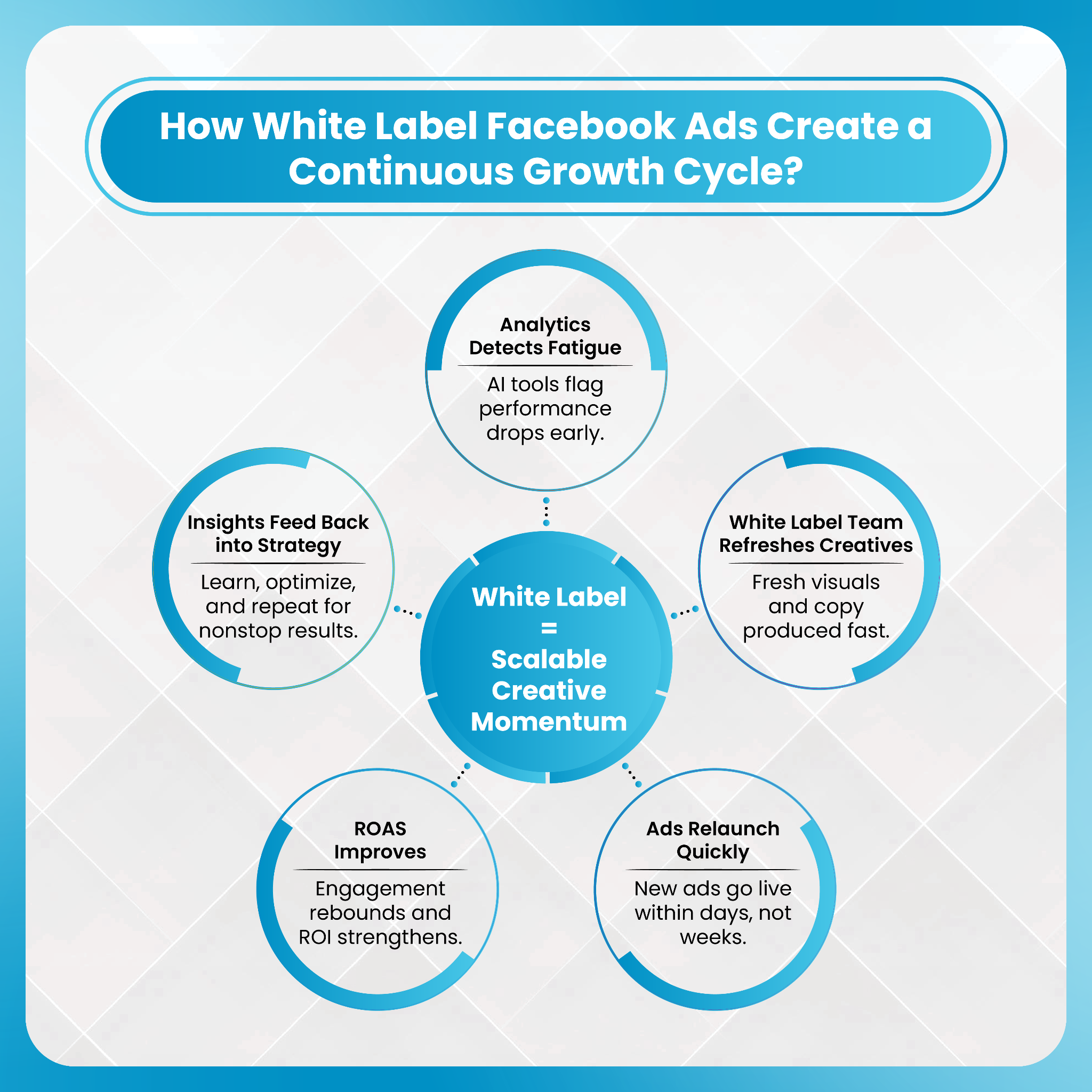
A reliable white label Facebook Advertising agency partner helps implement creative and campaign adjustments across multiple accounts through documented processes, clear task ownership, defined approval responsibilities, consistent quality checks, and ongoing performance monitoring.
3. Retain Strategic Control
Working with a white label Facebook Ad partner doesn't mean handing over the business. The agency retains the client relationships, the business context, the campaign strategy, the client communication, and the final say on every recommendation. Fulfillment support assists with execution; the agency stays responsible for oversight and outcomes.
DashClicks' White Label Facebook Ads Services are built as a fulfillment solution for agencies managing growing campaign workloads who still need consistent, dependable service delivery under their own brand.
Conclusion
Refreshing, pausing, and scaling Facebook Ads should always come back to campaign evidence, client objectives, and business conditions, not a gut reaction to a bad Tuesday.
- Establish client-specific performance benchmarks before making campaign changes.
- Refresh ads when creative performance or audience response shows real signs of weakening.
- Pause consistently underperforming ads only after reviewing sufficient data and ruling out tracking or landing-page problems.
- Scale campaigns when performance is sustainable, conversion quality is acceptable, and the client has the capacity to handle additional demand.
- Avoid reactive decisions based on isolated daily fluctuations or vanity metrics.
- Use a repeatable decision-making framework to improve oversight across every account.
- Consider white label fulfillment when growing workloads make consistent execution difficult to maintain internally.
Effective white label Facebook Ads isn't about constantly changing campaigns. It's about knowing when to act, when to wait, and when there's enough evidence to invest more. As workloads grow, that discipline becomes easier to maintain with the right execution support in place.