

.svg)

.svg)
.svg)
.svg)
.svg)
.svg)
Rankings went up. Organic traffic increased. More pages got indexed. The client still asks: "But are we getting more leads?"
This disconnect is more common than most agencies would like to admit. SEO professionals track what they can measure. Clients measure what affects their business. Those two perspectives do not always point at the same thing.
According to BrightEdge's Channel Share research, organic search accounted for 53.3% of trackable website traffic across the sites studied. That makes organic search a significant acquisition channel worth investing in. But traffic volume alone does not tell a client whether SEO is actually helping them grow.
The challenge becomes harder when an agency is managing several SEO accounts at once. Each client has different priorities. A local service business wants more calls from a specific area. A SaaS company wants demo requests. An ecommerce brand wants category revenue. One reporting template rarely serves all of them well.
This is where white label SEO fulfillment becomes relevant, not just as a way to handle more work, but as a way to scale execution while keeping strategy focused on what each client is actually trying to achieve.
The core argument here is straightforward: the agency should first define what success looks like for the client, then use SEO fulfillment to execute the work that moves toward that outcome.
Why Agencies Need to Connect SEO to Business Goals?
SEO becomes more valuable when individual activities are tied to actual client priorities. Without that connection, agencies can deliver technically sound work without meaningfully supporting the client's business goals.
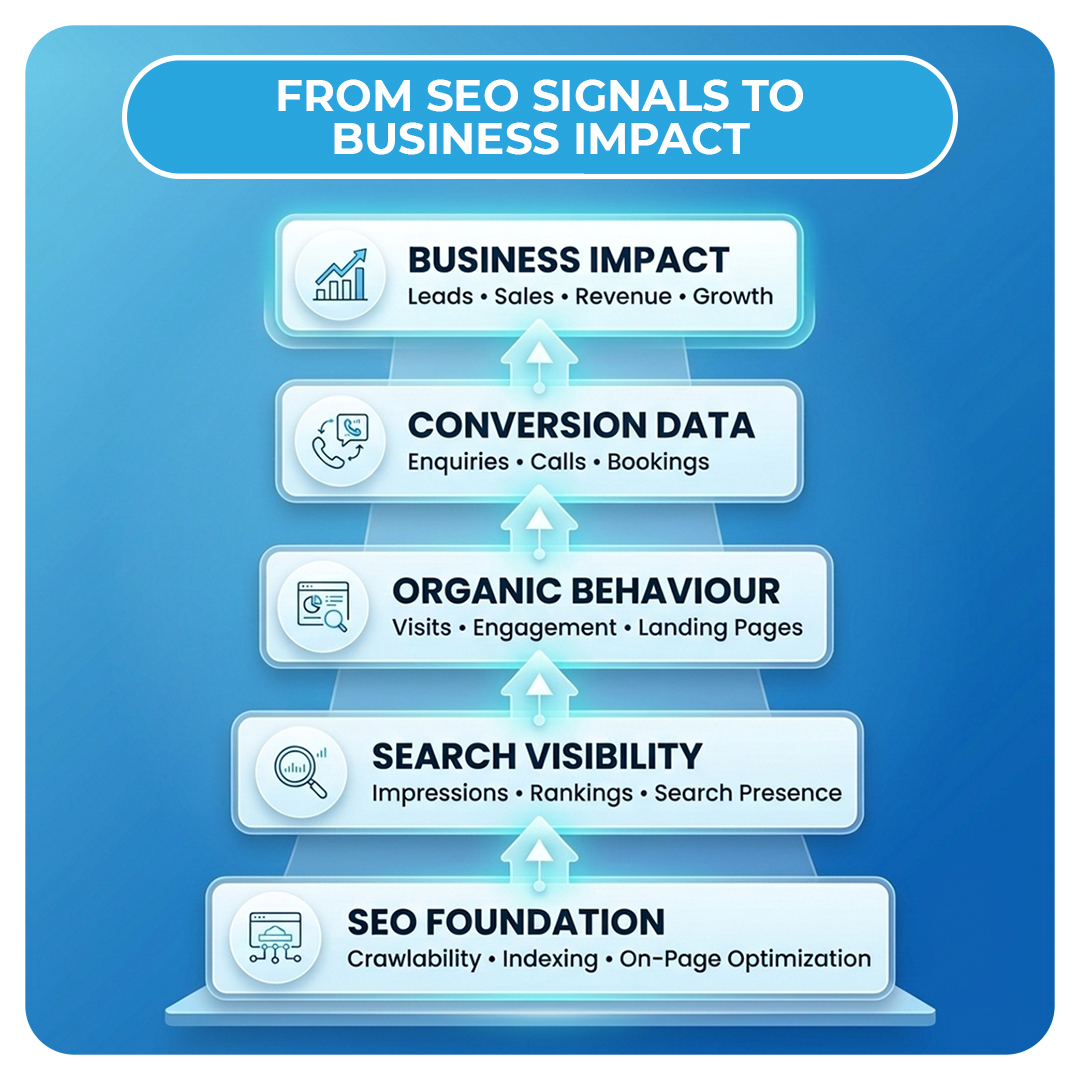
1. SEO Activity Does Not Automatically Equal Business Growth
Publishing content, fixing crawl errors, improving page speed, building links, and optimizing title tag are useful SEO activities, but they are not business outcomes.
Agencies should be able to answer a simple question for every task: why are we doing this, and how does it support the client's current objective? A technical fix, for example, becomes more meaningful when it removes an indexing barrier or improves a page that supports conversions.
SEO tasks are not inherently strategic. Strategy comes from understanding the client's goals and deciding where effort should be focused.
2. Clients Evaluate SEO Differently Than SEO Professionals
SEO professionals may focus on improving rankings, crawlability, and organic clicks. Clients are more likely to ask:
- Are we getting more enquiries from the right people?
- Is our priority service attracting more customers?
- Are people in the locations we care about finding us?
- Is SEO contributing to actual business?
Neither perspective is wrong. Agencies need to bridge the gap by translating SEO performance into outcomes that matter to the client.
3. White Label Fulfillment Makes Strategic Alignment More Important
When SEO execution is handed to a fulfillment team, the agency's strategic role becomes even more important. A white label partner cannot simply be told to "do SEO." They need clear context.
Effective white label SEO outsourcing depends on communicating:
- What the client wants to achieve
- Which services or products matter most
- Which locations the client wants to grow
- Who the target customer is
- What the campaign's current priorities are
White label SEO should scale execution, not replace the agency's strategic responsibility.
Start With What the Client Wants to Achieve
Before keyword research or site audits, agencies need to understand what the client actually wants to grow. Clear business priorities should guide every SEO decision that follows.
1. Identify the Primary Business Objective
SEO campaigns can support different business goals, including:
- Lead Generation: Attracting qualified enquiries
- Local Customer Acquisition: Reaching customers in specific areas
- Service-line Growth: Increasing visibility for a priority offering
- Ecommerce Growth: Supporting organic transactions across key categories
- Market Expansion: Building visibility in new regions or cities
- Brand Discovery: Reaching audiences unfamiliar with the business
Identifying the primary objective helps agencies decide where SEO resources should be focused. A local acquisition campaign, for example, requires a different approach from one supporting ecommerce growth.
2. Identify the Offers That Matter Most
Not every page, service, or product deserves equal SEO attention. Agencies should identify which offerings are most important based on:
- Margin: Which offerings generate the most value?
- Demand: Where is genuine search demand?
- Growth Potential: Which offerings does the client want to scale?
- Strategic Importance: Which areas matter to the long-term business plan?
This keeps campaigns focused instead of spreading effort across every offering.
3. Understand Who the Client Wants to Attract
Search volume alone does not determine whether a keyword is valuable. Agencies also need to understand the audience behind the search.
Key considerations include:
- Search Intent: What is the user actually looking for?
- Customer Type: Who is the client trying to reach?
- Location: Where does the target audience need to be?
- Commercial Value: Which visitors are most likely to become customers?
- Problems Being Solved: What need or problem is driving the search?
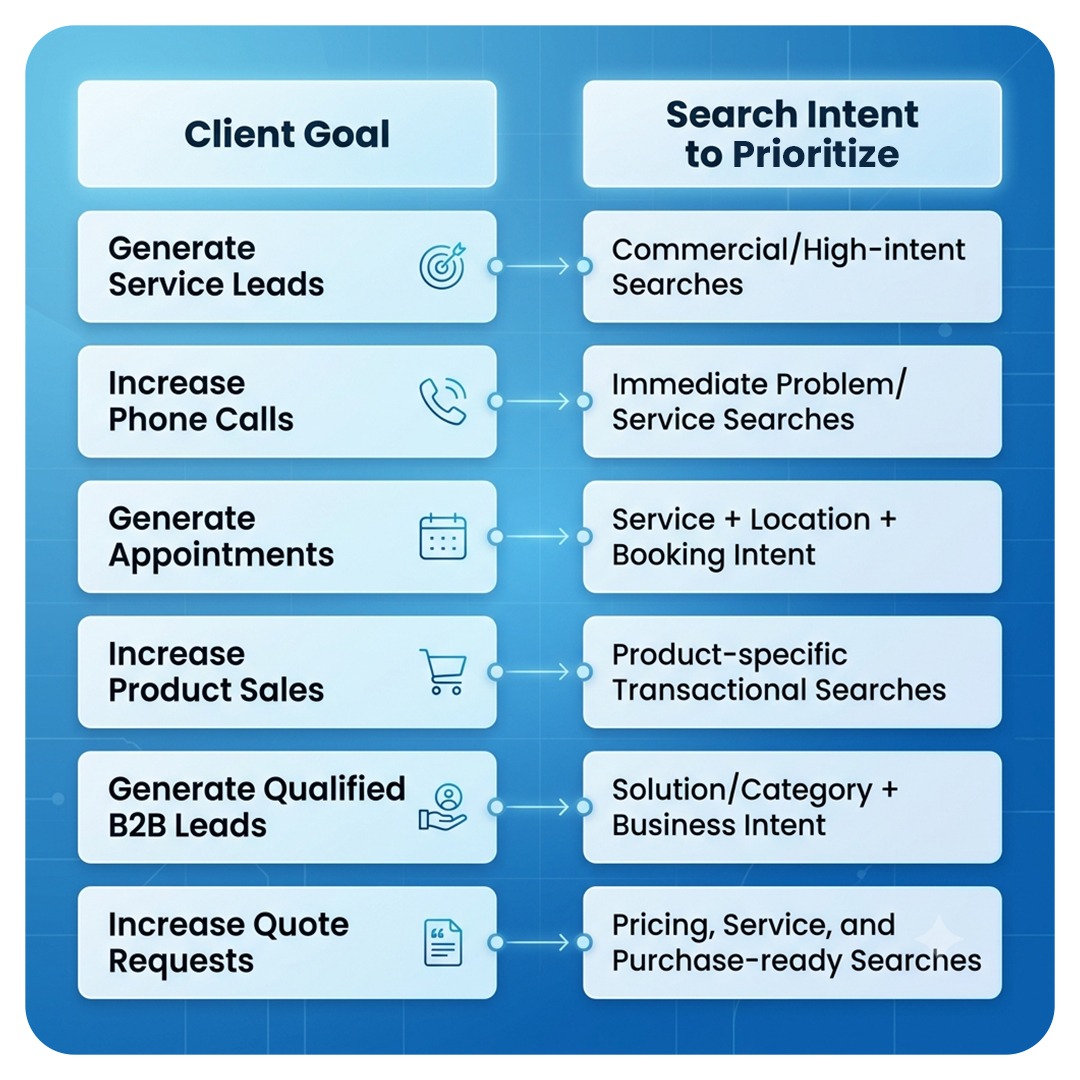
This helps agencies prioritise search opportunities that align with the client's audience rather than simply chasing volume.
4. Translate Business Priorities Into an SEO Brief
Once the client's goals are clear, agencies should turn them into a brief that a fulfillment team can act on. A useful framework is:
Business goal → Priority offer → Target audience → Search opportunity → SEO action → Desired outcome
For example, if the goal is to generate more leads for a premium service in a specific city, the agency can define the priority offer, target audience, relevant local search opportunities, and appropriate SEO actions such as service-page optimization and location-focused content.
This framework makes briefing a white label SEO firm more effective because the fulfillment team understands not just what needs to be done, but why it matters.
Turn Business Goals Into SEO Priorities
Different business objectives require different SEO priorities. Identifying the activities most closely connected to the client's current goal helps agencies and fulfillment teams focus their efforts where they matter most.
1. Goal: Generate More Qualified Leads
For lead generation, SEO should focus on attracting visitors with commercial intent and guiding them toward action:
- High-Intent Keyword Targeting: Prioritise searches that indicate someone is looking for a solution.
- Service-page Optimization: Strengthen pages representing the client's core offerings.
- Conversion-Focused Landing Pages: Give organic visitors clear information and relevant calls to action.
- Internal Linking: Guide users and authority toward priority commercial pages.
- Supporting Informational Content: Address related searches while creating pathways to service pages.
The goal is not simply more organic traffic, but more relevant visitors who have a genuine reason to contact the client.
2. Goal: Grow a Specific Service or Product
When one offering is a growth priority, SEO resources should concentrate around it:
- Build topical coverage around the service or product.
- Strengthen the primary commercial page.
- Create supporting content for different search intents.
- Use internal links to build authority toward the priority page.
This keeps fulfillment focused instead of spreading effort across loosely related topics.
3. Goal: Expand into New Locations
Location expansion requires more than adding city names to existing pages. Key priorities include:
- Location-Specific Landing Pages: Create pages for services genuinely offered in each target area.
- Local Keyword Targeting: Focus on how people in each market search for those offerings.
- Google Business Profile Optimization: Keep profiles accurate, active, and relevant.
- Location-relevant Content: Address local context rather than publishing generic location pages.
- Local Authority Considerations: Build credibility signals relevant to each target market.
The focus should be on markets the client genuinely intends to serve, not creating geographic coverage for its own sake.
4. Goal: Increase Ecommerce Revenue
Ecommerce SEO should connect closely to the products and categories that matter most:
- Category and Product-Page Optimization: Improve relevance and clarity for search engines and users.
- Commercial Search Intent: Prioritise queries associated with purchase consideration.
- Content Architecture: Organise related products, categories, and content for better discoverability.
- Internal Linking: Create clear pathways between products, categories, and supporting content.
- Technical SEO: Address barriers that affect the crawling and indexing of important pages.
Across all these goals, the key question is not which SEO tasks can we complete this month? It is which SEO activities have the strongest connection to the client's current growth priority.
Yes, this can be tightened while keeping the four H3s, responsibility split, briefing context, SOP point, and strategic ownership intact.
Use White Label SEO to Execute the Strategy
White label SEO fulfillment gives agencies additional execution capacity, helping them deliver SEO work at scale while keeping each client's business priorities in focus.
1. Separate Strategy Ownership From Fulfillment Execution
Responsibilities between the agency and fulfillment partner should be clear from the start.
Agency Responsibilities Include:
- Owning the client relationship
- Understanding business objectives
- Setting campaign priorities
- Approving strategic direction
- Communicating performance and progress
White Label Fulfillment Partner Responsibilities Include:
- Keyword research
- On-page optimization
- Technical SEO
- Content execution
- Link-building activities, where applicable
- Ongoing campaign maintenance and optimization
- Performance monitoring and reporting
This division allows the agency to retain strategic control while using fulfillment capacity for execution.
2. Give Fulfillment Teams the Context They Need
The quality of white label SEO work depends on the quality of the brief. Generic instructions can lead to work that is disconnected from the client's needs.
Agencies should provide:
- Primary Business Goal: What the client is currently trying to achieve
- Priority Areas: Which services, products, or locations matter most
- Target Customer: Who the campaign needs to reach
- Competitors: Relevant businesses to consider
- Seasonal Factors: Timing or demand patterns that affect priorities
- Conversion Goals: What counts as a meaningful action for the client
This context helps fulfillment teams understand the reasoning behind the work rather than simply completing isolated tasks.
3. Standardize Execution Without Making Campaigns Identical
SOPs for keyword research, content briefs, technical audits, and reporting can improve consistency across accounts. However, standardised processes should not result in identical campaigns.
The process should determine how work gets delivered, while each client's goals determine what work gets done.
4. Keep the Agency Strategically Involved
White label SEO outsourcing should reduce repetitive execution, not remove the agency from strategic decision-making.
The agency should continue to interpret performance, adjust campaign priorities, make strategic decisions, and communicate results in terms the client understands. The fulfillment partner handles implementation, while the agency retains ownership of strategy.
Choose SEO Performance Indicators That Match the Goal
Measurement should reflect what the client is trying to achieve. Using the same SEO metrics for every campaign can make reporting less useful and obscure whether performance is moving in the right direction.
1. Match Indicators to the Client's Objective
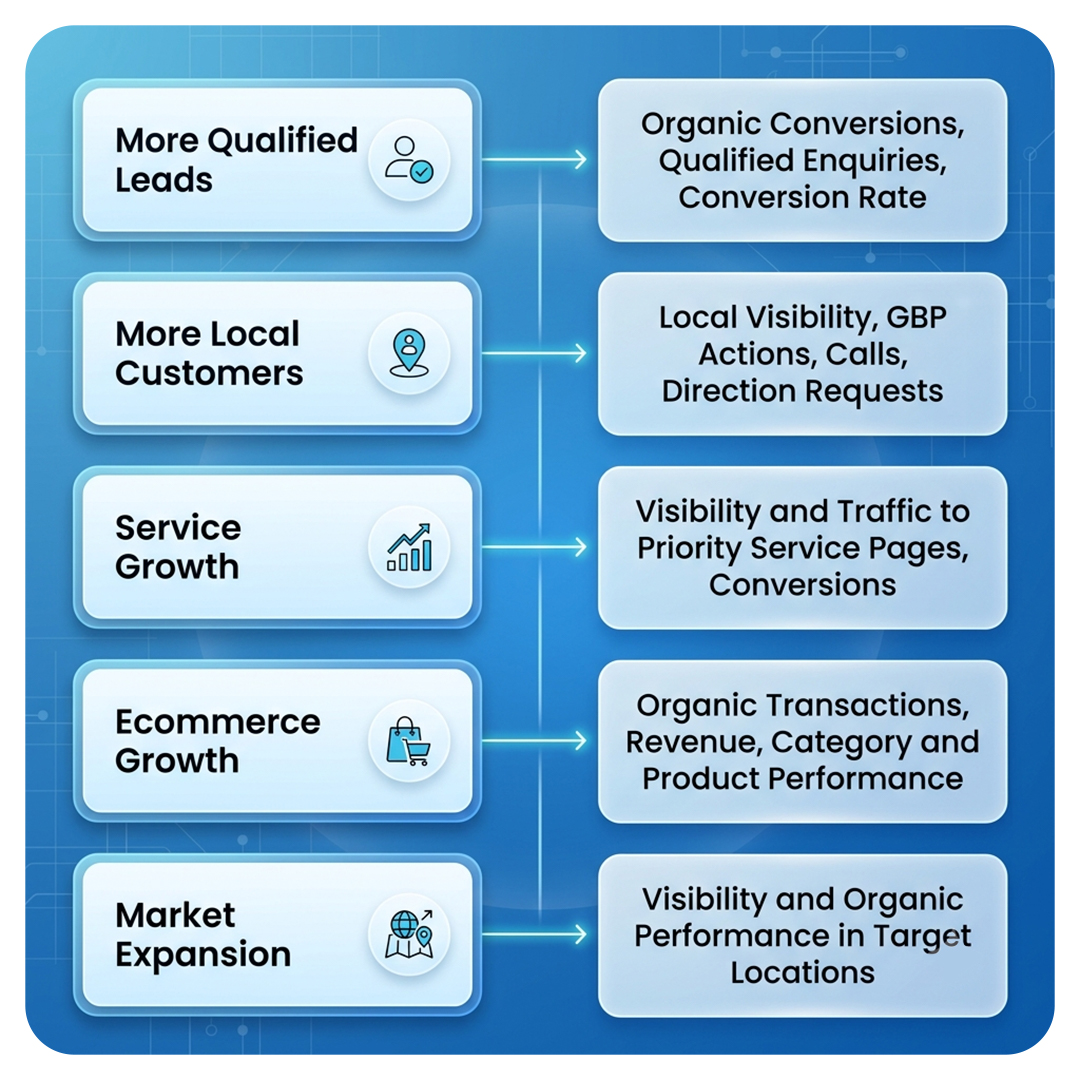
Different objectives require different measures. GBP actions are unlikely to be useful as a primary metric for an ecommerce client, just as category revenue would not be the main indicator for a local service business.
2. Distinguish Leading Indicators From Business Outcomes
Leading indicators show whether SEO activity is moving in a useful direction, such as:
- Keyword Rankings: Changes in visibility for target searches
- Organic Impressions: How often pages appear in search results
- Click-through Rates: How often users click after seeing a result
- Indexed Content: Pages that search engines can discover and index
- Organic Visibility Trends: Broader changes in search presence
Business outcomes are closer to what clients ultimately care about:
- Leads and Enquiries
- Phone Calls
- Bookings and Appointments
- Sales and Transactions
- Revenue
Leading indicators can demonstrate campaign progress, but they should not be presented as equivalent to business results. More impressions, for example, do not automatically mean more customers.
3. Don't Promise Direct Causation
SEO can contribute to customer acquisition, but it does not control every stage of the customer journey. Paid media, referrals, direct search, brand activity, seasonality, and other channels can also influence results.
Google Search Console can help agencies understand how a site performs in Google Search, including impressions and clicks generated by different queries. However, organic performance data cannot establish that a specific sale or enquiry came exclusively from SEO.
Agencies should show SEO's contribution clearly and accurately without overstating its direct impact on revenue or conversions.
Connect SEO Improvements to Meaningful Business Outcomes
Clients may not have the context to interpret SEO data on their own. Reporting becomes more valuable when agencies explain why the work matters and how it relates to the client's priorities.
1. Explain Why the Work Matters
There is a difference between reporting activity and explaining its purpose.
Instead of simply stating that 15 service pages were optimized, an agency could explain that priority service pages were optimized to strengthen their relevance for high-intent searches related to the client's core offering.
The specific explanation will vary by campaign, but the principle is consistent: reported work should have a clear strategic reason behind it.
2. Follow the Path From Search to Conversion
A useful way to frame SEO's contribution is:
Search visibility → Relevant visit → Priority landing page → Conversion action → Business opportunity
SEO primarily influences the earlier stages, such as whether a site appears for relevant searches and whether visitors reach the right page. What happens afterward can depend on the landing page, offer, pricing, user experience, and other factors beyond SEO.
Making this journey clear helps clients understand where SEO fits within the broader path to a business opportunity.
3. Look Beyond Aggregate Traffic
An increase in total organic sessions is not always a meaningful improvement. Traffic to low-intent informational content may have limited value for a lead-generation business, while a smaller increase in qualified visits to a priority service page could be more relevant.
Relevance and commercial intent matter more than volume alone. Agencies should report performance with this distinction in mind.
4. Use SEO Performance to Make the Next Strategic Decision
Monthly reports should do more than document what happened. They should help determine what comes next.
Performance data can help agencies assess:
- Which services are generating organic interest
- Which pages are close to performing well for valuable searches
- Which locations show potential
- Which content produces qualified visits
- Where conversion paths may need improvement
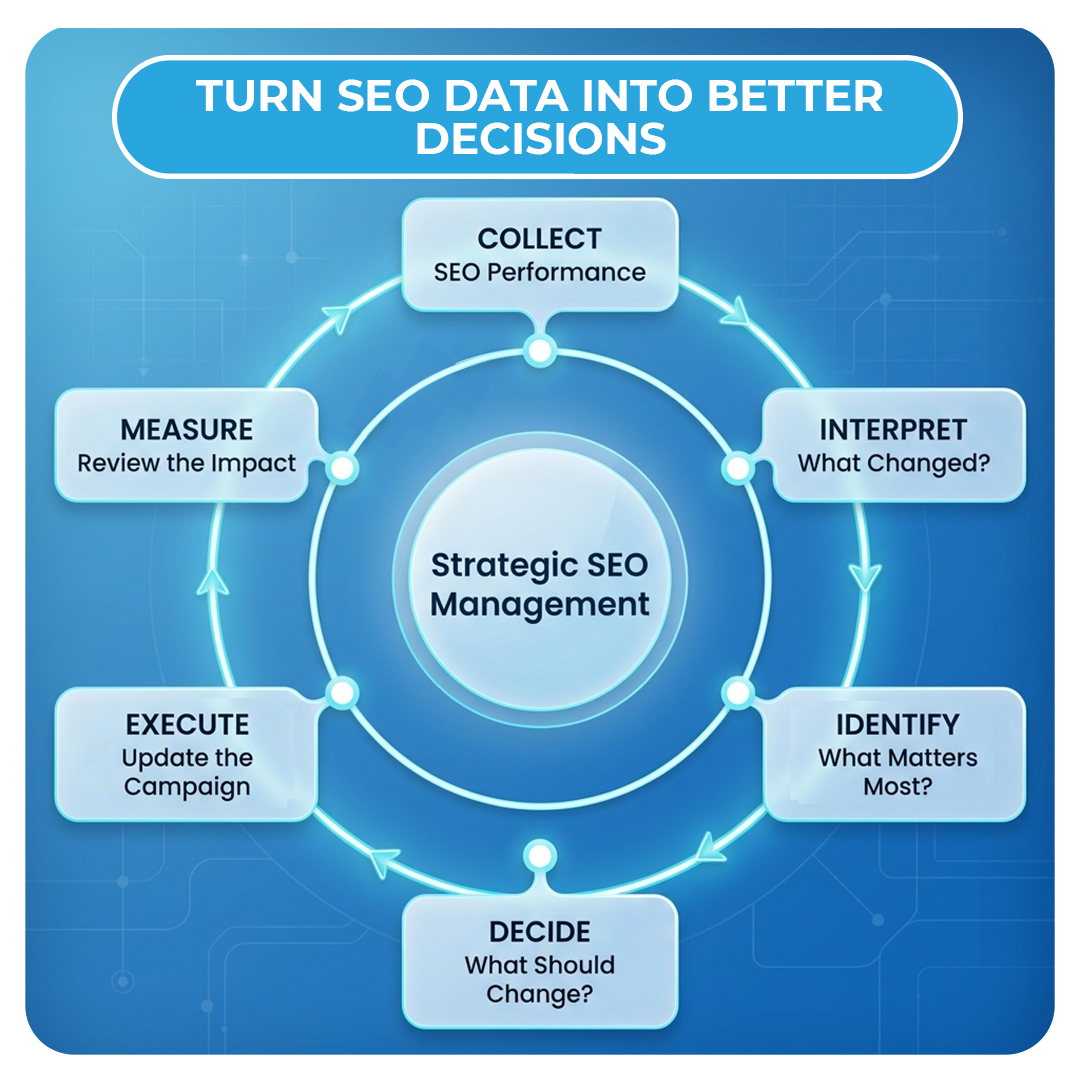
Used this way, SEO reporting becomes a strategic input rather than simply another monthly deliverable.
Adjust SEO Priorities as Client Goals Change
Business priorities change, and an SEO strategy built around earlier objectives may not remain relevant. Agencies need a process for recognising these changes and adjusting fulfillment accordingly.
1. SEO Strategy Shouldn't Remain Static
Common changes that can affect SEO priorities include:
- A client launches a new service
- A business enters a new city or region
- An ecommerce brand adds a priority product category
- A seasonal business approaches its peak period
- A secondary service becomes the main growth priority
Each change can affect where SEO resources should be directed.
2. Reprioritize Fulfillment Rather Than Simply Adding More Work
When priorities change, agencies should not automatically add tasks to an existing campaign. Fulfillment capacity is finite, and additional work can dilute attention across competing priorities.
Instead, agencies should identify which activities remain relevant and which can be reduced or paused to make room for the new objective. This becomes especially important when working with a white label SEO firm within a defined scope of work.
3. Build a Recurring Strategy-Review Process
Regular strategy reviews help agencies respond to changing priorities before campaigns become disconnected from business needs. Reviews can cover:
- Current business priorities
- Campaign performance against the objective
- Emerging search opportunities
- Conversion trends
- Upcoming client initiatives
- Relevant competitive changes
This helps prevent white label SEO from becoming a set-it-and-forget-it service where execution continues without strategic input.
DashClicks' White Label SEO Services
For agencies looking to scale SEO execution without significantly expanding their internal workload, DashClicks provides white label SEO fulfillment to support agency-led campaigns.
The fulfillment team supports core SEO execution while agencies retain ownership of the client relationship, strategic direction, and business priorities. Services include:
- Keyword research
- On-page SEO
- Technical SEO
- Content optimization
- Ongoing SEO maintenance
- White label reporting and dashboards
This model helps agencies scale execution while keeping fulfillment aligned with each client's goals, without requiring their internal teams to manage every operational task.
SEO can support business growth, but rankings, traffic, leads, and revenue are not guaranteed. Outcomes vary based on factors such as the client's market, competition, website, and overall strategy.
Conclusion
SEO performance becomes more meaningful when it is connected to what the client is actually trying to achieve. Rankings and traffic provide useful signals, but they do not tell the full story. Starting with a clear business objective helps agencies direct SEO efforts toward the areas that matter most.
The model is straightforward: the agency owns the strategy and client relationship, while white label SEO fulfillment supports execution. This allows agencies to scale delivery without losing the strategic context behind each campaign.
When agencies make SEO easier for clients to understand and easier for their teams to deliver consistently, they can build stronger long-term partnerships rather than simply maintaining recurring monthly services.




.svg)


.svg)
.svg)
.svg)
.svg)
.svg)