

.svg)

.svg)
.svg)
.svg)
.svg)
.svg)
As agencies scale, white label SEO becomes an attractive way to expand services without stretching internal resources. It allows teams to take on more clients, deliver consistent output, and focus on growth. But alongside these benefits, there’s a subtle risk that often goes unnoticed until results start slipping: strategy drift.
In the context of white label SEO, strategy drift happens when the original goals of a campaign slowly lose alignment with execution. It’s not usually caused by poor work or lack of effort. Instead, it stems from a disconnect between strategy, communication, and ownership.
Many agencies assume drift is a result of outsourcing. In reality, white label SEO doesn’t create the problem. It exposes weaknesses that already exist within strategic systems.
This challenge becomes more critical as agencies grow. The more layers you add between strategy and execution, the easier it becomes for direction to shift without anyone noticing.
A recent study highlights the scale of this issue. According to HubSpot (2024), 68% of marketers say aligning marketing activities with business goals is their biggest challenge. If alignment is already difficult within a single team, introducing an external partner increases the complexity.
Understanding where and why strategy drift happens is the first step toward preventing it.
Why Strategy Drift Happens in White Label SEO?
Strategy drift does not happen suddenly. It builds gradually through a series of small shifts between planning and execution. The visual below illustrates how this progression typically unfolds in white label SEO environments.
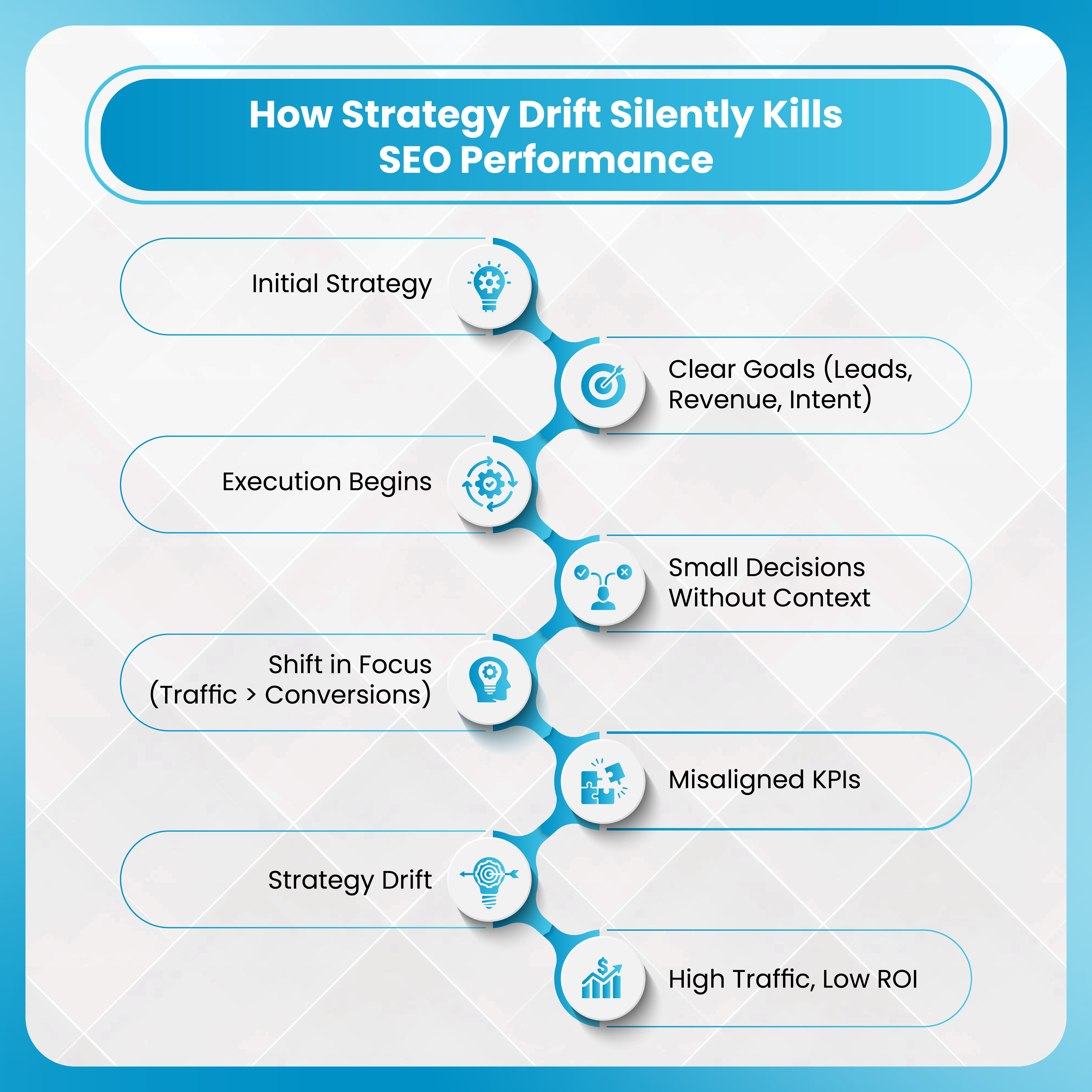
1. Fragmented Decision Ownership
In most white label setups, agencies define the strategy while partners handle execution. On paper, this looks efficient and scalable. It allows agencies to focus on growth while delegating production work. But in practice, it often creates subtle gaps in decision-making.
The core issue is that ownership becomes divided. Strategy lives with the agency, while execution lives with the partner. However, SEO is not just about executing tasks. It requires constant interpretation and small decisions at every step.
These small choices include:
- Selecting blog topics based on keyword opportunities
- Deciding how internal links are structured
- Choosing anchor text for backlinks
- Prioritizing which pages receive optimization efforts
Individually, none of these decisions seems critical. But together, they shape the direction of the entire campaign.
When execution teams make these choices without full visibility into the broader business goals, the campaign can slowly move away from its original intent.
For example, an agency may define a strategy focused on high-intent service keywords with the goal of generating leads. However, the execution team may start prioritizing informational content because:
- It is easier to produce at scale
- It ranks faster
- It shows quicker traffic gains
Over time, the campaign shifts toward top-of-funnel traffic. Reports begin to show growth in impressions and visits. On the surface, performance looks strong. But when you look deeper, conversions remain flat. Lead quality may even decline.
This is where the real impact of fragmented ownership becomes clear. The campaign did not fail due to poor execution. It drifted because execution decisions were made without consistent strategic alignment.
Drift rarely comes from one big mistake. It builds through dozens of small, reasonable decisions that were never connected back to the core objective.
2. KPI Misalignment Between Agency and Partner
Another major driver of strategy drift is misaligned performance metrics. Agencies and white label SEO partners often operate with different definitions of success. This is not due to disagreement, but due to perspective.
Agencies are accountable to clients. Their focus is on outcomes such as:
- Revenue growth
- Lead generation
- Cost per acquisition
- Overall return on investment
White label SEO partners, however, are typically measured on deliverables and SEO-specific metrics like:
- Keyword rankings
- Number of backlinks acquired
- Organic traffic growth
- Technical improvements
Both sets of metrics are important. The problem arises when they are not connected.
A campaign can show steady growth in rankings and traffic, yet still fail to generate meaningful business results. This creates a false sense of progress.
For example:
- A page ranks on the first page for a high-volume keyword
- Organic traffic increases significantly
- Engagement metrics look healthy
But if that keyword reflects informational intent rather than buying intent, it may not drive conversions. The campaign appears successful in reports, but underperforms where it matters most.
This disconnect is increasingly recognized across the industry. According to HubSpot’s State of Marketing (2024), 61% of marketers say improving ROI measurement is their top priority.
This statistic highlights a key shift. Businesses are no longer satisfied with visibility alone. They want a measurable impact on revenue and growth.
When KPI alignment is missing, teams tend to optimize for what is easiest to measure rather than what drives value. Rankings and traffic become the focus, while conversions and revenue are treated as secondary outcomes.
Over time, this leads to a strategy that looks strong on paper but delivers limited business impact.
3. Strategy Dilution Over Time
At the start of a campaign, strategy is usually clear and well-defined. Agencies invest time in:
- Understanding the client’s business model
- Identifying target audiences
- Mapping keyword opportunities
- Defining conversion pathways
This initial phase is often detailed and thoughtful. But as the campaign progresses, something changes. The strategy document that once guided decisions becomes less visible. Teams move into execution mode, focusing on:
- Publishing scheduled content
- Completing link-building targets
- Updating pages based on audits
These activities are necessary, but they can become routine. When execution becomes repetitive, the connection to the original strategy weakens. Teams may continue producing work without revisiting the “why” behind it. This is how dilution happens.
It is not caused by neglect or lack of skill. It happens because:
- Strategy is not revisited regularly
- Context is not reinforced across teams
- New insights are not integrated into the plan
Over time, the campaign evolves based on momentum rather than intention. Drift at this stage is gradual and often unnoticed. Performance may not drop immediately, which makes it harder to detect. But the long-term impact becomes visible in stagnation or declining ROI.
Maintaining strategic clarity requires ongoing effort, not just a strong start.
4. Over-Systemization Without Strategic Feedback
Systems and processes are essential for scaling SEO operations. Standard operating procedures help teams maintain consistency, meet deadlines, and manage large volumes of work.
However, there is a trade-off. SOPs are designed to standardize execution. They are not designed to question or adapt the strategy. When teams rely too heavily on predefined workflows, they may prioritize completion over evaluation. This creates a situation where:
- Content is published consistently
- Backlinks are built regularly
- Technical tasks are completed on schedule
From an operational perspective, everything runs smoothly. But without strategic feedback, these activities may no longer align with current goals.
For example, a content SOP might require a fixed number of blog posts each month. The team continues producing content to meet that quota. However, if those topics are no longer aligned with search intent or business priorities, the output loses value.
Similarly, link-building campaigns may focus on volume rather than relevance, simply because the process is built around targets. The absence of feedback loops turns systems into rigid structures. Instead of supporting the strategy, they begin to operate independently.
This is where drift accelerates. The campaign continues to move forward, but not necessarily in the right direction. To avoid this, systems must be paired with regular evaluation. Execution should inform strategy, and strategy should reshape execution.
5. Lack of Closed-Loop Feedback
One of the most overlooked causes of strategy drift is the lack of feedback between stakeholders.
In a typical white label SEO setup, multiple parties are involved:
- The client
- The agency
- The white label partner
- Sometimes separate content or analytics teams
Each group holds valuable insights. But these insights are not always shared effectively. Common gaps include:
- SEO teams do not have access to sales or CRM data
- Content teams do not receive feedback on lead quality
- Partners are not informed about which campaigns drive revenue
Without this information, execution teams are working with incomplete data. They may optimize for traffic or engagement without knowing whether those metrics translate into actual business results.
This creates a disconnect between performance and impact.
Research from Google and Deloitte (2023) shows that companies aligning marketing metrics with business outcomes are 1.6 times more likely to achieve revenue growth. This finding reinforces a simple idea. Data must flow across the entire system for the strategy to remain effective.
Closed-loop feedback ensures that:
- High-performing keywords are identified based on conversions, not just traffic
- Content strategies evolve based on real user behavior
- SEO efforts are adjusted based on sales outcomes
Without this loop, campaigns operate in silos. Each team focuses on its own metrics, without understanding the full picture.
As a result, improvements in one area may not contribute to overall success. Strategy drift is rarely caused by a single issue. It emerges when multiple small gaps combine over time.
The common thread across all these causes is disconnection. Between strategy and execution. Between metrics and outcomes. Between teams and insights.
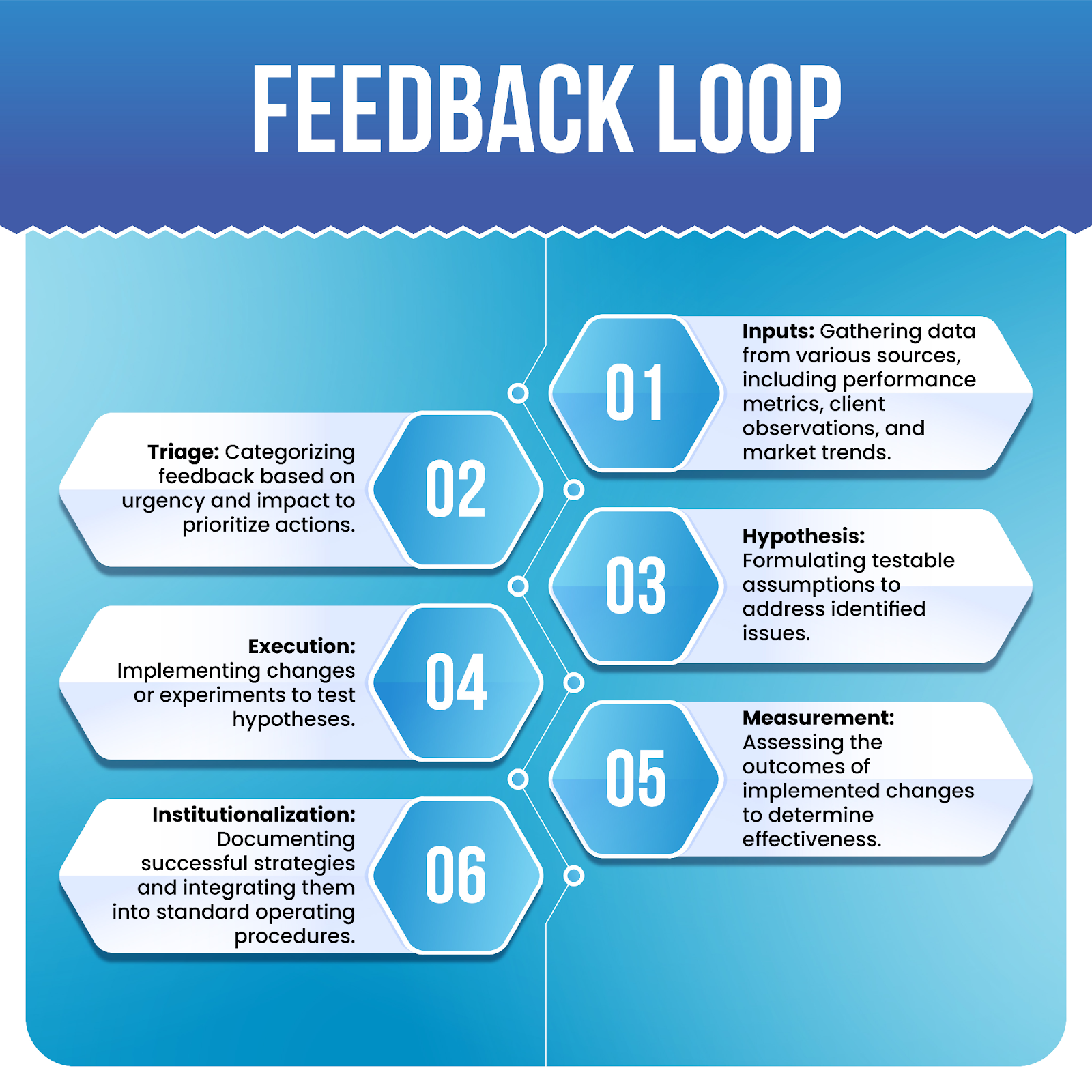
Addressing drift does not require more control or stricter processes. It requires better alignment, clearer communication, and systems that connect every part of the campaign.
How Agencies Build Anti-Drift Systems with White Label SEO?
1. Establish a Single Source of Strategic Truth
To prevent drift, agencies need a centralized and dynamic strategy system. This is not a one-time document. It is a living framework that evolves with the campaign.
A strong strategy system should include:
- Revenue goals tied directly to SEO efforts
- Ideal customer profiles and search intent layers
- Keyword clusters mapped to different funnel stages
- Clear conversion pathways
When strategy lives in a system rather than a static brief, alignment becomes easier to maintain. Everyone involved in execution can refer back to the same source of truth.
2. Shift from Task-Based to Intent-Based Execution
One of the most effective ways to avoid drift is to redefine how work is assigned. Instead of focusing on tasks, agencies should focus on intent. Every deliverable should answer two key questions:
- What business goal does this support?
- Where does it fit in the customer journey?
For example, instead of saying: “Write 8 blogs per month.”
Define the goal as: “Create content that captures mid-funnel search intent and supports service page conversions.”
This shift ensures that every action contributes to a larger objective.
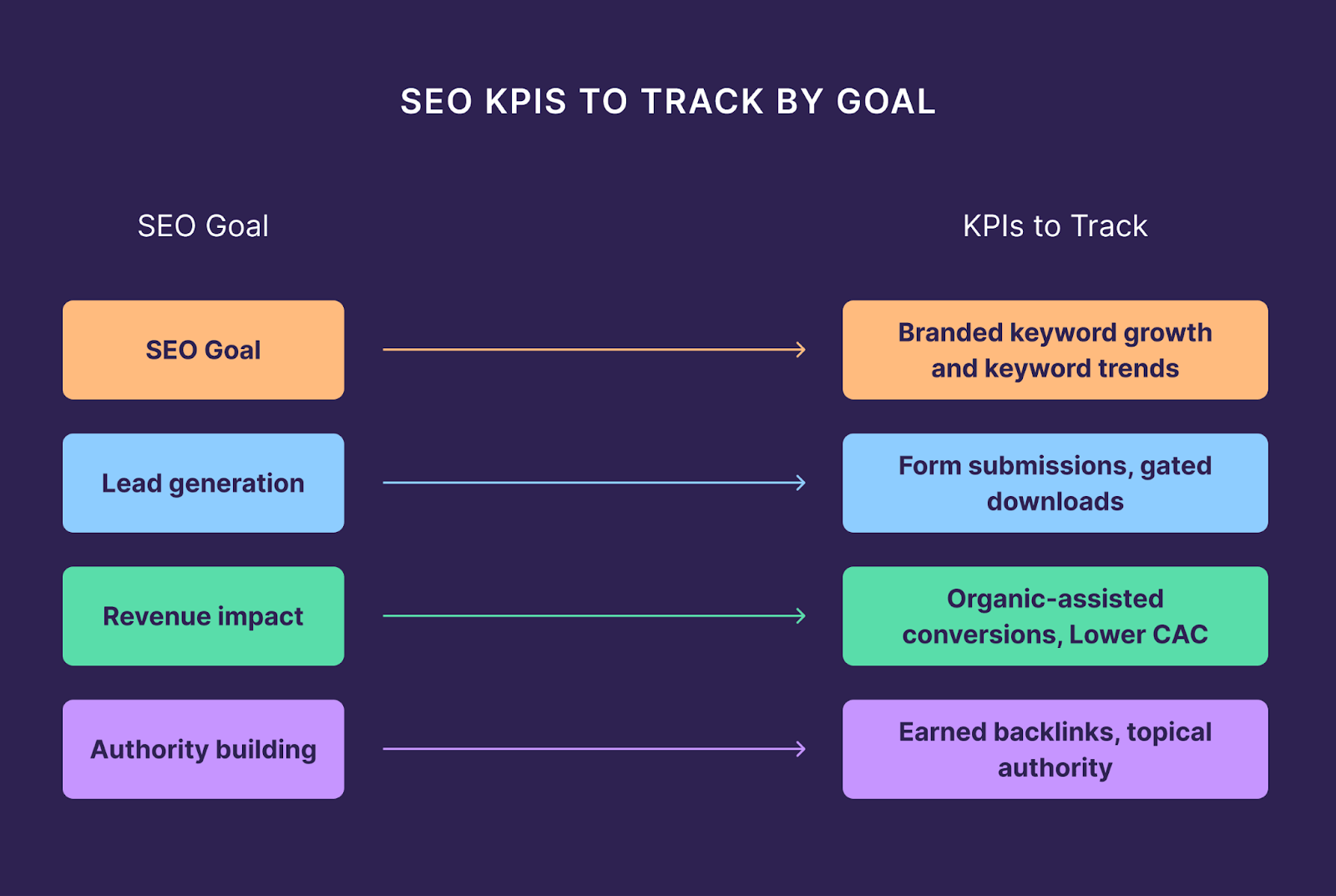
Image Source: Backlinko
3. Implement Intent-Based KPI Mapping
Metrics should reflect the full customer journey, not just top-level performance. Agencies can structure KPIs across three stages:
- Awareness: traffic growth and keyword visibility
- Consideration: engagement metrics like time on page and bounce rate
- Conversion: leads, sales, and revenue
This approach prevents over-investment in top-of-funnel content that does not drive business outcomes. It also creates a clearer connection between SEO efforts and client success.
4. Build Structured Communication Loops
Consistency in communication is essential for maintaining alignment. High-performing agencies establish regular check-ins at different levels:
Weekly (Execution Layer):
- Review tasks and progress
- Address blockers quickly
Monthly (Strategy Layer):
- Compare execution with original goals
- Identify early signs of drift
Quarterly (Business Alignment Layer):
- Connect SEO performance to revenue and pipeline
- Adjust strategy based on results
Most agencies report performance. The best ones recalibrate their strategy continuously.
5. Introduce Drift Detection Signals
Drift often shows up in subtle ways before it becomes a major issue. Agencies should monitor early warning signs such as:
- Increasing traffic but declining conversions
- Higher rankings without growth in leads
- More content production but lower engagement
These signals are often mistaken for progress.
In reality, they indicate misalignment. Catching these patterns early allows agencies to adjust before results decline.
6. Create an SEO Alignment Scorecard
Traditional reports focus on activity and output. A better approach is to measure alignment. An SEO alignment scorecard might track:
- Percentage of efforts focused on revenue-driving pages
- Accuracy of keyword intent targeting
- Contribution of organic traffic to conversions
- Ratio of content production to actual results
This shifts the focus from “how much was done” to “how well it supports business goals.”
7. Define Clear Control and Delegation Boundaries
A successful white label SEO partnership depends on clarity. Agencies should retain control over:
- Strategy development
- KPI definition
- Client communication
White label partners should focus on:
- Execution
- Technical SEO implementation
- Scalable content and link building
Problems arise when agencies outsource strategic thinking instead of execution. Maintaining this boundary keeps direction consistent.
8. Treat White Label SEO as a Strategic Extension
The best results come when partners are treated as extensions of the agency, not just vendors. This means sharing:
- Business context
- Customer insights
- Sales data
- Market positioning
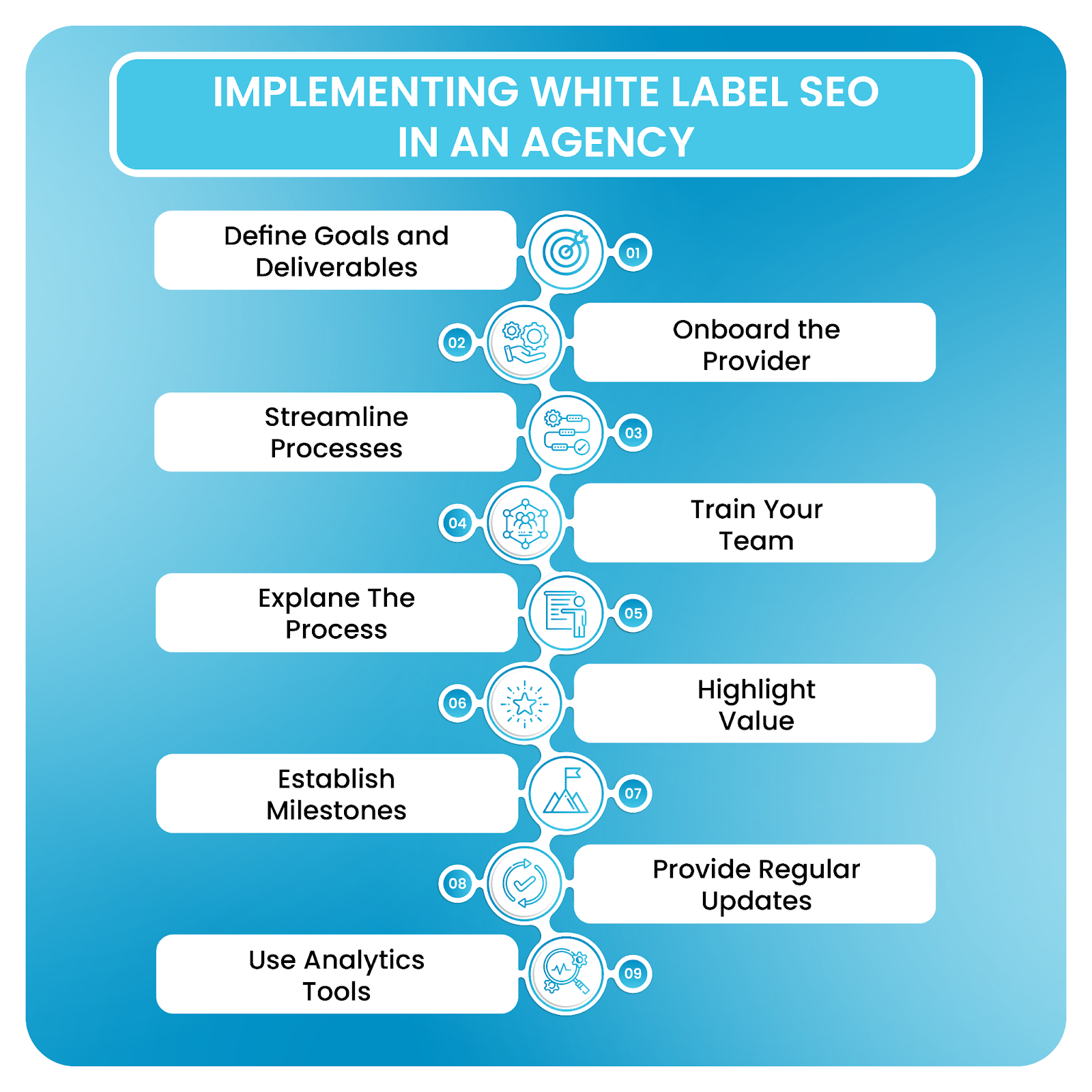
When execution teams understand the “why” behind tasks, they make better decisions. This reduces the risk of drift and improves overall performance. Even with strong systems in place, the choice of partner plays a critical role.
How DashClicks Helps Agencies Stay Strategically Aligned?
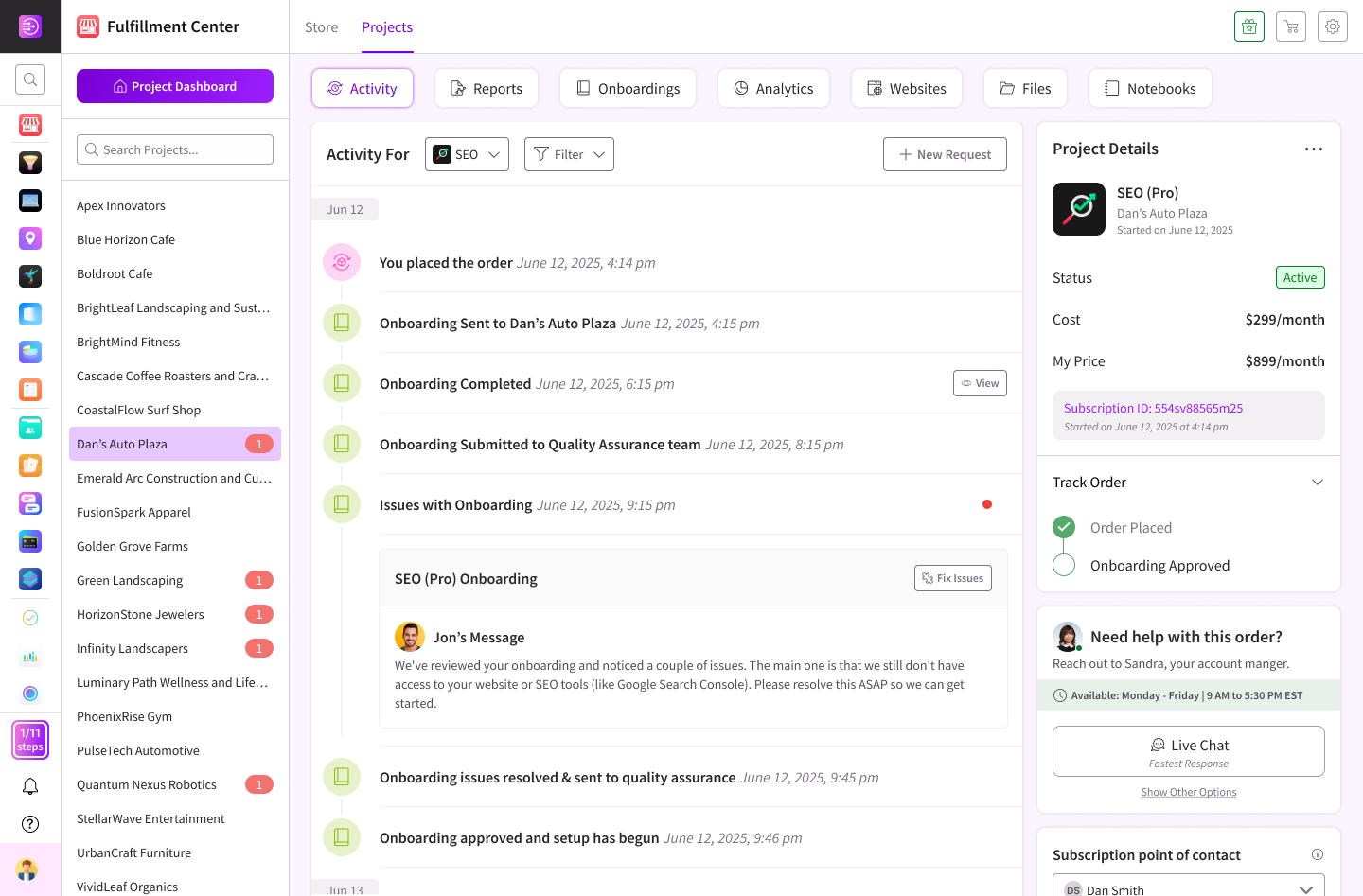
When agencies work with a platform like DashClicks, the focus goes beyond task completion. The system is designed to support alignment between strategy and execution.
DashClicks provides:
- Alignment-focused execution that supports agency-defined goals rather than generic deliverables
- Centralized reporting dashboards that connect SEO performance with real client KPIs
- Scalable services, including technical SEO, content creation, and link building
- Structured workflows that improve consistency and reduce communication gaps
One of the key advantages is that agencies maintain control over strategy and client relationships, while white label SEO services handle execution at scale.
This balance allows agencies to grow without losing direction. By combining clear communication, standardized processes, and performance tracking, the system helps reduce the risk of drift while improving efficiency.
The real value is not just outsourcing SEO tasks. It is enabling agencies to stay focused on strategy, growth, and measurable results.
Conclusion: From Drift Prevention to Strategic Advantage
Strategy drift is not a reflection of poor talent or weak execution. It is a systems issue. When alignment breaks down, even strong teams can lose direction.
Preventing drift requires:
- Shared ownership of goals
- Intent-driven execution
- Continuous feedback and recalibration
Agencies that invest in alignment do more than improve SEO performance. They build systems that scale effectively and deliver consistent results.
White label SEO, when managed correctly, becomes a powerful advantage rather than a risk. It allows agencies to expand capacity while maintaining strategic control. The difference lies in how well systems are designed and how clearly roles are defined.
If you are looking to scale your agency without losing alignment, it starts with choosing the right partner and building the right processes.


.svg)


.svg)
.svg)
.svg)
.svg)
.svg)