A single disapproved ad rarely derails a client relationship. A suspended account can. When Google Ads enforcement interrupts campaign delivery, clients lose momentum on time-sensitive promotions, marketing objectives get pushed back, and account managers end up scrambling to diagnose a problem instead of focusing on strategy and growth.
For agencies managing a handful of accounts, informal review might feel manageable. But as client rosters grow, so does the complexity. Different industries carry different advertising restrictions, different business models require different verification documentation, and a landing page that works perfectly for one client’s offer might trigger a policy flag for another. Multiply that across dozens of accounts, and the margin for error shrinks fast.
This is why Google Ads policy compliance works best as a continuous part of campaign management, not a reactive fix applied after an ad gets disapproved or an account gets suspended. This guide walks through how Google enforces its advertising policies, the most common compliance risks agencies encounter, and the practical steps agencies can take to reduce their exposure, whether managing campaigns internally or working with a white label Google Ads agency to extend fulfillment capacity.
Understanding Google Ads Policy Enforcement and Account Suspensions
Not every policy issue carries the same weight. Google’s enforcement actions generally fall into four categories, each with a different effect on campaign delivery:
- Ad disapprovals: When a specific ad violates a policy, it cannot serve until the issue is corrected or the disapproval is successfully appealed. This does not automatically mean the entire account is suspended. In many cases, it reflects an isolated issue with that ad’s copy, asset, or destination.
- Limited ad serving: Certain policies or account-specific circumstances can restrict how widely or where an ad is shown. This is narrower than a suspension but can still reduce reach and performance.
- Temporary account holds: Ad serving may be paused under applicable review procedures while Google evaluates an account. Not every hold reflects the same underlying issue, so the right response depends on the circumstances.
- Account suspensions: Ads stop running across the entire affected account. This is the most disruptive outcome and can interrupt activity for every client or business tied to that account.
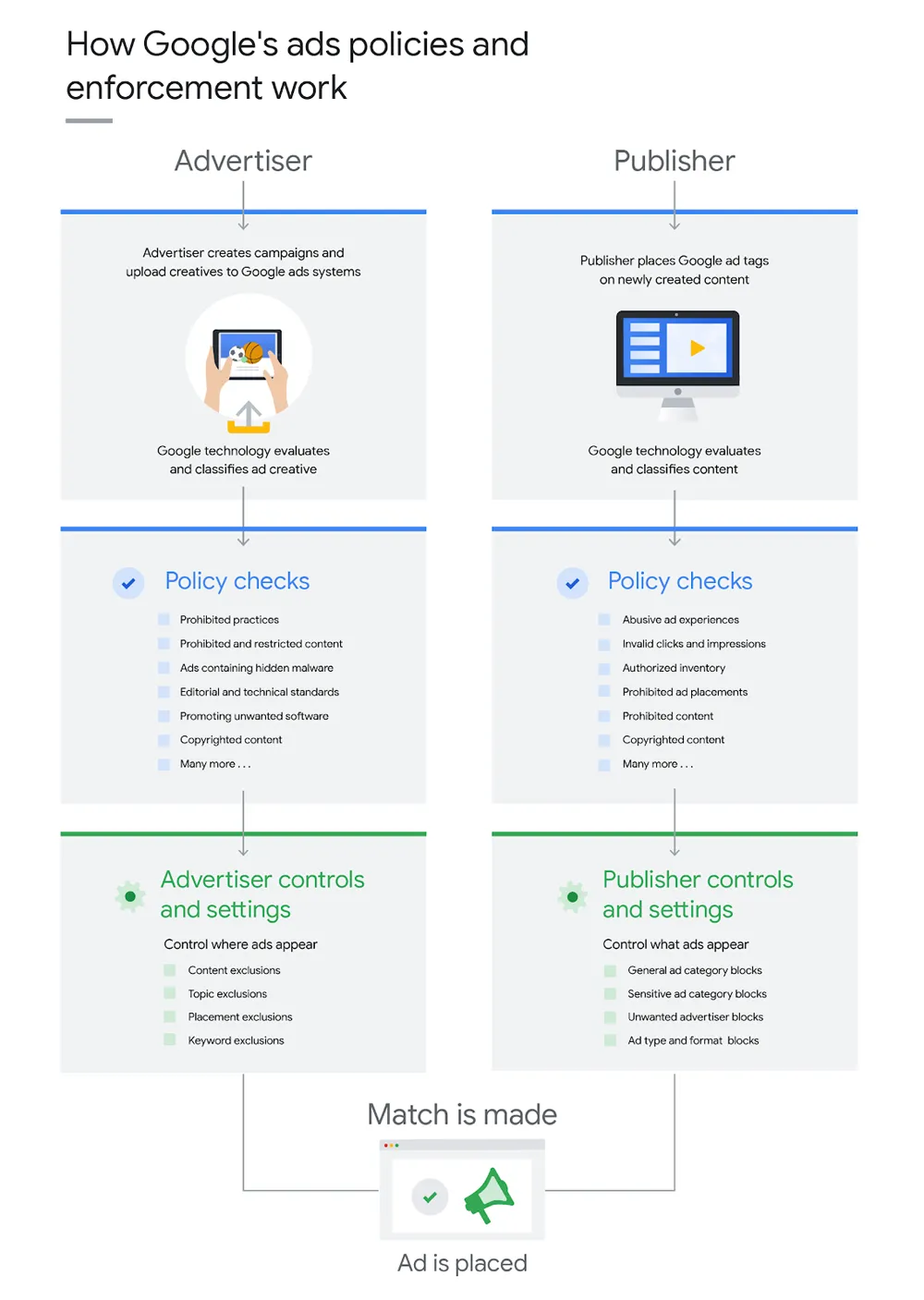
Image Source: Google
These outcomes are different enforcement responses, not sequential stages. A serious violation can result in immediate suspension without a warning or a limited-serving period first.
Repeat violations may involve warnings, while serious violations can bring immediate suspension. Enforcement can also extend beyond a single account: Google may restrict related accounts and can prevent new accounts from advertising if they are linked to an existing suspension. Opening a new account is not a reliable workaround for an unresolved suspension, and attempting it can create additional account-level risk.
According to Google’s 2024 Ads Safety Report, Google blocked or removed 5.1 billion bad ads across its advertising platforms in 2024 (Google Services, 2024). That figure illustrates the scale of enforcement, though it does not mean every one of those ads led to an account suspension. Many reflect ad-level enforcement rather than account-level action.
Common Google Ads Policy Risks Agencies Need to Watch
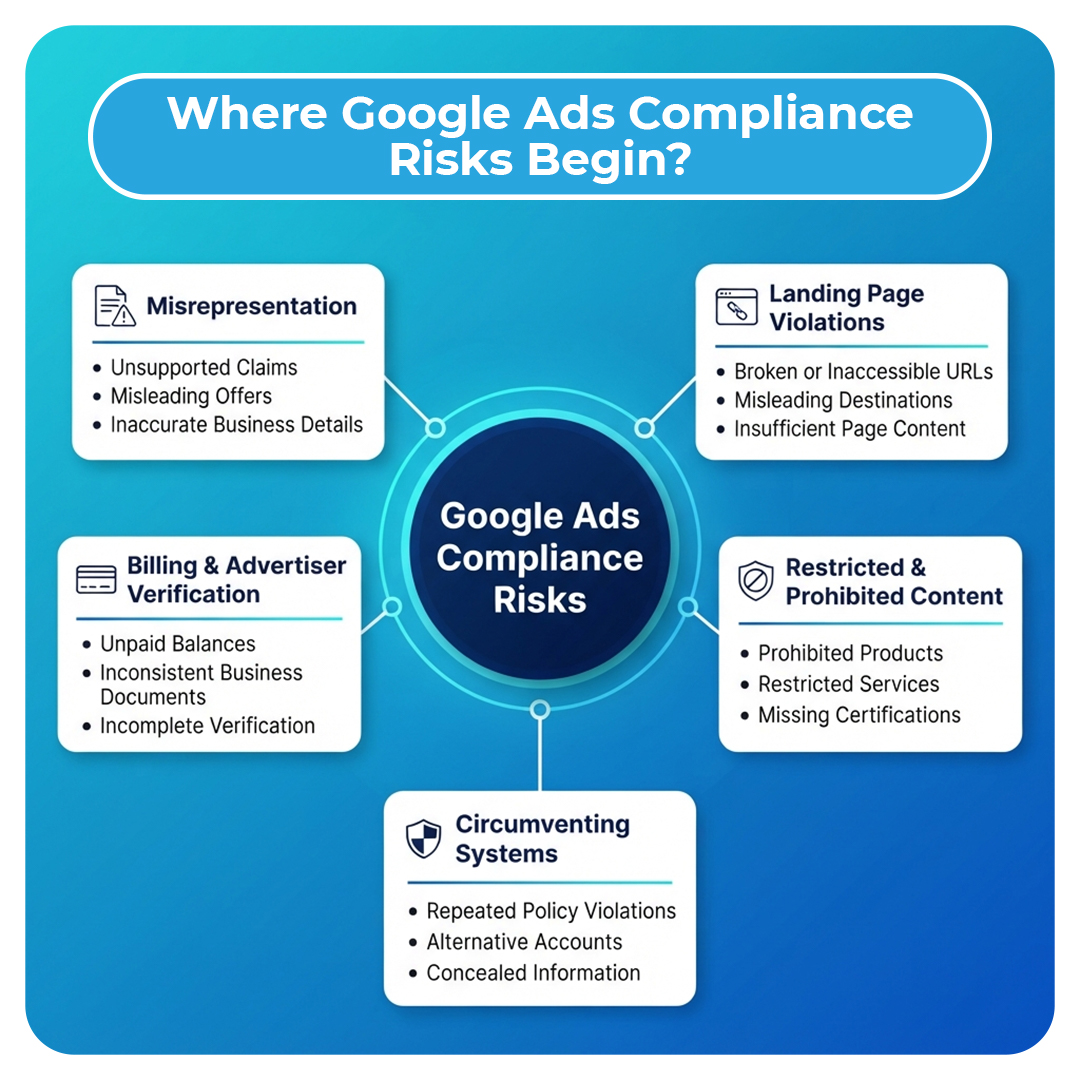
An issue that looks minor at the ad level can point to a broader concern involving business information, account behavior, or billing. Reviewing these five categories regularly helps agencies catch problems before they grow.
1. Misrepresentation
Misrepresentation covers how a business or offer is described. Common examples include:
- Unsupported or exaggerated claims about results, qualifications, or capabilities
- Misleading offers, or offers whose conditions are not clearly disclosed
- Business details that do not match the advertiser’s actual operations
- Pricing that omits relevant conditions or the true cost of the product or service
Agencies should verify promotional language against accurate, client-provided business information rather than assuming approved ad copy stays compliant. Claims that seemed acceptable at launch can become a liability if a client’s offer or qualifications change later.
2. Destination and Landing Page Violations
A compliant ad can still create problems if it leads to a non-compliant landing page. Common issues include:
- Broken or inaccessible destination URLs
- Display URLs that do not match the final destination
- Insufficient original or useful content on the page
- Landing page experiences that do not match what the ad promised
- Missing or inconsistent business and contact information
Reviewing an ad in isolation is not enough. Google evaluates the landing page as part of the overall ad experience, so agencies need to assess what users actually encounter after clicking.
Further Reading: 4 Woefully Underused, Crazy-Effective PPC Landing Page Tips
3. Restricted and Prohibited Content
Some products, services, and industries carry specific advertising limitations. Some are entirely prohibited, while restricted categories may require specific conditions, certifications, or account-level eligibility before ads can run. These limitations vary by product type and target location, so agencies should check restrictions before campaign assets are developed, not after. Consult Google’s current policy documentation for the specific product, service, and location being advertised.
4. Circumventing Systems
Behavior intended to bypass Google’s review or enforcement systems is one of the more serious compliance risks. Examples include:
- Repeatedly recreating disapproved ads without correcting the underlying issue
- Using alternative accounts to bypass an existing enforcement action
- Concealing business information or known policy violations
These behaviors can create account-level risk well beyond the original issue. Agencies should resolve the underlying problem directly rather than attempt workarounds that could trigger a more serious response.
5. Billing and Advertiser Verification
Billing and verification issues can affect account access and continuity even when ad content is fully compliant. Common risk areas include:
- Unpaid balances or suspicious payment activity
- Business information that does not match submitted documentation
- Incomplete advertiser verification or unresolved verification requests
- Unclear ownership or payment arrangements between the agency and the client
6. Distinguish Ad-Level Issues From Account-Level Risks
Not every disapproved ad signals a suspension risk. Many disapprovals are isolated to a specific ad or asset and can be corrected without broader consequences. Serious violations or patterns of problematic account behavior, however, can carry account-wide implications. Agencies need to assess the scope of an issue accurately before responding.
How Agencies Can Reduce the Risk of Google Ads Account Suspensions
Preventive checks built into standard campaign workflows reduce the need for manual troubleshooting after a violation occurs. Agencies that manage accounts internally or outsource Google Ads can apply the same six measures.
1. Establish an Advertiser Verification Checklist
Confirming advertiser and business information before launch reduces the likelihood of verification problems later. A solid checklist covers business identity and supporting documentation, website details that match what appears in ads, payment information tied to the correct business entity, required certifications for restricted categories where applicable, and consistency between submitted information and the client’s actual operations. Requirements vary by advertiser, business type, and campaign category, so confirm what applies to each client.
2. Review Claims Against Actual Business Offerings
Misrepresentation risk drops significantly when promotional claims are checked against verified business information. Review ad copy, pricing and discount structures, guarantees and performance claims, qualifications, product and service descriptions, and any conditions tied to an offer. Get accurate information and explicit client approval before publishing claims, so ad copy never sets expectations the business cannot meet.
3. Audit Landing Pages Independently
An ad review is incomplete without a landing page review. Check page functionality across devices, consistency between the display URL and final destination, visible contact information, relevance to the advertised offer, original and useful content, and clear pricing where applicable. Recheck landing pages whenever a client updates their website, changes an offer, or modifies the services being advertised.
4. Build Policy Checks Into Campaign Approvals
A documented pre-publication review ensures compliance checks happen before a campaign goes live, not after a disapproval. It should cover keywords and search intent, ad copy and claims, images, videos, and other assets, targeting settings, final URLs, and industry-specific or account-level restrictions, with clearly documented responsibility for who performs the final review.
5. Monitor Account Notifications and Policy Changes
Ongoing monitoring catches problems a one-time pre-launch review cannot. Regularly check ad disapprovals, policy warnings, verification requests, billing notifications, repeated issues across multiple campaigns, and changes to Google Ads policies that could affect active campaigns. Assign clear ownership for monitoring and a process for escalating unresolved issues.
6. Maintain Clear Account Access and Billing Practices
Account hygiene plays a direct role in compliance. Use appropriate permission levels, limit access to people who genuinely need it, maintain secure login practices, keep billing arrangements transparent, and clarify who resolves payment issues and maintains documentation. Review access whenever team members change, or a client relationship ends. Replace shared credentials with role-based permissions.

Managing Google Ads Compliance Across Multiple Client Accounts
A compliance process that works for a single account can become inconsistent once a team manages multiple industries, business models, and landing page configurations. Scaling compliance requires systems, not just good intentions.
- Create client-specific compliance profiles: Document each client’s industry, advertised products and services, relevant restrictions, required certifications, business information and verification status, and client-approved claims and offer details. These profiles keep campaign decisions grounded in accurate, client-specific information.
- Standardize compliance SOPs: Use campaign review templates, approval requirements, pre-launch checklists, documentation practices, escalation procedures, and monitoring routines. Standardization makes checks repeatable across account managers without replacing client-specific review.
- Avoid cross-account assumptions: A campaign approved for one client does not establish compliance for another, even within the same agency. Different business models, claims, certifications, and landing pages create different requirements, so review each account and campaign on its own terms.
- Maintain an account-level issue log: Record recurring disapprovals, policy notifications, verification requests, corrective actions, the person responsible, and unresolved follow-ups. The log helps teams spot patterns and preserves institutional knowledge when responsibilities shift.
- Clarify client responsibilities: Compliance is shared. Define who supplies accurate documentation, confirms pricing and claims, approves final messaging, manages billing, responds to verification requests, and provides updates when business details change. Agencies can guide the process, but clients remain responsible for accurate and current information about their own businesses.
Google’s 2024 Ads Safety Report states that, on average, over 90% of ads seen by people on Google came from verified advertisers (Google Services, 2024). That underscores how central advertiser verification is to Google’s advertising ecosystem. Verification does not guarantee policy compliance, ad approval, or immunity from suspension, but it is a foundational step agencies should not skip.
What Agencies Should Do When a Google Ads Account Gets Suspended
When a suspension does occur, the priority is understanding the reason, correcting the underlying issue, and following Google's official appeal process. There are no shortcuts that reliably restore account access, and agencies should avoid suggesting otherwise to clients.
Step 1: Identify the Exact Suspension Reason
Start by reviewing the suspension notification within the account to identify the specific policy or account issue cited. Determine which account, campaigns, or business details are affected, and review any related communications from Google. Avoid guessing at the cause based on an unrelated ad disapproval or a different account issue, since an inaccurate diagnosis can lead to wasted time correcting the wrong problem.
Step 2: Audit the Account and Affected Assets
A thorough audit should review:
- Ads and campaign assets.
- Landing pages and final URLs.
- Business information on file.
- Billing details.
- Advertiser verification status.
- Account access and any related account activity.
This audit helps identify the actual underlying issue rather than addressing only the symptom that triggered the notification.
Step 3: Correct Policy Violations
Once the cause is identified, the next step is resolving it before submitting an appeal. Depending on the situation, this might mean correcting inaccurate claims, fixing landing page issues, completing outstanding verification requirements, or addressing billing discrepancies. Not every suspension can be resolved through the same corrective action, so the fix should match the specific issue identified during the audit.
Step 4: Collect Supporting Evidence
Gathering relevant documentation strengthens an appeal by demonstrating that the underlying issue has genuinely been addressed. Depending on the situation, this might include accurate business documentation, updated website information, or other records directly relevant to the suspension reason. Avoid including unrelated or unnecessary documents that do not support the specific issue cited.
Step 5: Submit a Thorough Appeal
An effective appeal should directly address the specific suspension reason, describe the corrective actions taken, and provide accurate, relevant supporting information. Keeping the appeal factual, clear, and internally consistent gives it the best chance of a fair review. Submitting one complete, well-supported appeal is a better approach than sending multiple incomplete appeals in quick succession.
Step 6: Monitor Google's Decision and Communicate With the Client
While the appeal is under review, agencies should monitor account notifications for Google's response, keep a record of the appeal and supporting materials submitted, and keep the client informed about the suspension, the corrective actions taken, and the possibility of continued campaign disruption. Clients should understand that the outcome is uncertain until Google issues a decision, and next steps should be based on that decision rather than assumed in advance.
Account reinstatement is never guaranteed. Agencies should not create replacement accounts to bypass enforcement, and should not encourage clients to do so either. Any further action should follow Google's official instructions and current policy guidance.
How White Label Google Ads Support Helps Agencies Maintain Consistent Oversight
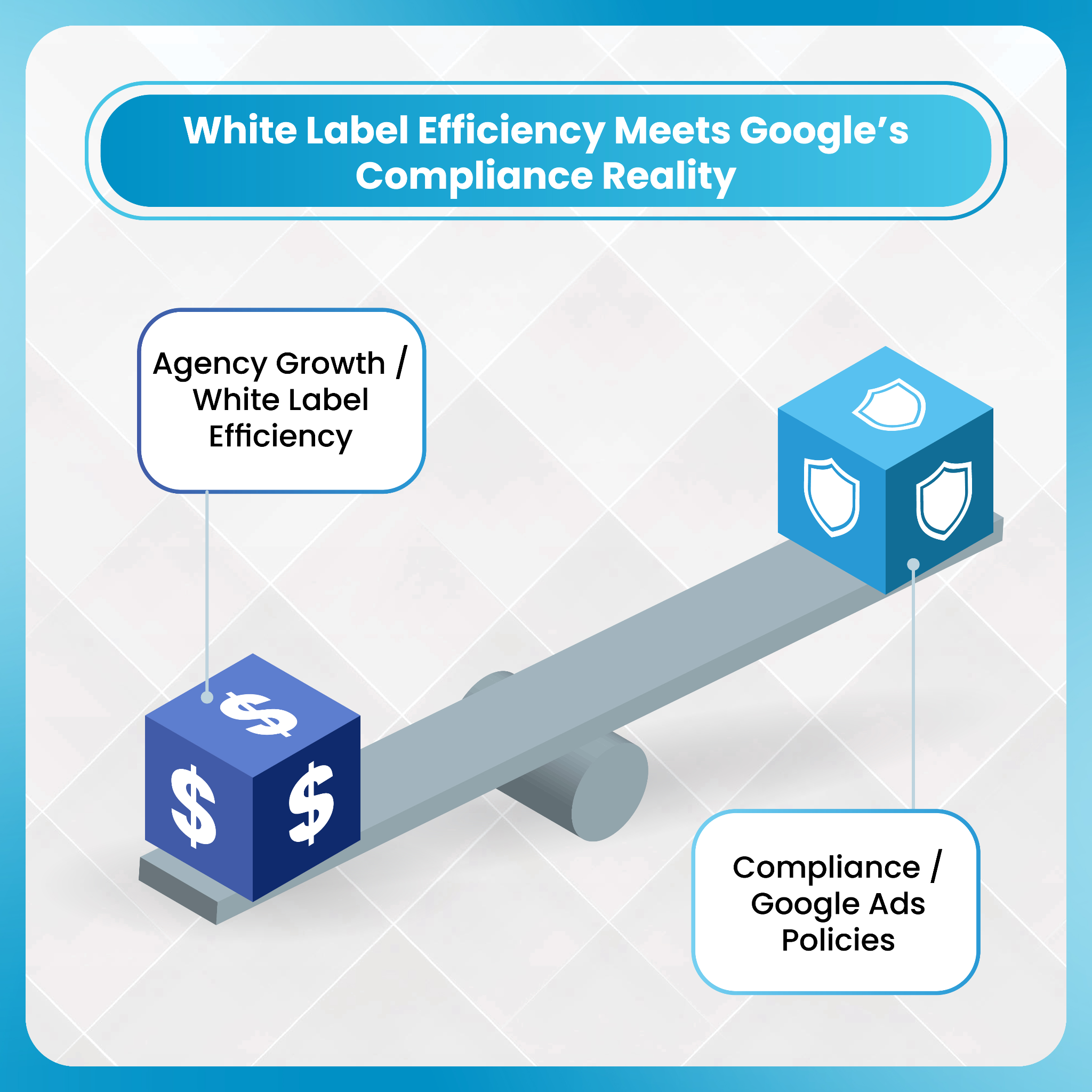
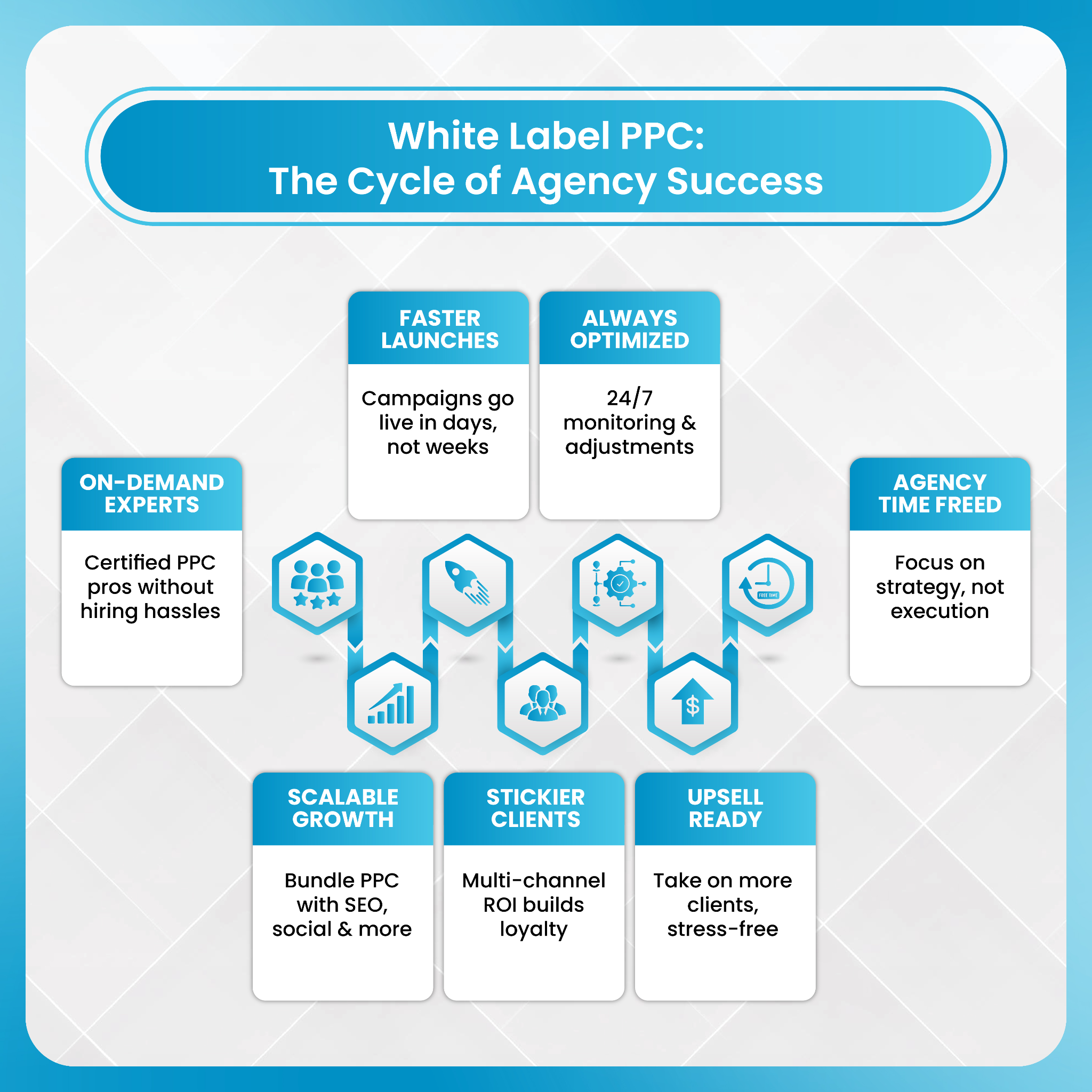
Building and maintaining the compliance processes described above takes real operational capacity, something that becomes harder to sustain as an agency's client portfolio grows. This is where white label Google Ads fulfillment support can help agencies stay consistent without adding headcount for every new account.
1. Support Consistent Campaign Execution
A reliable fulfillment partner can help manage recurring campaign tasks and quality checks, including campaign setup and implementation, ad copy and asset reviews, landing page and destination checks, ongoing campaign monitoring, and routine account maintenance and reporting. This kind of support keeps the discussion grounded in practical campaign fulfillment rather than any claim that a provider can guarantee policy approval.
2. Standardize Recurring Quality Checks
Documented workflows and repeatable review processes help reduce avoidable oversights across a growing number of accounts. That said, quality checks still need to account for each client's industry, business model, and applicable advertising restrictions. Standardization supports consistency, but it does not replace client-specific judgment.
3. Expand Fulfillment Capacity as Client Portfolios Grow
Additional execution support allows agencies to take on more accounts without overloading internal PPC teams. With recurring, repeatable work supported externally, internal teams can focus their time on strategy, client communication, and the account-level decisions that require direct agency judgment.
Position DashClicks as an Extension of the Agency's Team
For agencies looking to outsource Google Ads execution without losing control of client relationships, DashClicks offers white-label fulfillment support built for exactly this purpose. As a white label Google Ads agency, DashClicks helps agencies expand their campaign management capacity while retaining ownership of strategy, client recommendations, and final account decisions.
Standardized execution support can help agency teams maintain more consistent workflows as they take on new clients and industries. At the same time, the agency remains responsible for understanding each client's specific requirements and ensuring appropriate oversight of every account under its management. Working with an experienced outsourced Google Ads partner does not remove that responsibility, but it does give agencies more breathing room to apply it consistently across a growing book of business.
Building Compliance Into Everyday Account Management
Google Ads compliance is not a single checklist completed once and forgotten. It requires ongoing attention across advertiser verification, ad content, landing pages, account activity, and billing, applied consistently to every client an agency manages.
Standardized checks, documented processes, and clearly defined client responsibilities give agencies a repeatable way to reduce avoidable risks as their portfolios expand. And as campaign workloads increase, dependable fulfillment support can help agencies maintain the consistent oversight that strong Google Ads management demands, without stretching internal teams too thin to catch the details that matter.