A well-targeted ad can still fail to convert. Even with the right keywords, compelling headlines, and competitive bids, conversions may stall if the landing page fails to deliver on the ad’s promise. The click is only the beginning. What happens next determines whether ad spend generates leads, sales, or wasted budget.
This gap between ad performance and landing page performance is where many agencies struggle. The issue is not always a lack of skill, but confusion between execution and strategy. Checking for broken forms is an execution task. Deciding which pages to prioritize, what improvements should achieve, and how success will be measured requires strategic judgment. These decisions must remain with the agency.
According to WordStream’s 2025 benchmark analysis of more than 16,000 search advertising campaigns, the average Google Ads conversion rate reached 7.52%. However, this reflects search advertising campaigns broadly, not landing pages specifically, and should not be treated as a universal target. Industry, offer, audience intent, and landing page experience all influence conversion performance.
Effective landing page optimization requires more than fixing technical issues. It involves identifying opportunities, prioritizing improvements, testing changes, and measuring their impact on business outcomes. Fulfillment teams can support execution, but agencies must retain ownership of strategic decisions and performance accountability.
Understanding this distinction helps agencies scale PPC delivery without sacrificing strategic control, campaign effectiveness, or client satisfaction.
What Landing Page Optimization Actually Covers in PPC?
Landing page optimization is often reduced to visual tweaks or page speed fixes. In reality, it spans four interconnected areas: message alignment, conversion friction, technical performance, and measurement. Missing any one of these can undermine the others.
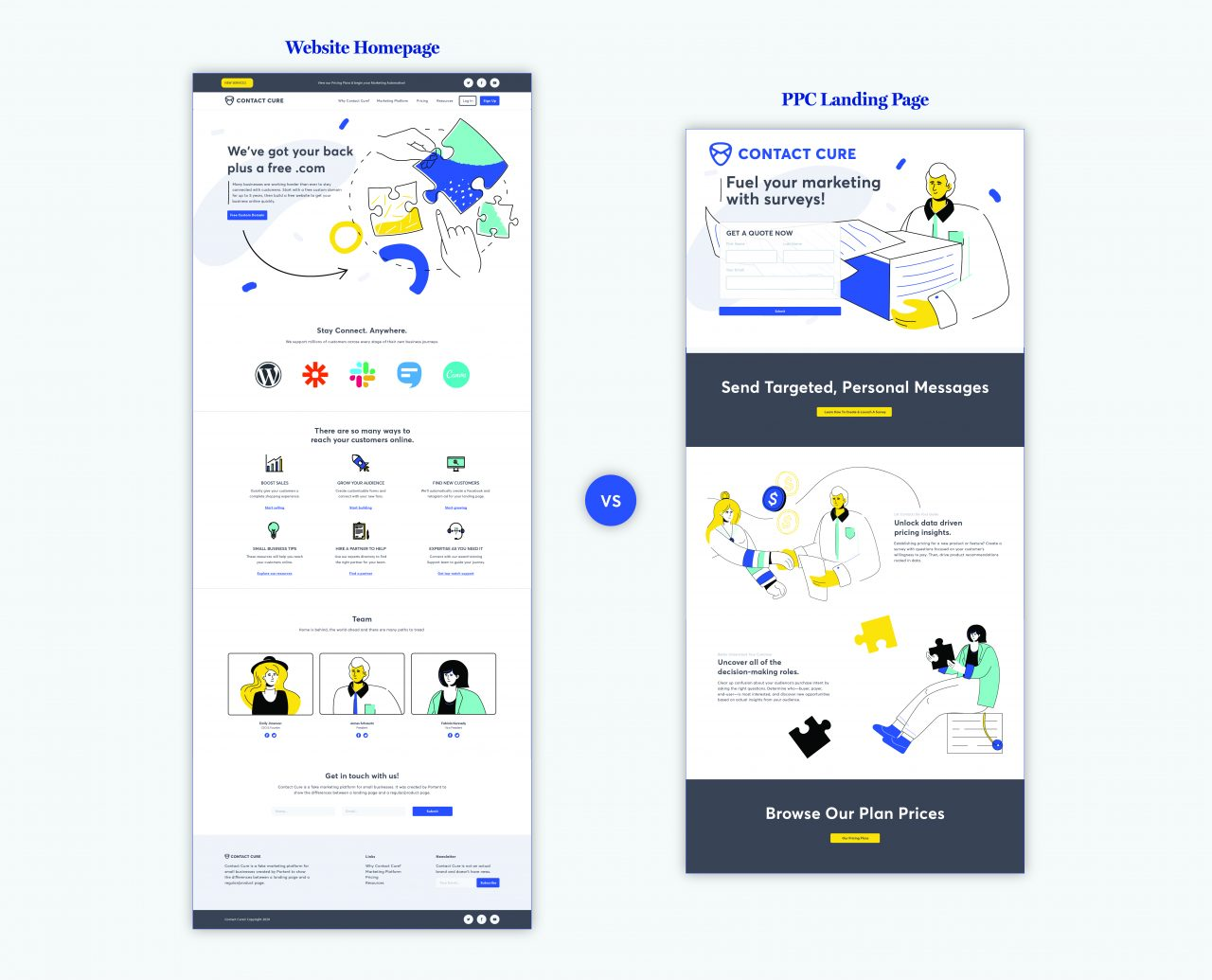
Image Source: Portent
1. Message Alignment
The headline, offer, supporting content, and call-to-action on a landing page need to reflect the promise made in the ad and the intent behind the keyword that triggered it. When a visitor clicks an ad for "affordable roof repair" and lands on a generic homepage with no mention of pricing or repair services, the disconnect creates friction immediately. That mismatch raises doubt, and doubt reduces conversions.
Message alignment is not about repeating keywords on the page. It is about confirming, in the first few seconds, that the visitor landed in the right place for their specific need. Alignment should reflect the intended audience and the campaign's objective, whether that is generating a lead, driving a purchase, or encouraging a call.
2. Conversion Friction
Friction shows up in familiar forms: too many required fields, confusing navigation, weak or missing trust signals, vague offers, and unclear next steps. Each of these makes it harder for a visitor to complete the action the campaign is built around.
Removing friction should always serve the actual conversion goal. A shorter form might increase submission volume, but if it strips out qualification fields the client relies on to assess lead quality, the "improvement" can create a worse outcome for the business. Friction reduction needs to be evaluated against what the client actually needs from each lead or sale, not just raw conversion counts.
3. Technical Performance
Mobile usability, page load behavior, broken elements, responsive layouts, and functioning forms all fall under technical performance. These issues are often invisible in white label analytics software but immediately obvious to a real visitor trying to complete a form on a phone with a slow connection.
Automated audit tools are useful for flagging potential issues, but they do not replace manually verifying the actual visitor experience. A page can score well on an automated scan and still have a broken dropdown menu or a form field that fails silently on mobile Safari.
4. Measurement and Conversion Tracking
Optimization decisions are only as good as the data behind them. Before any team acts on performance numbers, it needs to confirm that conversion events, form submissions, calls, and purchases are being tracked accurately. A page that "underperforms" might actually be converting fine, with a tracking error masking the true results.
Google's Quality Score is built from three components: ad relevance, expected click-through rate, and landing page experience. Quality Score functions as a diagnostic signal, helping teams identify where a campaign might be weak. It is not a direct input used in the Google Ads auction, and improving landing page experience does not automatically increase conversions or guarantee lower costs. Treating Quality Score as a proxy for business performance leads to misplaced priorities.
Where PPC Fulfillment Ends and Agency Strategy Begins?
Outsourcing PPC execution works best when both sides understand not just what tasks are assigned, but who holds decision-making authority over each part of the process. A task list alone is not enough. Clear decision rights prevent confusion and protect the quality of client work.
What the Fulfillment Partner Executes
A fulfillment partner operating within an agreed scope of work can reasonably handle:
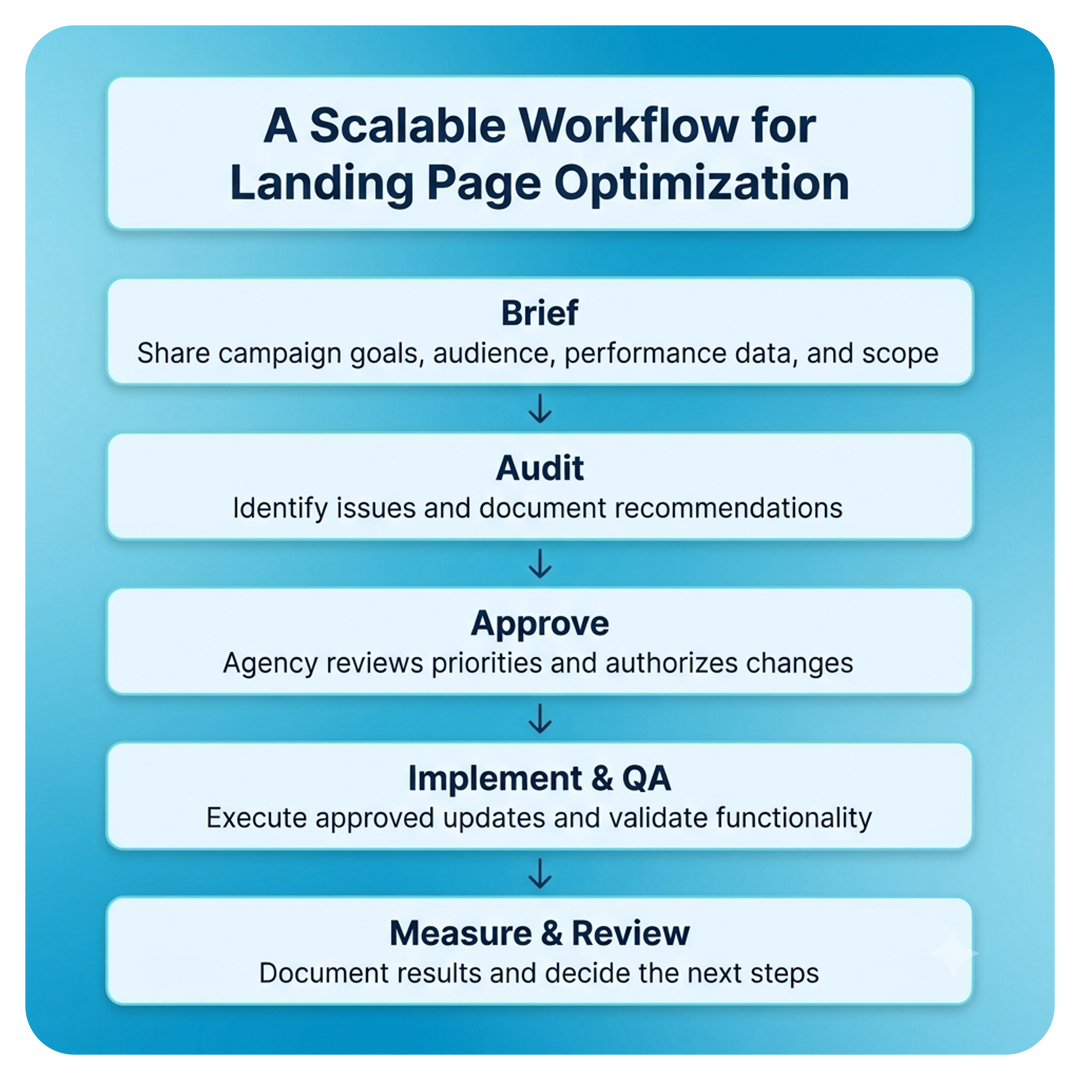
- Auditing landing pages and documenting identified issues.
- Implementing approved copy, layout, or form changes.
- Checking mobile usability and basic technical functionality.
- Validating tracking after approved changes go live.
- Documenting test results and implementation status.
This work needs to follow the agency's specifications, approval procedures, and defined scope. A white label fulfillment partner executing outside of that scope, even with good intentions, introduces risk.
What the Agency Decides
The agency retains responsibility for the decisions that shape outcomes, not just the tasks that produce them:
- Defining conversion goals and campaign objectives.
- Prioritizing which pages and opportunities deserve attention.
- Interpreting client economics, lead value, and broader business context.
- Approving messaging, offers, and positioning.
- Deciding which tests are worth the time, budget, and implementation effort.
- Evaluating whether a performance change actually supports the client's goals.
Technical recommendations, no matter how well-researched, cannot determine the right business decision on their own. White label PPC for agencies can point out that a form has too many fields. Only the agency, with knowledge of the client's sales process and lead qualification needs, can decide whether to shorten it.
Shared Responsibilities and Decision Rights
Some work genuinely benefits from collaboration: reviewing findings, shaping hypotheses, planning implementation, running QA, and validating outcomes. For this collaboration to function without confusion, agencies should document who recommends a change, who approves it, who implements it, and who measures the result.
Escalation procedures matter here. Changes that touch brand positioning, compliance language, pricing, offers, or significant development work need a clear path back to the agency or client before anything goes live. Fulfillment teams should never assume approval on sensitive or strategic changes. When in doubt, the default should be to ask.
How Agencies Should Prioritize Landing Page Changes?
Not every landing page deserves equal attention, and not every issue flagged in an audit deserves immediate action. Prioritization should be driven by business impact, not by what is easiest to fix first.
- Start With Business Impact: Agencies should prioritize pages tied to meaningful ad spend, substantial traffic, weak conversion performance, expensive leads, or high-value conversion actions. A page with low traffic and a minor design flaw is not the place to start when another page is burning a significant budget with a confusing offer.
- Separate Symptoms From Causes: Low conversion rates do not automatically point to poor landing page design. The real cause could be a mismatch between keyword intent and page content, an offer that fails to resonate, form friction, a tracking error inflating the apparent problem, or a disconnect between what the ad promises and what the page delivers. Jumping straight to a redesign without investigating the actual cause wastes time and risks fixing the wrong thing.
- Analyze Segmented Performance Data: Comparing results by campaign, keyword intent, device, location, and conversion action often reveals patterns that overall account averages conceal. A page might perform well on desktop but poorly on mobile, or convert well for one campaign's audience but not another's. These segments point toward specific, addressable problems. Correlation between a change and a performance shift is a clue, not proof, and should be treated accordingly.
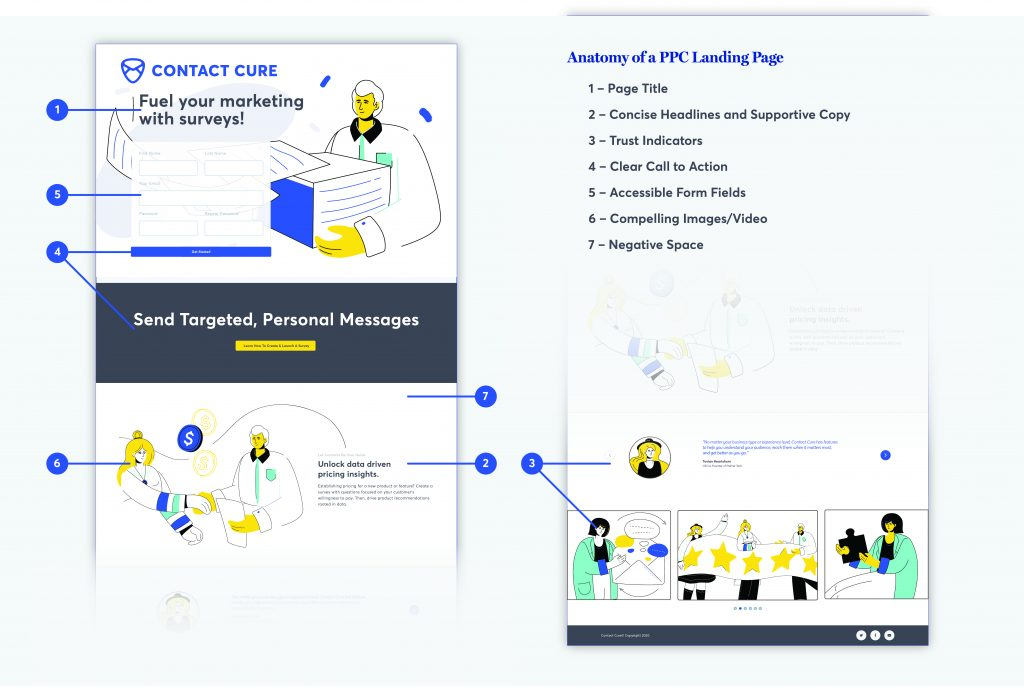
Image Source: Portent
Rank Recommendations and Set Approval Thresholds
Organizing recommendations into clear tiers helps teams act efficiently without losing oversight:
- Critical Fixes: Broken forms, incorrect tracking, broken destination URLs, or other issues directly affecting functionality or measurement.
- High-impact Opportunities: Changes backed by relevant performance data and a clear hypothesis.
- Lower-priority Refinements: Design adjustments or enhancements with limited evidence of meaningful business impact.
Agencies should define which routine, lower-risk changes a fulfillment team can implement independently and which require agency or client sign-off before moving forward.
Turning Landing Page Data Into Meaningful Tests
Spotting a problem is only the first step. Turning that observation into a structured test, rather than a batch of unrelated changes, is what produces results that can actually be trusted and repeated.
- Build a Testable Hypothesis: Every proposed change should connect to a specific performance issue and a clearly stated expected outcome. A hypothesis like "shortening the form from eight fields to four will increase submission rate without reducing lead quality" gives the team something concrete to evaluate once the test concludes.
- Choose the Right Variable: Common test variables include headline alignment, offer presentation, CTA wording, form length, and trust signals like testimonials or certifications. When practical, isolating a single meaningful variable makes the results easier to interpret. Changing the headline, the offer, and the form length all at once leaves teams unable to determine which change drove the outcome.
- Define Success Before Launch: Before a test goes live, the team needs to agree on the primary metric and any relevant guardrails. Depending on the client, this might mean lead quality, cost per qualified lead, revenue, or another business-specific outcome. A higher conversion rate is not automatically a win if the leads coming through are lower quality or less likely to close.
- Account for Testing Limitations: Traffic volume, conversion frequency, seasonality, and other simultaneous campaign changes can all distort test results. A page with low monthly conversions will take longer to produce statistically meaningful data, and drawing conclusions too early risks acting on noise rather than signal.
- Divide Testing Responsibilities: The agency owns the strategic hypothesis, the success criteria, and the evaluation of results. The fulfillment partner can support implementation, QA, data collection, and reporting within the agreed scope. Once a test concludes, interpreting the findings and deciding whether to continue, revise, or stop remains an agency decision, not a fulfillment one.
For context, Unbounce's 2024 Conversion Benchmark Report analyzed more than 41,000 landing pages, 464 million unique visitors, and 57 million conversions, finding a median landing page conversion rate of 6.6% across industries. That median offers comparative context. It is not a guaranteed target for every industry, offer, traffic source, or client, and performance below or above that median does not by itself indicate success or failure.
The Technical and Measurement Issues Agencies Must Retain Oversight Of
Implementing a change is not the finish line. Confirming that the page and its tracking still function correctly afterward is just as important as the change itself.
1. Conversion Tracking
Forms, calls, purchases, and other meaningful actions all need validation after any update. This includes checking event accuracy and watching for duplicate conversion counts, which can quietly inflate reported performance. Tracking should be verified after deployment rather than assumed to still be correct, since even minor page changes can break existing tags or analytics configurations.
2. Mobile Experience
Mobile checks should go beyond confirming that a page technically fits a smaller screen. The real test is whether important information, forms, navigation, and calls to action remain accessible and usable throughout the entire conversion journey on a phone, not just on the initial view.
3. Performance Diagnostics and Core Web Vitals
Loading speed, responsiveness, and visual stability all shape how a visitor experiences a page. Google's recommended Core Web Vitals thresholds provide useful benchmarks:
- Largest Contentful Paint (LCP): 2.5 seconds or less.
- Interaction to Next Paint (INP): 200 milliseconds or less.
- Cumulative Layout Shift (CLS): 0.1 or less.
These thresholds represent recommended user-experience targets, not guarantees of better conversion rates. Performance diagnostics should be weighed alongside actual visitor behavior and business results, not treated as a standalone measure of success.
4. Cross-System Coordination and Post-Deployment QA
Some changes extend beyond a fulfillment team's scope and require a developer, analytics specialist, CRM owner, or client approval. Post-deployment QA should check forms, tracking, redirects, destination URLs, and any other elements affected by the change. Issues that cross functional or technical boundaries need agency oversight to make sure nothing falls through the gap between teams.
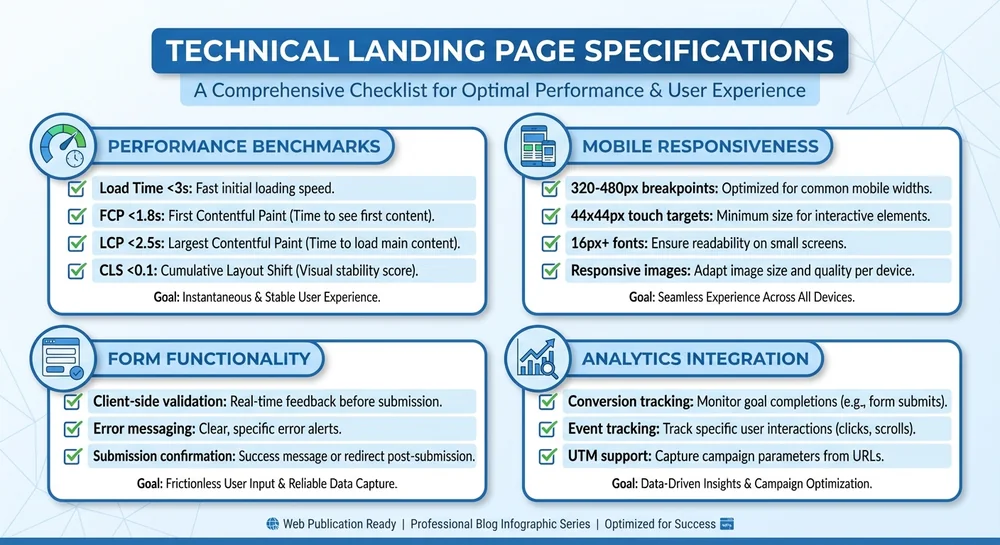
Image Source: Landy
Building a Repeatable Fulfillment Workflow Across Client Accounts
Scaling PPC fulfillment across multiple client accounts requires consistency in process, not uniformity in strategy. Every client's audience, offer, and business goals are different, even when the workflow supporting them is standardized.
- Standardize the Process, Not the Strategy: Shared audit templates, QA checklists, reporting formats, documentation standards, and approval procedures create consistency and reduce errors. These tools improve efficiency precisely because the recommendations that flow through them remain specific to each client's context, not because every client receives the same playbook.
- Create Clear Handoffs: Before a fulfillment team begins work, it needs a complete brief that includes the target audience and campaign objective, the approved offer and messaging requirements, the primary conversion action, relevant campaign and landing page performance data, and the scope of work along with approval requirements. Incomplete briefs lead to unnecessary revisions, conflicting instructions, and wasted time on both sides.
- Document Changes and Establish Review Cycles: Recording what changed, why it changed, who approved it, when it was implemented, and how success will be evaluated creates a clear paper trail. Recurring performance reviews and defined escalation procedures help teams catch issues early, evaluate results honestly, and refine the workflow over time.
Protect Agency Capacity With White Label PPC Fulfillment
Delegating repeatable execution and technical checks gives agency specialists more time to focus on client strategy, business outcomes, and account growth rather than getting pulled into every form check and tracking validation.
For agencies managing outsource PPC management needs across a growing client base, white label PPC management services can add execution capacity without requiring new hires.
DashClicks offers white label PPC fulfillment as one option for agencies seeking additional execution support while keeping client relationships and strategic decisions in-house. This kind of partnership works best when it is treated as added capacity, not a replacement for the agency's judgment about what each client actually needs.
Keep Strategy in Agency Hands
Effective Google Ads landing page optimization depends on clear ownership at every stage: execution, measurement, and strategic decision-making. Fulfillment partners can audit pages, implement approved changes, check technical functionality, and validate tracking. But prioritization, understanding client context, approving tests, and evaluating whether results actually serve the client's business goals are decisions that belong to the agency.
Fulfillment adds capacity. It does not replace the judgment required to decide what matters and why. Agencies that maintain this distinction can scale their PPC delivery with confidence, knowing that the execution layer supports their strategy rather than quietly reshaping it.