

.svg)
.jpg)
.svg)
.svg)
.svg)
.svg)
.svg)
A strategist I know keeps a screenshot pinned above her desk: a client's product page, ranked third for a fat commercial term, that had stopped mattering. The searcher never scrolled to it. An AI answer sat at the top, summarized the category in four sentences, named two competitors, and moved on. The ranking was real; the visibility was gone. That gap is why people go looking for AI SEO tools now, though most can't yet name what they're after.
So here's the honest shape of it. Most lists rank these products against each other, as if you were choosing one thing; you aren't. You're hiring a tool for a job, producing content an answer will quote, seeing whether it does, planning what to write next. Some platforms, such as SE Ranking and Semrush, cover several of these jobs within broader SEO suites, while others are built around a narrower specialty. The audience is already there: 34% of US adults have now used ChatGPT, and 58% of those under 30.
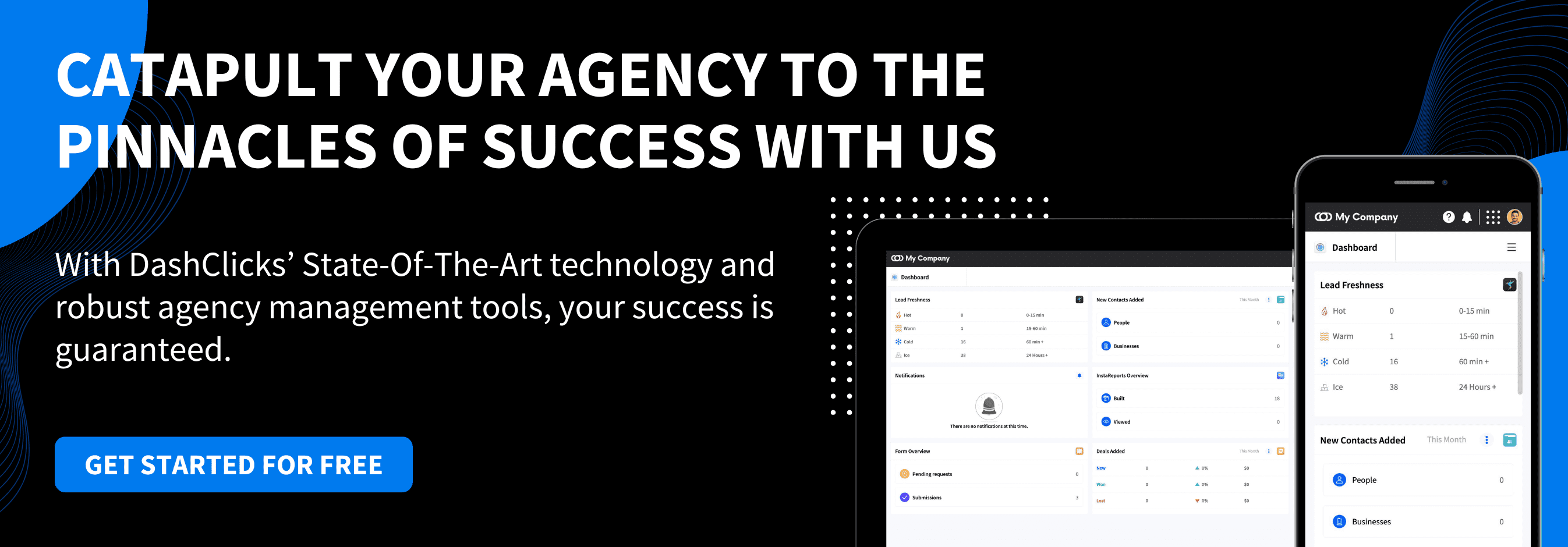
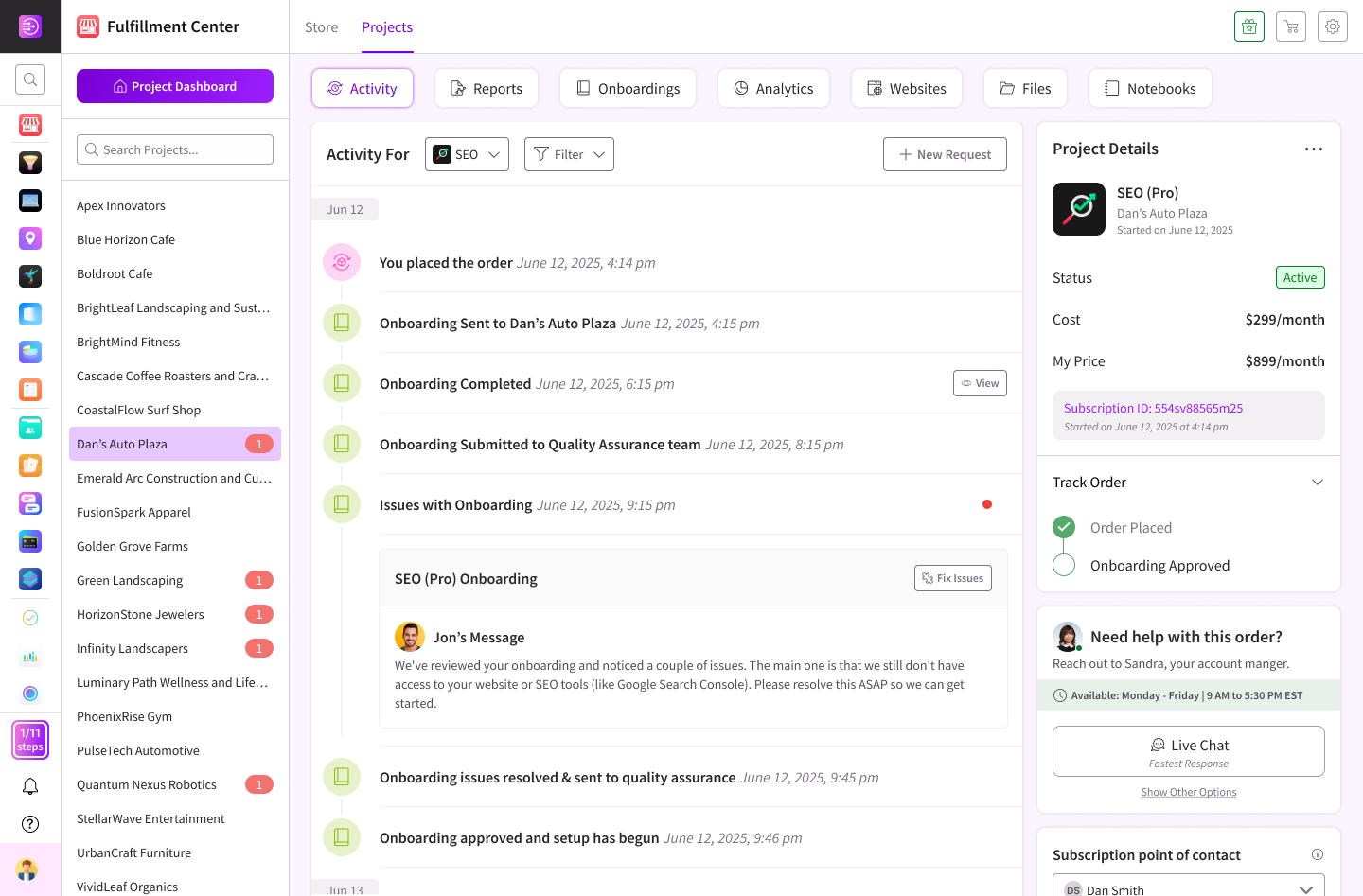
For agencies managing SEO across multiple clients, the tool itself is only part of the workflow. DashClicks, for example, provides white label SEO services that can complement AI-assisted research and content workflows, particularly when teams need to connect individual optimization tasks with a broader client SEO strategy.
The walk-through below sorts the eight tools by the job they are designed to do, rather than treating them as interchangeable products.
Job 1: Producing Content an AI Answer Will Actually Quote
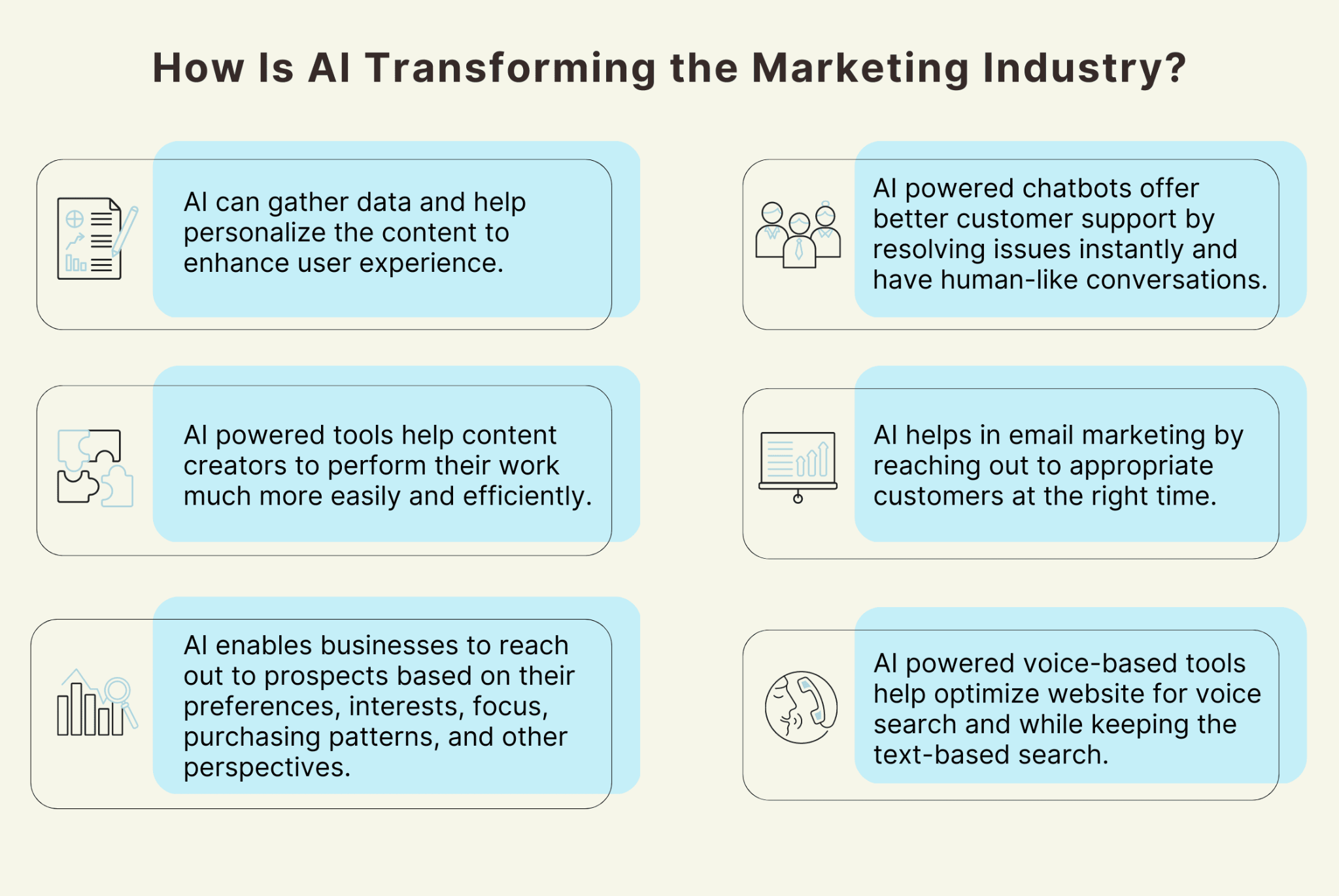
This is the job most teams mean by "AI SEO," and it isn't ranking: a position gets you ranked, being quoted gets you named inside the answer a person actually reads. The two used to travel together, then separated - only 1% of users click a source cited inside an AI summary, so the mention itself is often the prize. You write differently once you believe that: cleaner claims, tighter definitions, answers that survive being lifted out of context. The AI SEO tools relevant to this job, including SE Ranking, Surfer, Frase, and NeuronWriter - approach content optimization by comparing drafts with what's already performing in search.
Job 2: Knowing Whether AI Engines Mention You At All
You can't optimize what you can't see, and for most of a year that's what teams were flying without. The page ranks; does an AI answer cite it? Different question, different instrument. This is where AI search optimization tools earn their keep - watching the answers themselves, logging which brands get named, tracking your share of the conversation over time. SE Ranking, Peec AI, and Writesonic each do a version of this. The stakes are concrete: Google's AI Mode cites about 12.6 links per answer drawn from tens of thousands of domains, with only around 14% overlap with the organic top 10 (SE Ranking's AI Mode study). Ranking and being cited are now two different games; watching only the old one tells you less than half of what happened.
Job 3: Planning Topical Authority Before You Write
This is the least glamorous job, and the one that quietly compounds. Nobody screenshots a content map. But the teams cited consistently tend to be those who decided, months earlier, which territory to own - then covered it well enough that an AI model reads them as the authority. That's planning work, not writing work. MarketMuse's topic modeling and SE Ranking's keyword and gap data can both support this process, helping teams identify areas where a content cluster may need additional coverage. The payoff shows up late but large: generative-AI referral traffic grew more than tenfold between mid-2024 and early 2025, and those visits last 41% longer than non-AI traffic (Adobe). Authority turns that trickle into something you can plan around.
For agencies that handle the broader SEO strategy beyond content planning, services such as those offered by DashClicks can help connect topical research with ongoing search optimization. That distinction matters when content planning is only one part of a client's wider organic growth strategy.
Job 4: Doing It in One Site
Some teams would rather not assemble a stack at all - not chase four logins, four billing dates, four support queues. For them, Semrush folds AI content and visibility into modules inside the suite they already run, so the whole job happens under one roof. It's the pragmatist's answer, and no shame in it.
The Eight Tools, Evaluated by Use Case
The best AI SEO tools aren't the ones that win a category outright; they're the ones matched to a job - the generative AI SEO tools that draft and grade, the trackers that watch the answers, the planners that map the territory. Read the eight as a spectrum, not a leaderboard.
1. SE Ranking
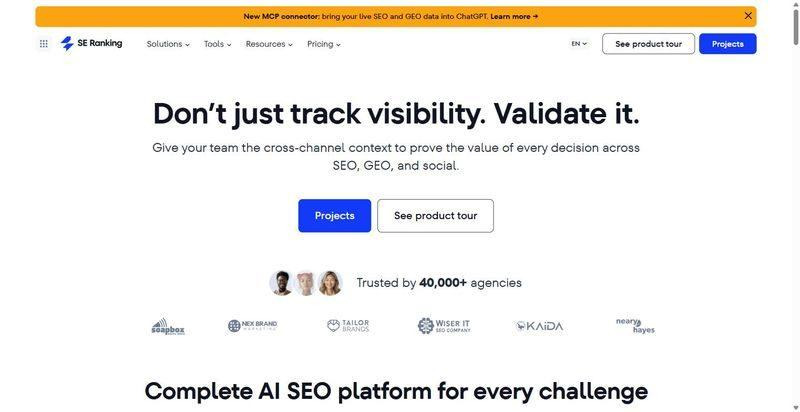
An AI-powered SEO platform that covers several of the jobs discussed in this guide, combining content optimization, SEO research, and AI visibility tracking.
Best for: Content teams that want to produce, track, and plan in one place, not stitch three tools together.
Standout: Its AI Results Tracker records how a brand is mentioned and linked across AI Overviews, AI Mode, Gemini, Perplexity and ChatGPT, storing the cached answers and their cited sources; the AI visibility dashboard turns "are we even in the answer?" from a guess into something you can read.
Pros:
- Grades a content editor draft against the live top 10.
- Tracks AI Results across five engines with cached answers and source intelligence.
- Keeps keyword, audit and gap data under one roof.
- Ships API and MCP access on every plan.
Cons:
- Reserves deeper sentiment and cross-country benchmarking for the AI Search add-on.
- Scales prompt and research caps with plan tier.
- Trails a dedicated specialist on any single, isolated job.
Pricing: Core $129/mo ($103.20/mo billed annually), Growth $279/mo; 14-day trial.
Where it lands: A broad option for teams that prefer to manage content, SEO research, and AI visibility tracking within one platform rather than using separate specialist tools; it concedes the specialist's edge and still earns its place, because most teams lose more hours to switching tools than to any one tool's ceiling.
2. Surfer SEO
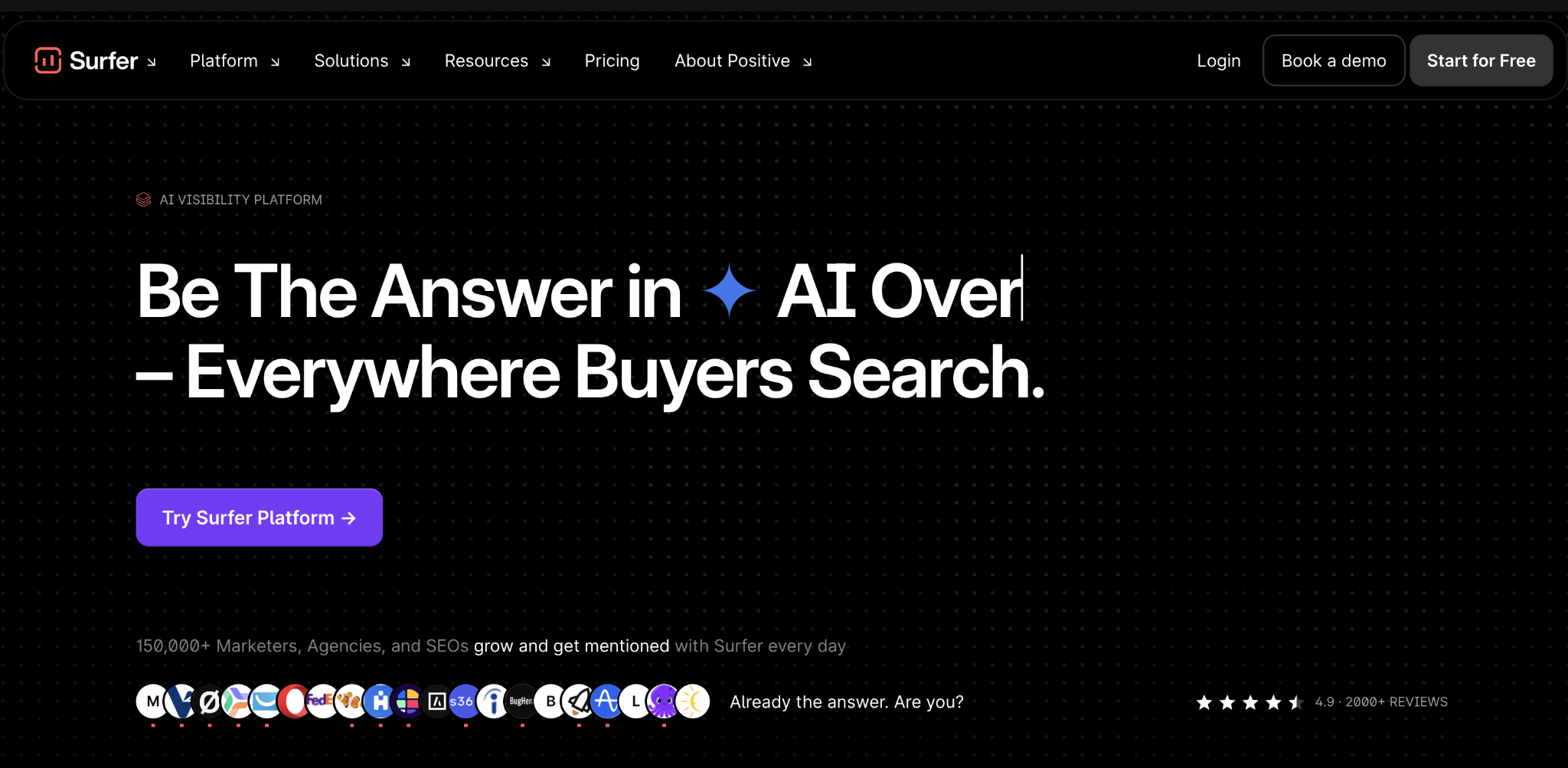
Real-time on-page grading that tells a writer, mid-sentence, whether a draft is complete against what already ranks.
Best for: Writing teams who want a shared, objective score every draft has to clear.
Standout: The Content Editor scores as you write and maps term coverage against the ranking pages, while newer AI-visibility prompt tracking watches ChatGPT, Perplexity and Google for whether your pages get named.
Pros:
- Grades fast enough to fit inside one editing pass.
- Bundles an AI writer and humanizer.
- Flags cannibalization and internal-link gaps.
- Draws its terms from the live SERP.
Cons:
- Prices multi-engine visibility tracking steeply.
- Caps documents and pages on lower tiers.
- Grades words but won't track a site.
Pricing: Discovery $49/mo, Standard $99/mo, Pro $182/mo (billed yearly).
Where it lands: The grader that ends the "is this done?" argument - the quality layer across a roster of writers, its ceiling the page, not the site.
3. Frase
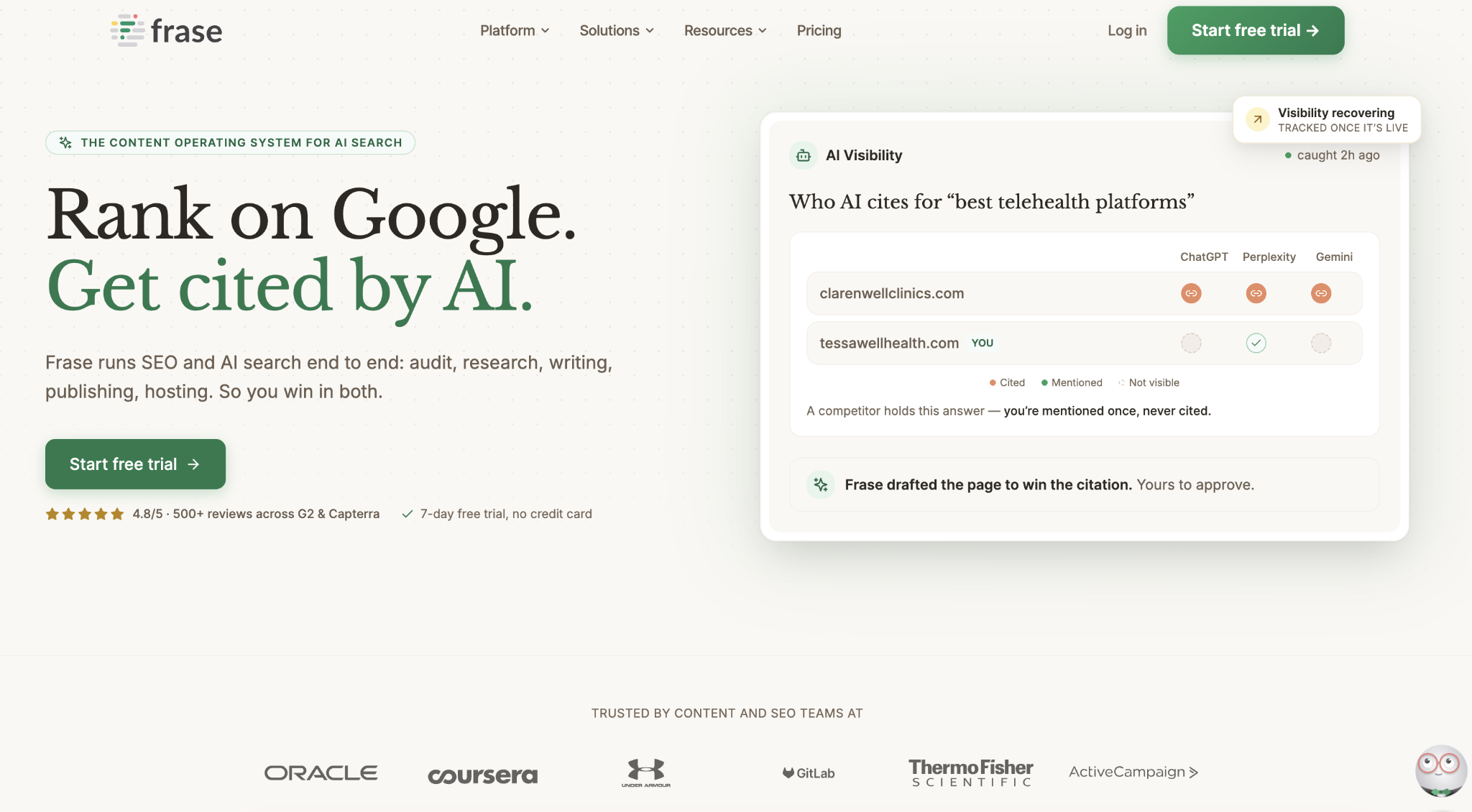
Turns a query into a SERP-based brief and outline fast, so writers start from structure, not a blank page.
Best for: Teams whose bottleneck is the research-to-brief step.
Standout: Frase pulls headings and questions from the ranking pages and builds a brief in minutes, then tracks answer coverage across ChatGPT, Google AI, Perplexity, Claude and Gemini as breadth widens by tier.
Pros:
- Compresses briefs from hours into minutes.
- Produces competent AI first drafts.
- Runs content-gap audits.
- Suggests internal links.
Cons:
- Tightens article and audit quotas at volume.
- Reserves its richest AI-visibility coverage for the top tier.
Pricing: Starter $39/mo, Professional $103/mo, Scale $239/mo (billed yearly).
Where it lands: A brief engine that quietly saves the hours nobody budgets for; buy it for the research-to-brief compression, and treat the AI-visibility layer as a bonus.
4. Semrush
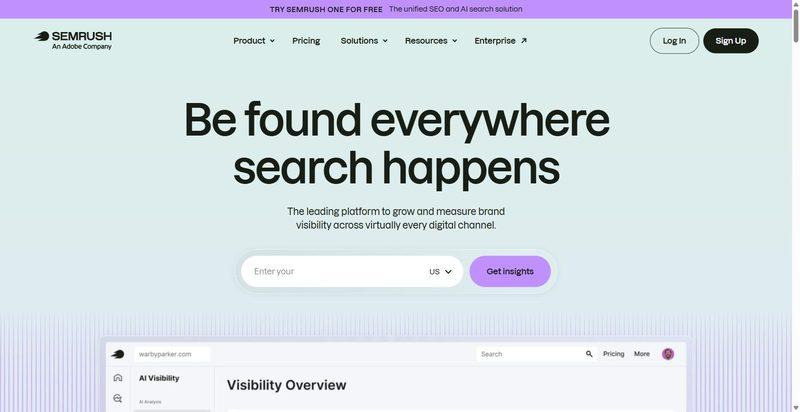
A full SEO suite that keeps its AI work in separate compartments - a Content Toolkit, an AI Visibility Toolkit, and an assistant.
Best for: Teams who would rather keep AI features inside a suite they already run.
Standout: The AI Visibility Toolkit tracks custom prompts daily across ChatGPT, Google AI, Gemini, and Perplexity, while ContentShake AI turns out SEO-scored drafts, all under one login.
Pros:
- Draws on broad, mature platform data.
- Generates SEO-scored drafts through ContentShake AI.
- Tracks prompts daily across four answer engines.
- Puts AI where the team already works.
Cons:
- Cost stacks across the base plan plus the AI Visibility and Content toolkits.
- Packaging was reorganized recently, so plan names shift under you.
- You reach the AI layer only through suite pricing.
Pricing: Content Toolkit $60/mo; AI Visibility Toolkit from $99/mo per domain; base plans $117 to $456/mo on annual terms.
Where it lands: Sensible when the suite is already your home; bought mainly for that AI layer, though, it becomes an expensive front door - a whole house for the use of three rooms.
5. MarketMuse
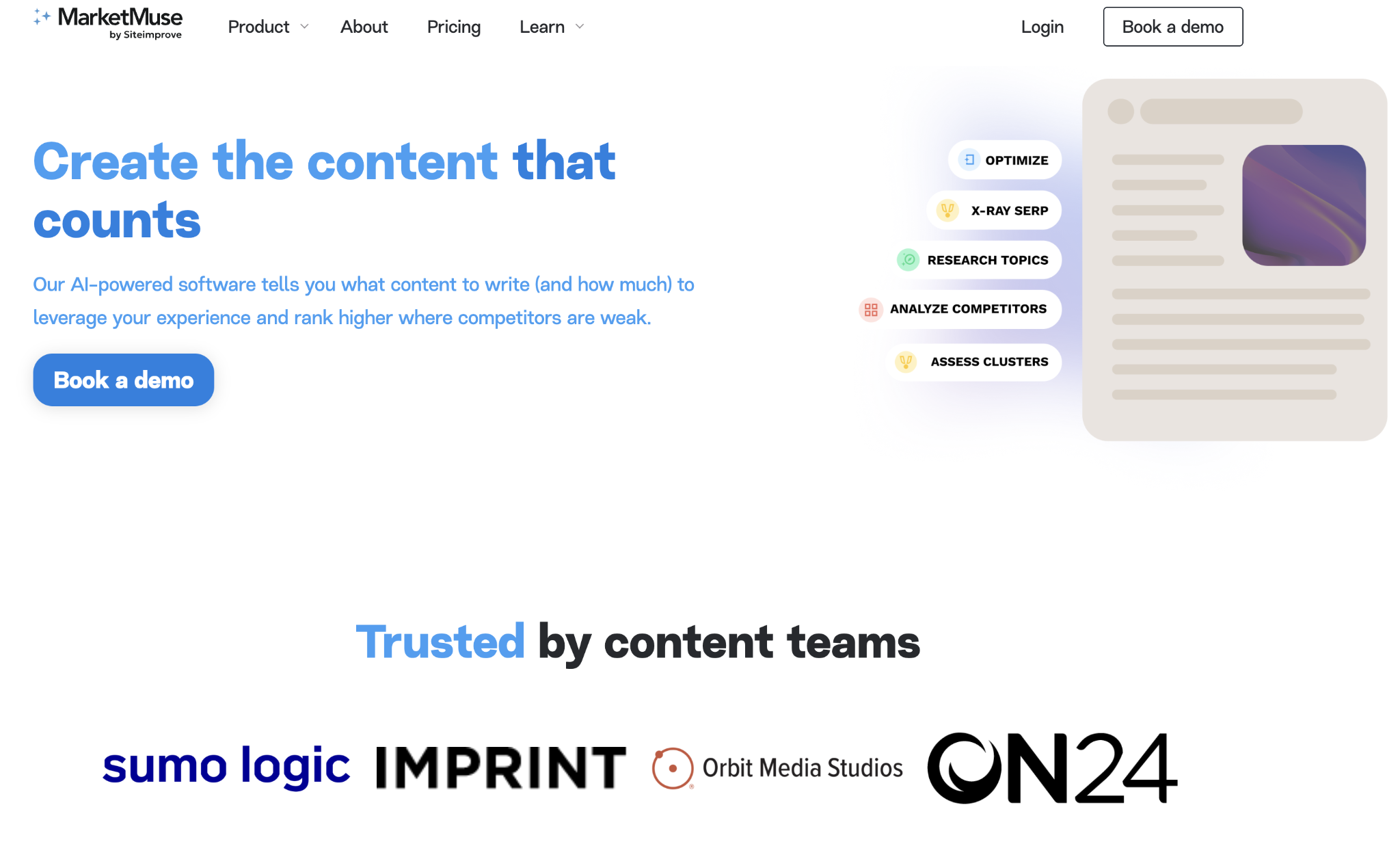
A content-planning platform built on topic modeling, made for the quieter decision of what to write before anyone opens a document.
Best for: Teams planning topical authority across a large library, not polishing a single page.
Standout: Proprietary topic modeling produces personalized difficulty and topic-authority scores, feeds nine brief types, and runs content-inventory analysis that maps coverage and gaps across an entire domain. It is less a grader than a cartographer.
Pros:
- Models topics in a way that earns its keep.
- Surveys the whole library through content inventory.
- Supplies multiple brief types for different jobs.
- Analyzes SERPs and keywords alongside the planning.
Cons:
- Paid pricing is demo-gated and stubbornly opaque.
- Query and brief caps run low on the lower tiers.
- Carries a learning curve before it repays the effort.
Pricing: Free tier at 10 queries a month; paid Optimize, Research, and Strategy by quote (Optimize historically around $149/mo).
Where it lands: The tool for the strategist who draws the map before booking the trip; for anyone grading one piece at a time, it is far more machinery than the task asks for.
6. Peec AI
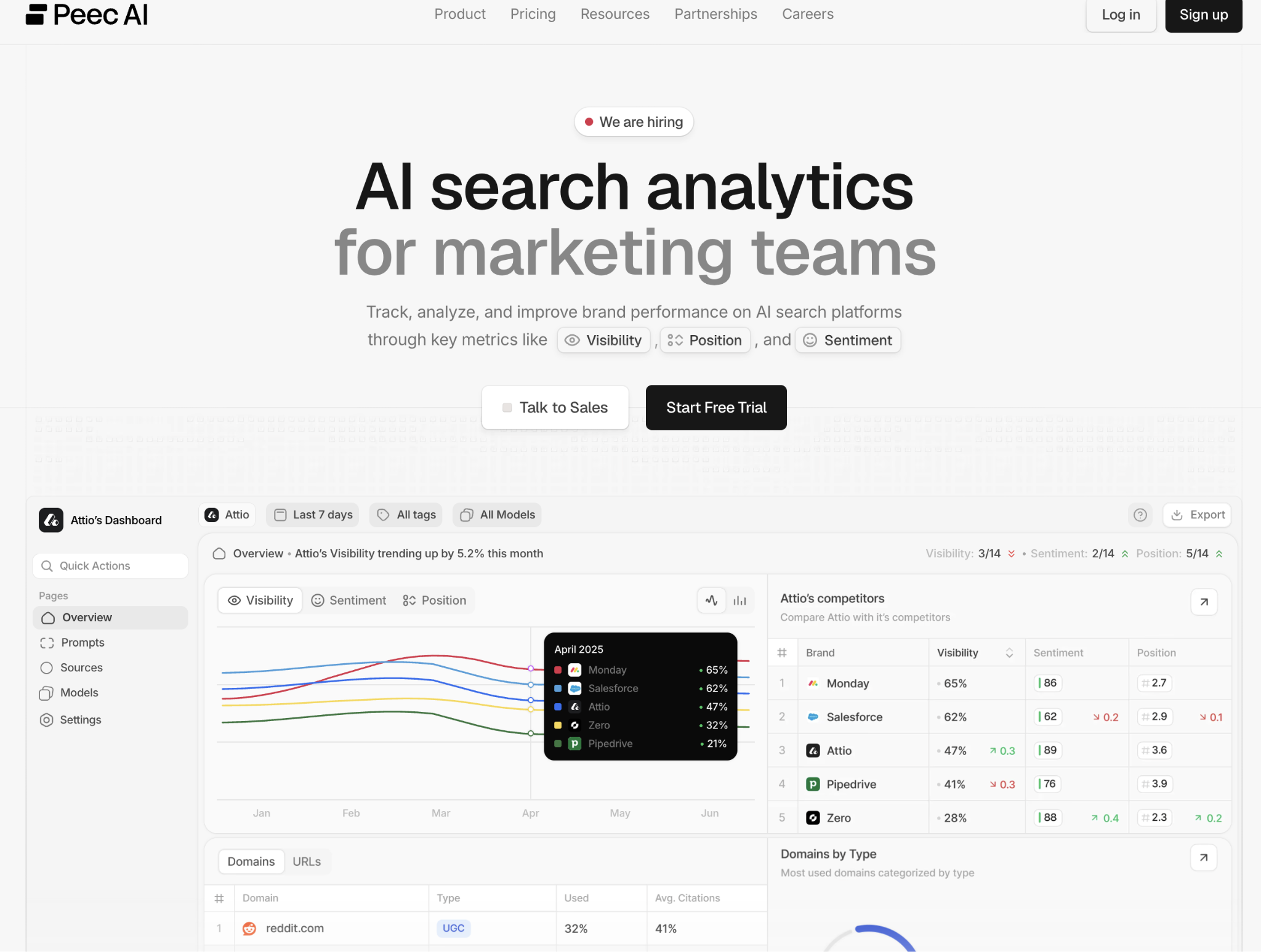
A focused AI-search analytics tool that measures brand visibility inside AI answers, and declines to do anything else.
Best for: Teams monitoring AI-answer share of voice against competitors.
Standout: It tracks brand mentions, share of voice, and cited sources across ChatGPT, Perplexity, Gemini, Copilot, and AI Overviews, with daily readings and prompt-level detail. The narrowness is deliberate.
Pros:
- Purpose-built for AI-visibility analytics.
- Surfaces competitor and cited-source views.
- Refreshes tracking daily.
- Reports cleanly, without clutter.
Cons:
- Does one job only, with no writing, audits, or classic rank tracking.
- Applies prompt and model limits on lower tiers.
- Charges more as you add models.
Pricing: Starter $95/mo, Pro $245/mo, Advanced $495/mo, with roughly 15% off on annual.
Where it lands: The right instrument when AI visibility is the whole brief; if your platform already tracks this respectably, it is a second subscription solving a problem you have mostly solved.
7. Writesonic
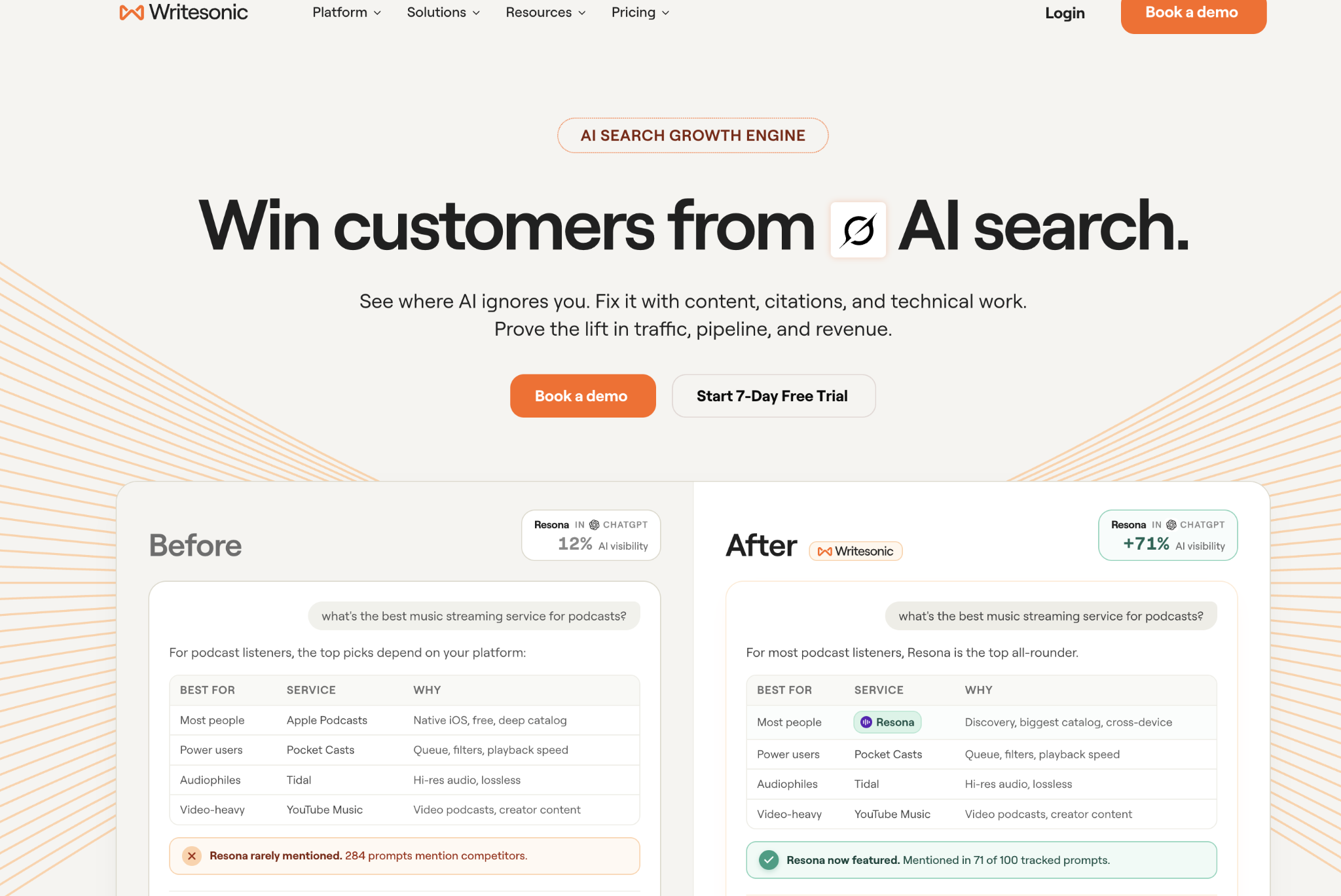
Rebuilt as an AI-search-visibility platform that pairs bulk article generation with audits and LLM/GEO tracking in one place.
Best for: Teams producing AI articles at volume who want answer-tracking in the same tool.
Standout: Bulk article generation runs alongside visibility tracking across ChatGPT, Gemini and Google AI Overviews; higher tiers add an Action Center that turns tracked gaps into on-page and off-page tasks, closing the produce-and-measure loop inside one screen.
Pros:
- Generates long-form articles at genuine volume.
- Runs site audits alongside production.
- Tracks visibility across AI answer engines.
- Adds sentiment analysis on higher tiers.
Cons:
- Reserves broadest LLM coverage and the full Action Center for Enterprise.
- Caps article counts even on Growth.
- Produces output that still needs a human editor.
Pricing: Starter $79/mo, Basic $199/mo, Growth $399/mo (billed yearly).
Where it lands: A throughput engine with a feedback loop, useful when volume is the constraint and someone still reads what ships; buy it for the loop, not the autopilot - the danger is in the pages nobody read before they went live.
8. NeuronWriter
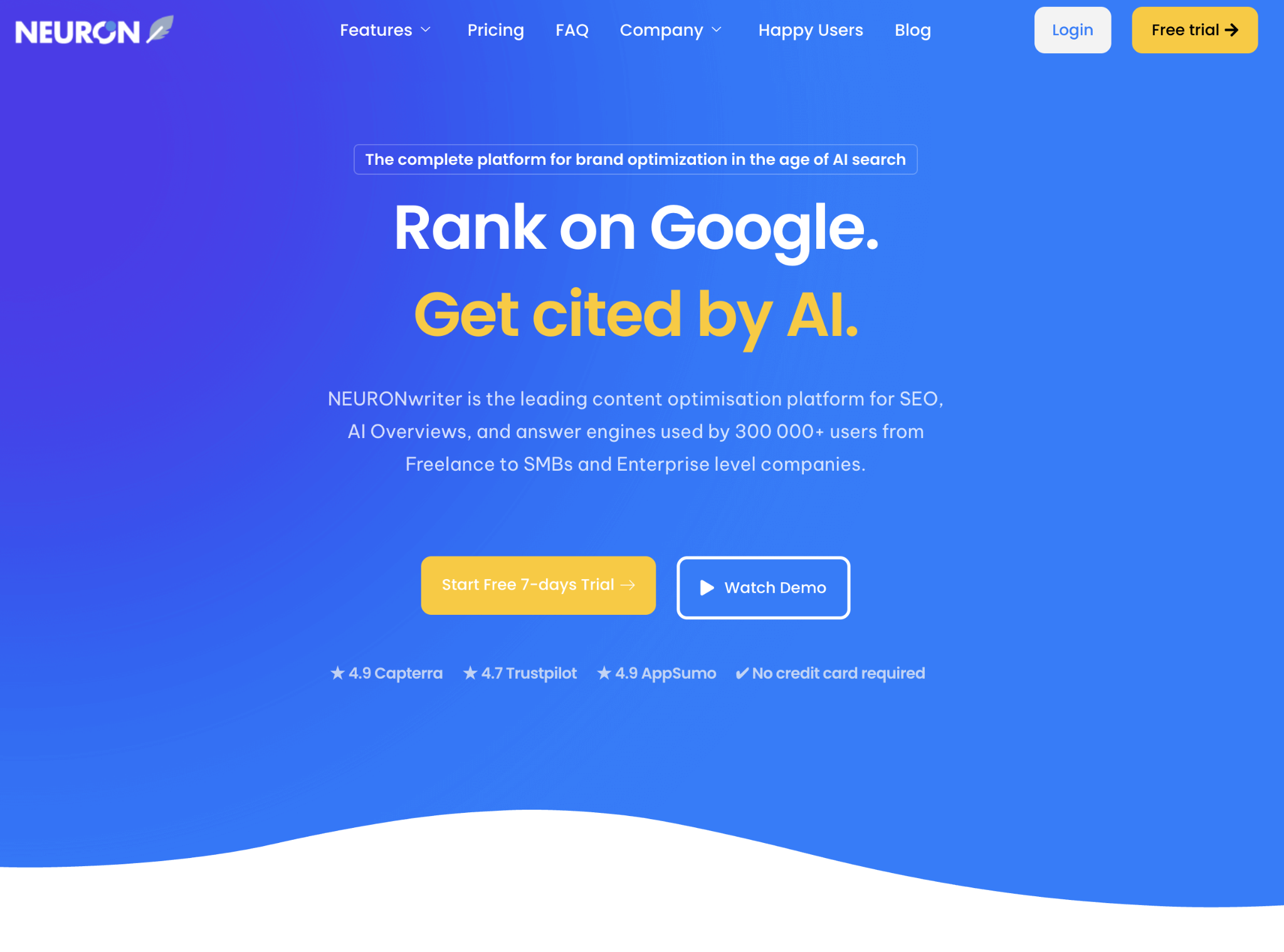
A semantic-SEO content optimizer that grades drafts against NLP term models and tracks answer coverage, all at a low entry price.
Best for: Teams wanting disciplined semantic optimization without a premium per-seat bill.
Standout: Semantic content optimization sits at the center, fed by SERP-based recommendations and a one-click AI writer; answer tracking spans Google, ChatGPT, Perplexity and AI Mode, with WordPress and Shopify integrations on higher tiers. It scores a draft the way a strict editor might: against what the topic demands, not what you hoped to say.
Pros:
- Scores drafts with credible semantic depth.
- Writes competent first-pass copy in one click.
- Tracks answer coverage across major engines.
- Prices its entry tier within easy reach.
Cons:
- Presents a more utilitarian interface than premium rivals.
- Caps projects and analyses on lower tiers.
- Gates advanced features behind higher plans.
Pricing: Bronze $23/mo ($19/mo annual), up to Diamond $117/mo.
Where it lands: The workmanlike optimizer for teams who want the discipline of a content score without the premium ticket; the payoff is a draft held to a real standard rather than a flattering one.
Where This Leaves You
You don't buy a category; you hire for a job - a reframe that survives every price comparison. Some platforms cover several parts of the workflow, while specialists make more sense when one task becomes the whole assignment: AI visibility when being cited is the mandate, content planning when building topical authority is the work itself, or content optimization when improving individual pages is the priority. Being cited in an AI answer and ranking in blue links are now two different games, and your toolkit has to play both. The tools multiplied because the jobs did.
The tools become even more useful when they sit inside a broader SEO workflow. Agencies can combine AI-assisted research and optimization with white label SEO services such as those provided by DashClicks, giving clients a strategy that extends beyond what any individual AI SEO platform can handle.
Skip if: your platform already tracks AI visibility (don't pay twice for the same signal), or you're tempted to hand a high-stakes, expertise-heavy page to an autonomous writer.
Choose for the job in front of you, and the shortlist gets short fast.
Frequently Asked Questions
Q1. Which AI SEO tool is best for content production?
Ans. It depends on the job. Writesonic is geared toward higher-volume content production with tracking, while NeuronWriter focuses on semantic content optimization. Other platforms, including SE Ranking, combine content production with additional SEO and AI-visibility features rather than focusing exclusively on one part of the workflow.
Q2. How do you track brand visibility in ChatGPT and AI Overviews?
You need a tool that monitors AI-generated answers and records whether your brand appears, how often it appears, and which sources are cited. Several platforms in this list track visibility across ChatGPT, Gemini, Perplexity, and Google AI Overviews, including SE Ranking, Writesonic, and NeuronWriter, although their coverage and reporting features differ.
Q3. Do AI writing tools hurt rankings?
Not inherently. The bigger concern is publishing inaccurate, unhelpful, or poorly edited content regardless of how it was produced. Search systems evaluate the quality and usefulness of the resulting content, so AI-generated drafts should be reviewed for accuracy, originality, relevance, and clarity before publication.
Q4. What job should you not hand to an AI SEO tool?
Anything where an incorrect answer carries significant legal, medical, financial, or reputational consequences. AI tools can assist with research, structure, and drafting, but high-stakes content still requires appropriate human expertise, fact-checking, and editorial judgment.


.svg)


.svg)
.svg)
.svg)
.svg)
.svg)