

.svg)

.svg)
.svg)
.svg)
.svg)
.svg)
Prospects rarely interact with a brand from the same starting point. On any given day, an agency might be advertising to someone who has never heard of the client, someone who recognises a problem but is not ready to buy, someone who visited the website last week, someone who interacted with a previous ad, someone who is ready to convert, and someone who has already purchased.
Showing all these people the same creative, offer, and call-to-action creates a disconnect. A first-time viewer needs a very different message from a shopper who abandoned their cart.
The central idea is simple. Effective Facebook Ads strategies should reflect where a prospect is in the customer journey, not simply who the prospect is.
A useful way to structure this is the funnel: Awareness → Interest → Consideration → Conversion → Retention. Each stage should influence six elements together: audience, message, creative, offer, CTA, and optimization.
The reach is certainly there. Facebook ads reached 2.28 billion users globally in January 2025, according to DataReportal's analysis of Meta advertising data. Scale alone does not guarantee results, but it does mean prospects at every stage are reachable.
Applying this framework across a handful of client accounts is where things get complicated. That is where scalable execution becomes a real concern for agencies, which is why Facebook ads outsourcing has become part of many agency operating models.
Map Facebook Ads to the Client's Customer Journey
The five-stage funnel gives you a shared language for every account you manage. Here is how the stages line up.
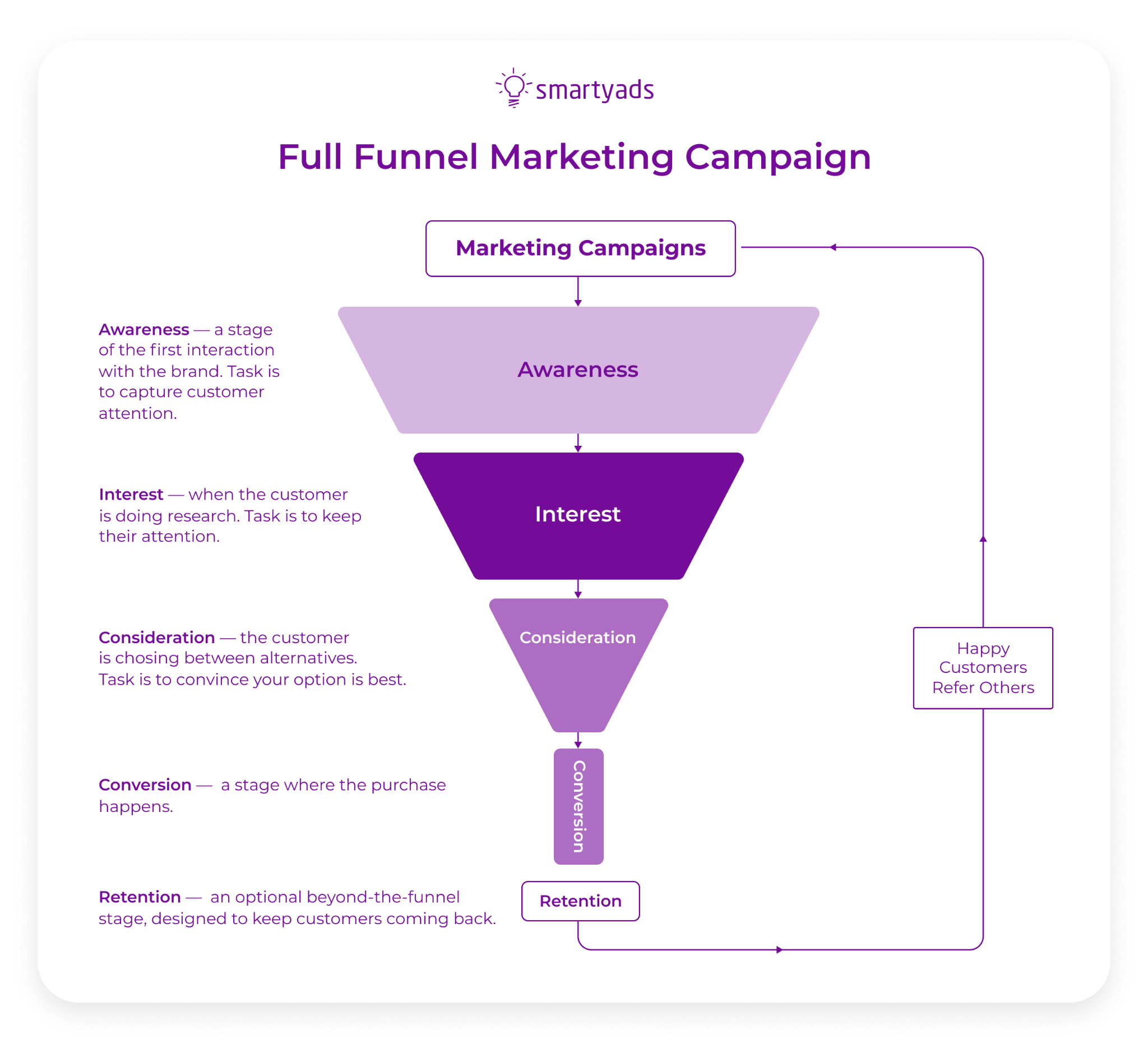
Image Source: SmartyAds
- Awareness: At this stage, the prospect does not know the brand exists. The job is to introduce the brand and surface a problem worth solving.
- Interest: The prospect now recognises a problem. Your ads should help them understand that problem better and hint at possible solutions.
- Consideration: Here the prospect is comparing options. This is the moment for evidence, education, comparisons, demonstrations, and proof.
- Conversion: The prospect is ready to act. Your job is to remove objections and encourage the desired action.
- Retention: The prospect has already bought. Now you reconnect with existing customers and encourage repeat purchases, upgrades, or complementary services.
The takeaway matters more than the labels. The customer journey should influence more than targeting. It should shape the entire advertising strategy.
Adapt Targeting and Messaging as Customer Intent Increases
Intent changes everything. As a prospect moves closer to a decision, your targeting narrows, and your messaging sharpens.
Awareness: Reach People Who Don't Know the Brand
Cold audiences call for a wider net and a lighter ask. Focus on:
- Broad audiences
- Relevant interests where they genuinely apply
- Problem-focused messaging
- Educational content
- Attention-driven creative
Awareness campaigns do not always need to push an immediate sale. Pushing a hard offer at someone who just met the brand usually wastes budget.
Compare these two messages. Instead of: "Book Your Free Consultation"
An awareness ad might use: "5 Signs Your Business Is Losing Leads Without Realising It"
The second message respects where the prospect actually is. It opens a conversation about a problem rather than demanding a commitment. The first line only makes sense once someone already trusts the brand.
Interest and Consideration: Help Prospects Evaluate the Solution
These audiences have shown some intent. You can retarget people based on signals such as:
- Video views
- Social engagement
- Website visits
- Previous ad interactions
- Content engagement
The messaging should follow a natural progression: Problem → Solution → Benefits → Proof.
Creative that works well here includes:
- Educational ads
- Demonstrations
- Testimonials
- FAQs
- Comparisons
- Case-study-style content
The goal is confidence. You are helping the prospect believe this solution fits their situation.
Conversion: Focus on High-Intent Prospects
Conversion audiences have signalled they are close. Think about people who:
- Viewed a product or service page
- Started a form
- Added a product to cart
- Visited pricing information
- Repeatedly interacted with the brand
For these audiences, lean into:
- Stronger offers
- Clear CTAs
- Social proof
- Objection handling
- Appropriate urgency
As a reference point, WordStream's 2025 benchmark found that 726 U.S. Facebook/Meta lead campaigns averaged a 7.72% conversion rate. Treat this as a benchmark, not a universal target. Performance varies by industry, campaign objective, offer, audience, and conversion process, so one client's healthy number could be another client's warning sign.
Match Creative and Offers to Each Stage
Changing your targeting is not enough on its own. If the creative and offer do not match the prospect's level of intent, even a perfectly built audience will underperform.
Here is a quick reference for creative and CTA by stage:
Awareness:
Creative: Hooks, problems, educational content
CTA: Learn More
Interest
Creative: Educational videos, guides, solution explanations
CTA: Explore / Learn More
Consideration
Creative: Testimonials, demonstrations, comparisons, benefits
CTA: See How It Works / Get Details
Conversion
Creative: Offers, proof, urgency, objection handling
CTA: Book / Buy / Get a Quote
Retention
Creative: New products, complementary services, upgrades
CTA: Shop / Upgrade / Learn More
The pattern is clear. The further a prospect moves through the customer journey, the more specific the advertising can become.
Plan for Creative Fatigue
Even great creativity wears out. When the same audience sees an ad too many times, performance slips and costs climb. Agencies need a repeatable process for this, covering:
- Monitoring creative performance
- Identifying fatigue early
- Refreshing messaging
- Testing new formats
- Leaving well enough alone when a campaign is still performing
That last point is easy to forget. Refreshing a winning campaign too soon can do more harm than good.
Build Different Facebook Ad Strategies for Different Clients
Here is where many agencies slip. The five-stage framework is universal, but the journey underneath it is not. You cannot copy one client's campaign structure onto another and expect it to fit.
Look at how three common client types differ.
1. Local Service Business
Journey: Awareness → Problem Recognition → Service Research → Lead → Sales Call
The focus is local reach and lead generation. Ads often drive form fills or calls within a defined service area, and the sales call closes the deal.
2. Ecommerce
Journey: Discovery → Product View → Cart → Purchase → Repeat Purchase
Here you lean on product discovery, remarketing to cart abandoners, direct purchase conversion, and repeat-purchase campaigns for existing buyers.
3. B2B
Journey: Awareness → Education → Lead → Qualification → Sales → Customer
B2B journeys tend to run longer and add a qualification step. A lead is rarely a customer straight away, so nurturing and sales involvement matter more.
Several factors reshape the journey from client to client:
- Sales cycle length
- Average order value
- Purchase frequency
- Decision complexity
- Number of decision-makers
- The client's sales process
- The actual conversion goal
The lesson is worth stating plainly. The framework can be standardised. The customer journey cannot. Agencies need a repeatable methodology without forcing every client into an identical campaign structure.
Use Performance Data to Refine the Customer Journey Strategy
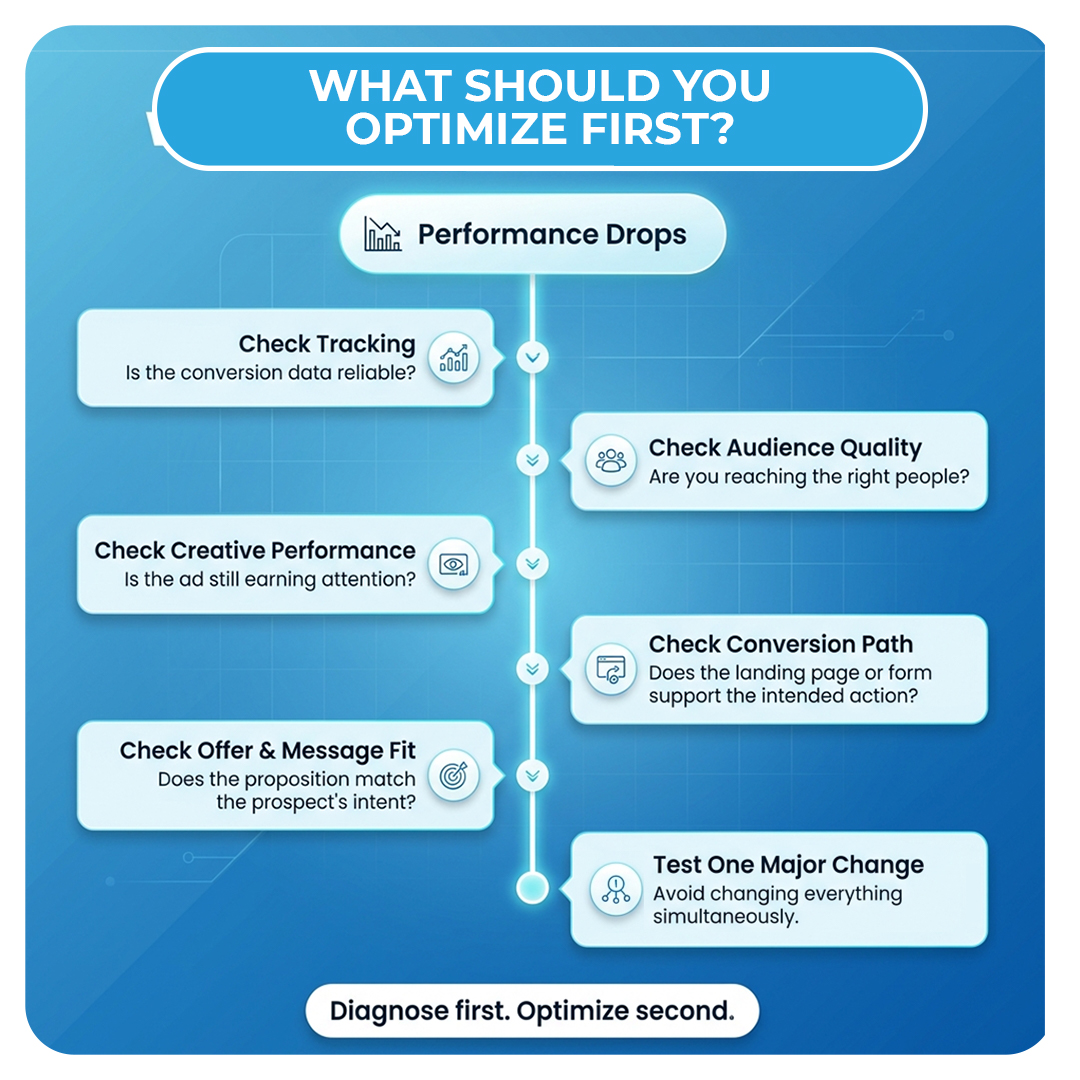
A funnel is not something you build once and leave alone. It needs regular review, because prospect behaviour and market conditions shift.
Ask these questions on a recurring basis:
- Which audiences are progressing?
- Where are prospects dropping off?
- Which creative generates qualified actions?
- Which stage has the highest cost per acquisition (CPA)?
- Which audiences need additional retargeting?
- Which campaigns deserve more budget?
- Which campaigns should be reduced or replaced?
Different stages call for different KPIs. Judging an awareness campaign by conversions makes little sense.
Awareness
- Reach
- Impressions
- Video views
Interest / Consideration
- Engagement
- Landing-page views
- Content interactions
- Leads
Conversion
- Conversions
- CPA
- Conversion rate
- Return on ad spend (ROAS)
Retention
- Repeat purchases
- Customer value
- Repeat conversion rate
Campaign objectives also shape what "good" looks like. WordStream's 2025 data shows Facebook traffic campaigns averaged a 1.71% click-through rate (CTR), while Facebook lead campaigns averaged 2.59%. Comparing a traffic campaign against a lead-campaign benchmark would give you a misleading picture. Use benchmarks for context, not as automatic pass or fail thresholds.
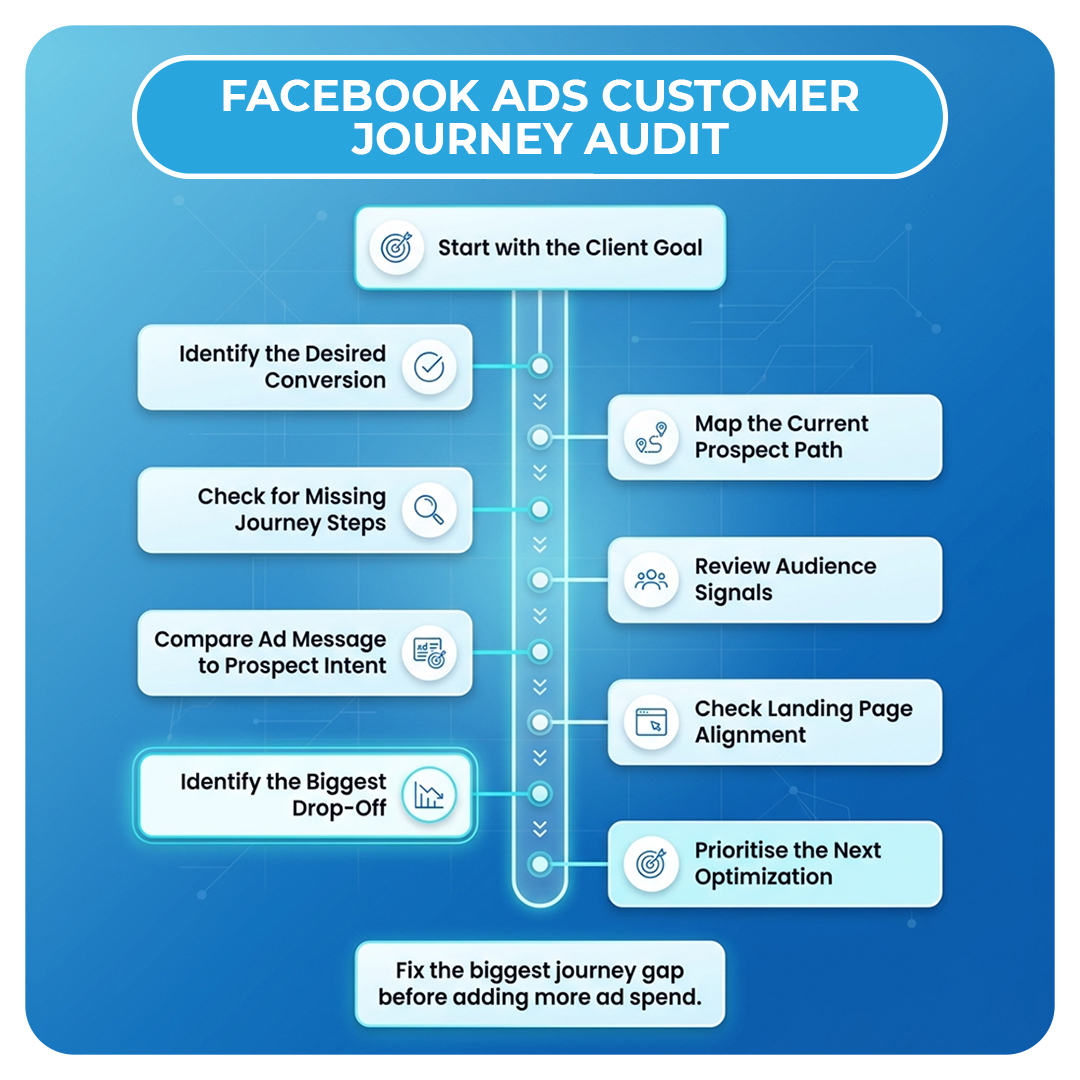
The Challenge of Managing Full-Funnel Facebook Ads Across Multiple Clients
Strategy is one thing. Executing it across a full client roster is another.
Picture an agency with four clients:
- Client A: Awareness plus lead generation
- Client B: Ecommerce plus retargeting
- Client C: B2B lead generation plus nurturing
- Client D: Local service plus lead generation and remarketing
No two of these accounts share the same setup. Each one demands different:
- Audiences
- Campaign structures
- Creative
- Testing
- Optimization
- Reporting
At this point, the challenge stops being about understanding Facebook Ads. The real question becomes whether you have enough specialist execution capacity to do the work well.
That pressure shows up in several ways:
- More campaign management
- More creative testing
- More optimization
- More reporting
- More account coordination
- More client communication
- Greater risk of inconsistent execution
Costs move too. WordStream's 2025 data found Facebook lead campaign cost per lead (CPL) rose 20.94% overall to $27.66, with performance varying substantially by industry. This does not prove that agencies must outsource. It does show why campaigns need ongoing monitoring and adjustment rather than a set-it-and-forget-it approach.
How White Label Facebook Ads Helps Agencies Manage Full-Funnel Campaigns?
When execution capacity becomes the bottleneck, white label Facebook ads services offer a way forward. The point is to solve a complexity problem, not simply to cut costs.
1. Add Fulfillment Capacity
Agencies can take on more Facebook Ads work without hiring a new specialist for every account. This makes it easier to say yes to new clients without overloading the existing team.
2. Support Different Customer Journey Stages
A capable partner can support the full range of campaign types, including:
- Awareness campaigns
- Retargeting
- Lead generation
- Conversion campaigns
- Customer re-engagement
3. Access Specialist Execution
Practical support often covers:
- Campaign setup
- Audience targeting
- Retargeting
- Creative testing
- Campaign optimization
- Performance monitoring
4. Maintain Client Ownership
Clear boundaries keep the relationship clean.
The Agency Owns:
- Strategy
- Client goals
- Communication
- Approvals
- The overall account relationship
The Fulfillment Partner Supports:
- Campaign execution
- Optimization
- Monitoring
- Recurring PPC tasks
Put simply, white label fulfillment allows agencies to standardise how campaigns are executed without standardising how every client's customer journey is marketed. That balance is exactly why many teams choose to outsource Facebook Ads execution while keeping strategy in-house.

How DashClicks Supports Facebook Ads Fulfillment for Agencies?
DashClicks is one example of a white label Facebook Ads fulfillment model built with this operating structure in mind.
Its relevant capabilities map closely to the challenges covered above:
- White label Facebook Ads fulfillment
- Campaign management
- Audience targeting
- Retargeting
- Campaign optimization
- Creative support
- Performance monitoring
- Quality assurance (QA)
- White-label reporting
Taken together, these support agencies run several different customer journeys at once. An awareness build for one client, a retargeting sequence for another, and a B2B lead-nurture setup for a third can all move forward without stretching a single in-house specialist across every task.
The division of responsibility stays intact throughout. DashClicks can help maintain execution capacity while the agency retains ownership of client strategy, client communication, approvals, and the overall relationship.
For agencies weighing up the best white label Facebook ads support for their roster, the deciding factor should be execution reliability across varied account types, not promises about specific outcomes. Fulfillment support is about capacity and consistency, not guaranteed leads, revenue, or ROAS.
The Right Message at the Right Stage
Not every prospect needs the same ad. Customer intent should influence targeting, messaging, creative, offers, CTAs, and optimization together, not one element in isolation.
Awareness audiences need a lighter, problem-first message, while high-intent prospects respond to proof, offers, and clear next steps. On top of that, different client types follow different journeys, so a local service business, an ecommerce store, and a B2B firm each need their own structure.
None of this works without ongoing attention. Performance data should feed back into the funnel so campaigns keep improving. Run this across many accounts at once and the execution load grows fast, which is where white label fulfillment can add capacity without forcing you to build a bigger in-house team overnight.
The main point is this. The best Facebook Ads strategy isn't simply about reaching the right audience. It's about understanding where that audience is in the customer journey and giving them the right message at the right stage. Getting there at scale is as much an operations problem as a marketing one.
More clients bring more campaign complexity, and more complexity raises your fulfillment requirements. If your roster is growing faster than your team, it may be worth exploring how DashClicks' white label Facebook Ads fulfillment can add execution capacity while you keep full ownership of strategy, communication, and client relationships.


.svg)


.svg)
.svg)
.svg)
.svg)
.svg)