

.svg)

.svg)
.svg)
.svg)
.svg)
.svg)
Most agencies trying to crack the $10K/month tier are still pitching like it's 2019. A deck, three case studies in a PDF, two sales calls, a Calendly link, and a hope. Meanwhile, the prospect has six tabs open, three other agencies in their inbox, and an AI assistant summarizing all of you into a single comparison table.
The pitch motion broke. Most owners haven't noticed yet because the $1-3K retainer business still closes on momentum and referrals. But the moment you try to move that same motion upmarket, the close rate collapses. Bigger budgets mean bigger buying committees, more scrutiny, and longer cycles. Decks don't survive that.
Video does. Not "we should do more video" video. A specific, ordered stack of five assets that compresses trust, demonstrates judgment, and lets a five-person committee pre-sell you to each other while you sleep. That is what changes the unit economics of a six-figure agency relationship.
This is the playbook we use and the one we'd hand any agency owner trying to break out of the $3K ceiling in 2026.
Why Video Maps to Higher-Ticket Sales in 2026?
Four things shifted in the last 18 months, and together they make video the cheapest trust-builder an agency can deploy.
Trust collapsed faster than tooling caught up. Buyers assume your case studies are cherry-picked and your testimonials are friend favors. A 90-second clip of a real strategist explaining a real tradeoff does more for credibility than ten written reviews. You can fake a logo wall. You can't fake the way someone talks about their own work for 90 seconds straight.
AI made everyone sound the same. Every agency website now opens with "we drive growth through data-driven strategy." Every cold email leads with "I noticed you're hiring." Text is commoditized. Video is the last channel where personality still cuts through, which is why the smartest agencies are leaning hard into the B2B video trends shaping 2026 and treating the medium as a moat, not a marketing tactic.
Buying committees got wider. A $10K/month decision now routes through a CMO, a head of growth, a finance lead, and sometimes a founder. You're not in the room for 80% of the conversation. Video is the only asset that scales your pitch into that room without you. A founder forwarding a 3-minute case study video to her CFO is worth more than three live calls.
Attention asymmetry got brutal. A founder will skim your proposal for 90 seconds. She'll watch a well-cut video for 4 minutes. That extra 2.5 minutes is where deals are won.
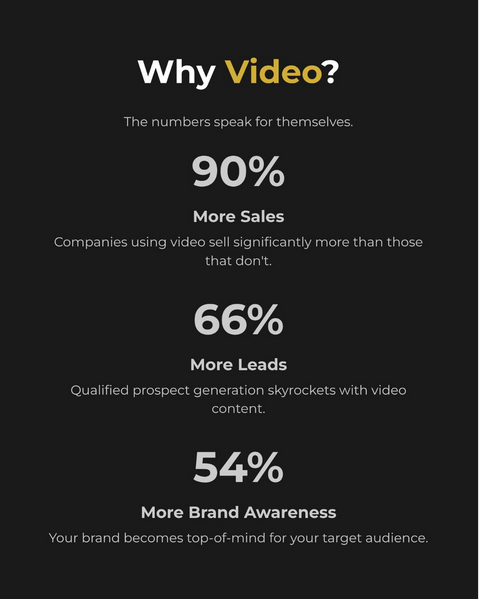
Image Source: Instagram
The 5-Asset Video Stack That Lets Agencies Pitch $10K+ Retainers
This is the stack. Build it in order. Don't skip the fun ones.
1. The 90-Second Positioning Film (Homepage Hero)
What it does: tells a $10K-budget visitor, in under two minutes, who you serve, what you believe, and why you're different. Not a "sizzle reel." A point of view, delivered to camera by the founder or lead strategist.
Length: 75-100 seconds. Anything over two minutes loses the senior buyer.
Lives at: top of the homepage, autoplay muted, with captions baked in.
The best ones name a specific enemy. "We don't do retainers for agencies who measure success in impressions." That kind of line filters out the $2K tire-kickers and pulls in the buyer who's been burned before. Good positioning borrows the rules of strong video storytelling, which means stakes, specificity, and a clear before-after.
2. The Vertical-Specific Case Study Video (Proposals)
What it does: replaces the three-page case study PDF that nobody finishes. A 2-3 minute interview-style cut with the client on camera, B-roll of the actual work, and hard numbers on screen.
Length: 150-180 seconds. One per vertical you sell into.
Lives at: inside proposals, on a dedicated `/work/[client-name]` page, and in cold outreach as a contextual proof point.
Build one for each of your top three verticals. A SaaS prospect doesn't care about your dental client. A dental practice doesn't care about your B2B fintech win. Generic case studies signal that you're generic.
3. The Strategist POV Shorts (LinkedIn-Native)
What it does: builds a personal brand for the senior strategist who closes deals, so prospects show up to the first call already half-sold.
Length: 45-90 seconds, vertical, captioned, hook in the first 1.5 seconds.
Lives at: LinkedIn, primarily. Cross-post to YouTube Shorts and Instagram Reels if you have bandwidth.
The bar for shorts is lower than agencies think. A phone, a clip-on mic, and the right video maker gets you publishable assets in under an hour each. "Why don't most ecommerce brands run TikTok ads in Q1." Not "5 tips for better marketing." Opinions are what justify a senior fee. If you want to go deeper on the long-form side as well, there's a real argument for building out a YouTube channel, but only after the shorts engine is humming.
4. The Proposal Walkthrough (Async Loom Pitch)
This is the one most agencies skip and it's the one that moves the needle most. After the discovery call, instead of booking a second "proposal review" call, you send a 6-12 minute screen-recorded walkthrough of the proposal with you on camera in the corner.
Length: 6-12 minutes. Don't pad it.
Lives at: a Loom or Vidyard link inside the proposal email, with view tracking on.
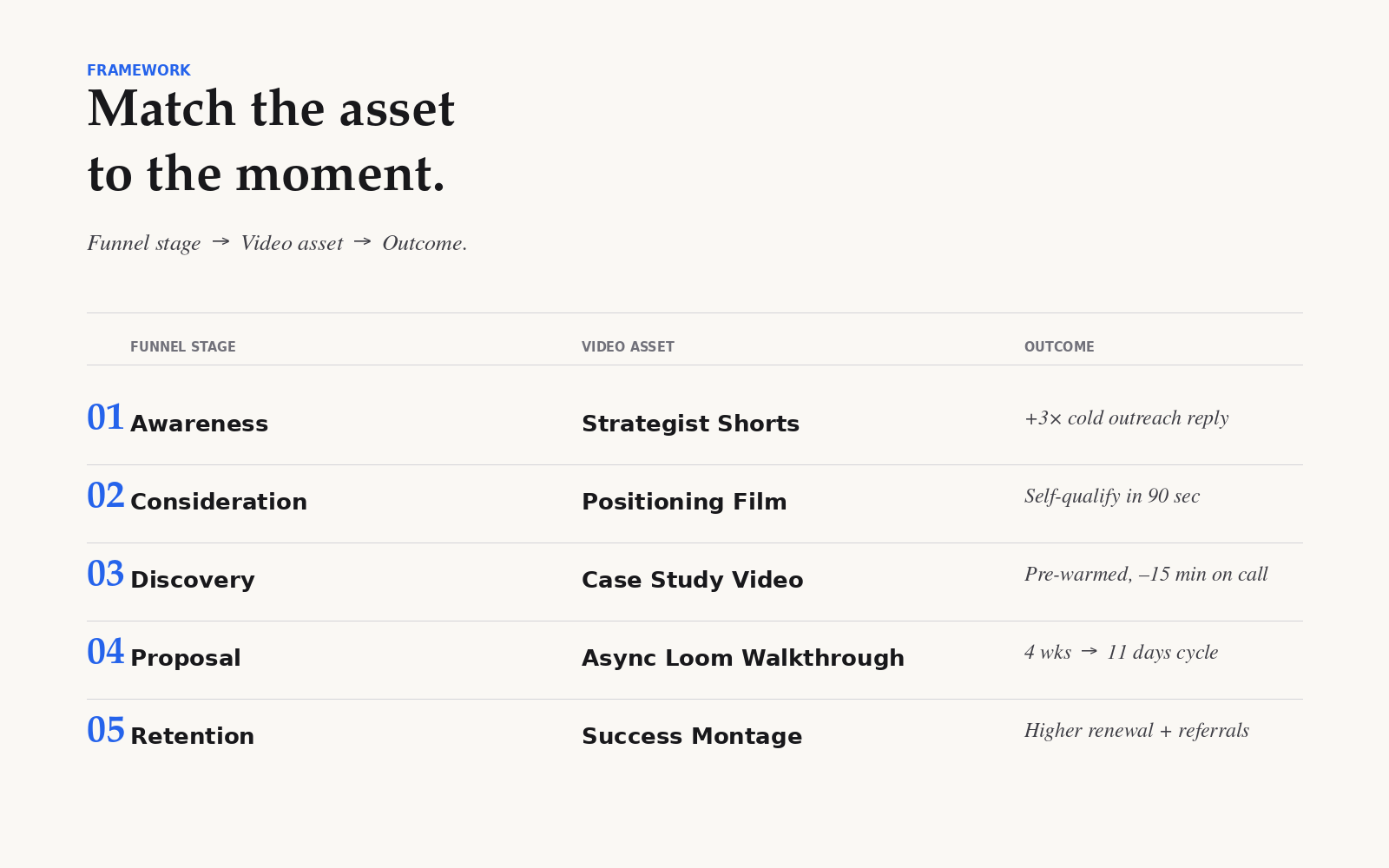
Why it works: the prospect can forward it to her CFO, watch it twice, and pause to take notes. You also see exactly who watched, for how long, and where they re-watched. That data alone is worth the production cost. We've seen this single asset compress the sales cycle from 4 weeks to 11 days on six-figure deals. For a deeper take on integrating video across the full sales motion, this guide on using video inside a marketing strategy is a solid starting point.
5. The Client Success Montage (Retention and Referrals)
What it does: keeps existing clients sold (so they renew at higher rates) and turns them into referral engines.
Length: 60-90 seconds, produced quarterly.
Lives at: the QBR deck, a private client portal, and the client's own internal Slack when they want to show their boss why the agency line item is justified.
This is the cheapest asset to produce and the one with the highest dollar return. A client who can forward a great quarterly recap video to their CEO is a client who doesn't churn when the CMO turns over.
How to Produce All Five Without Burning $50K?
Here's the lean stack we actually use. Total upfront cost: under $3,000. Ongoing monthly: roughly $1,500-2,000.
Hardware:
- iPhone 15 Pro or 16 Pro (you already own this). Shoots 4K, ProRes, log color. $0 incremental.
- A $120 lavalier mic (DJI Mic 2 or Rode Wireless ME). Audio is 70% of perceived production quality.
- A $90 LED key light. One light, behind the camera, slightly off-axis.
- A $40 tripod. That's it.
Software:
- Riverside or Descript for remote client interviews. Around $24/month. Descript's editing-by-transcript is a cheat code for the proposal walkthroughs and shorts.
- CapCut Pro or Premiere for finishing. $10-20/month.
- Loom or Vidyard for async pitches. $15/month, and the analytics pay for themselves on the first closed deal.
People:
- One freelance editor at $300-500 per finished video. You find these on Twitter, in the Descript community, or in agency Slack groups. Avoid Fiverr for anything client-facing.
- A part-time producer/scheduler (5-8 hours a week) if you're producing shorts at volume. $400-600/month.
That's the whole rig. The 90-second positioning film, done once and updated annually, runs $800-1,500 if you outsource the cut. Case study videos, $400-600 each. Shorts, $50-100 per finished asset once you have the workflow dialed.
Compare that to the $20-50K agencies used to spend on a "brand video" project, and the math gets interesting fast. If you want to scale further without hiring in-house, white label fulfillment is a reasonable way to handle the editing layer once your volume goes past 8-10 finished videos a month, and it keeps your agency margins intact while you scale output.
Where to Deploy Across the Funnel?
Building the assets is half the work. The other half is putting them in the right place at the right moment.
- Top of funnel: Strategist POV shorts on LinkedIn. Positioning film on the homepage. Run the shorts as paid retargeting against website visitors for around $300-500/month.
- Cold outreach: Embed a 30-second personalized Loom inside the first email. Not the case study, not the pitch. Just a strategist talking about something specific to that prospect's business. Reply rates roughly 3x in our testing.
- Discovery call: Send the vertical-specific case study video the day before, as homework. Prospects show up warmer and you skip 15 minutes of "tell me about your other clients."
- Proposal: Send the async walkthrough instead of booking a second call. Use the view-tracking to time your follow-up.
- Retention: Quarterly success montage delivered alongside the QBR. Reference it in renewal conversations.
- Referral: When a client says "this was great," ask for a 60-second testimonial recorded on their phone. Edit it into the next case study cycle.
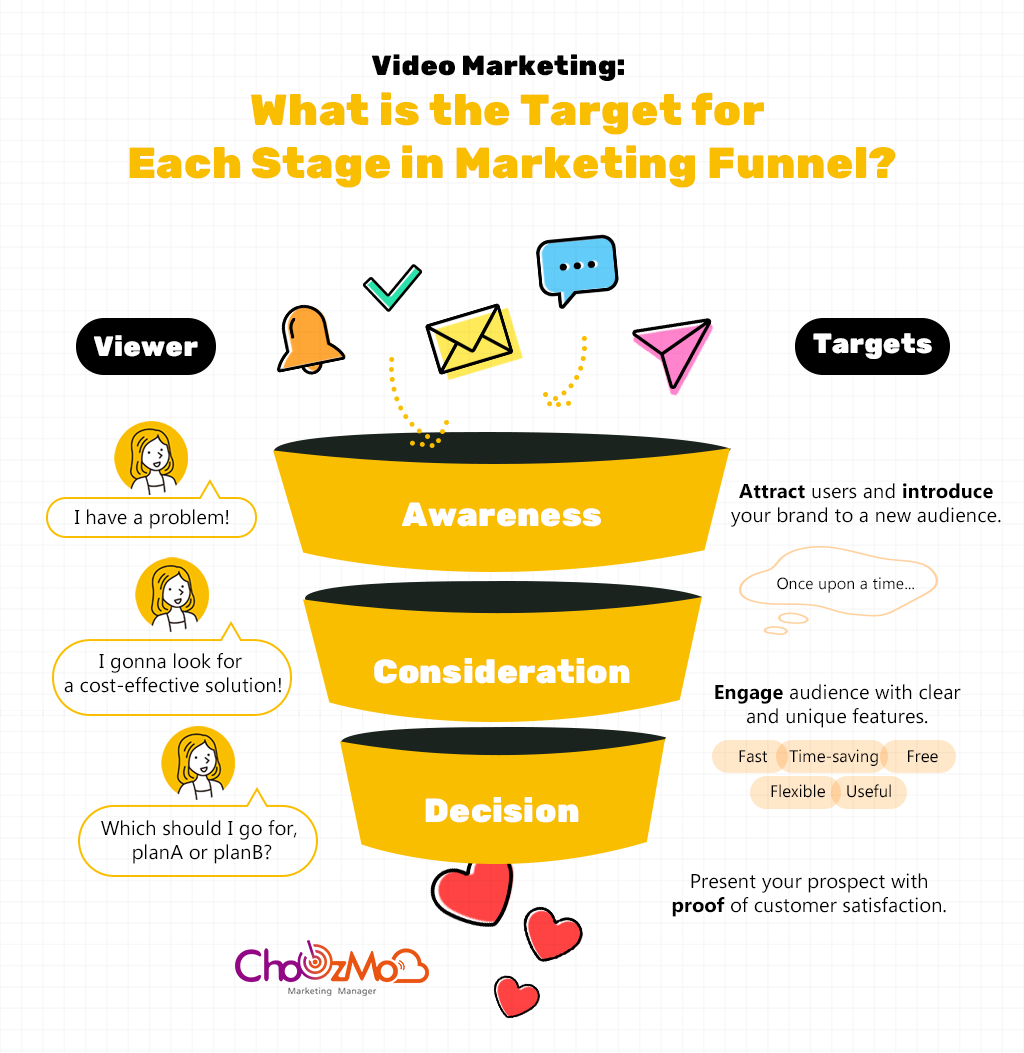
Image Source: Imgur
Turning Video Engagement Into Revenue
Creating video assets is only part of the equation. The agencies seeing the biggest returns are the ones that connect video marketing to a repeatable client acquisition system.
A prospect who watches your positioning film, engages with your LinkedIn content, or spends ten minutes reviewing a proposal walkthrough is signaling intent. The challenge is tracking those signals and turning them into meaningful sales conversations before they go cold.
This is where agency growth platforms like DashClicks can help streamline the process. Rather than managing leads, follow-ups, reporting, and fulfillment across multiple disconnected tools, agencies can centralize their marketing and sales operations in one place. When video becomes part of a larger lead-generation strategy, it becomes easier to identify engaged prospects, nurture opportunities through the pipeline, and maintain consistent communication throughout longer sales cycles.
The highest-performing agencies in 2026 aren't relying on video alone to close deals. They're combining trust-building content with systems that capture, organize, and convert buyer interest at scale. Video creates attention, but the right marketing infrastructure ensures that attention turns into signed contracts and long-term client relationships.
Measuring ROI, with Actual Math
Track four numbers. Everything else is vanity.
- Proposal-to-close rate. Baseline it before you deploy the async walkthrough, then measure 90 days after.
- Average contract value (ACV). Video gives you the confidence to quote higher. Watch this number move.
- Sales cycle length. First call to sign a contract. Async pitch typically cuts this 30-50%.
- Cost per finished video asset. Keep this honest so you know what's actually scaling.
Here's the math that matters. Say you're running a five-deal-a-month pipeline at an $8K ACV, closing 18% of proposals. That's roughly $7,200/month in the new MRR.
Add the video stack. Close rate moves to 27% (we've seen 30%+ at agencies with disciplined async pitches). Same pipeline, same ACV. New MRR: $10,800/month. That's $3,600/month in incremental revenue from the same lead flow, or about $43K in annualized recurring contract value.
Now layer in the ACV lift. Confident positioning and a better pitch motion typically move ACV 20-40%. Take the conservative end. $8K becomes $9,600. Run the same math: 5 deals x 27% x $9,600 = $13,000/month in new MRR. That's $70K+ in incremental annualized revenue against a video stack that costs you maybe $25K/year fully loaded.
If you're not sure where to peg your new rates, this agency pricing guide is a useful sanity check before you re-quote your next proposal.
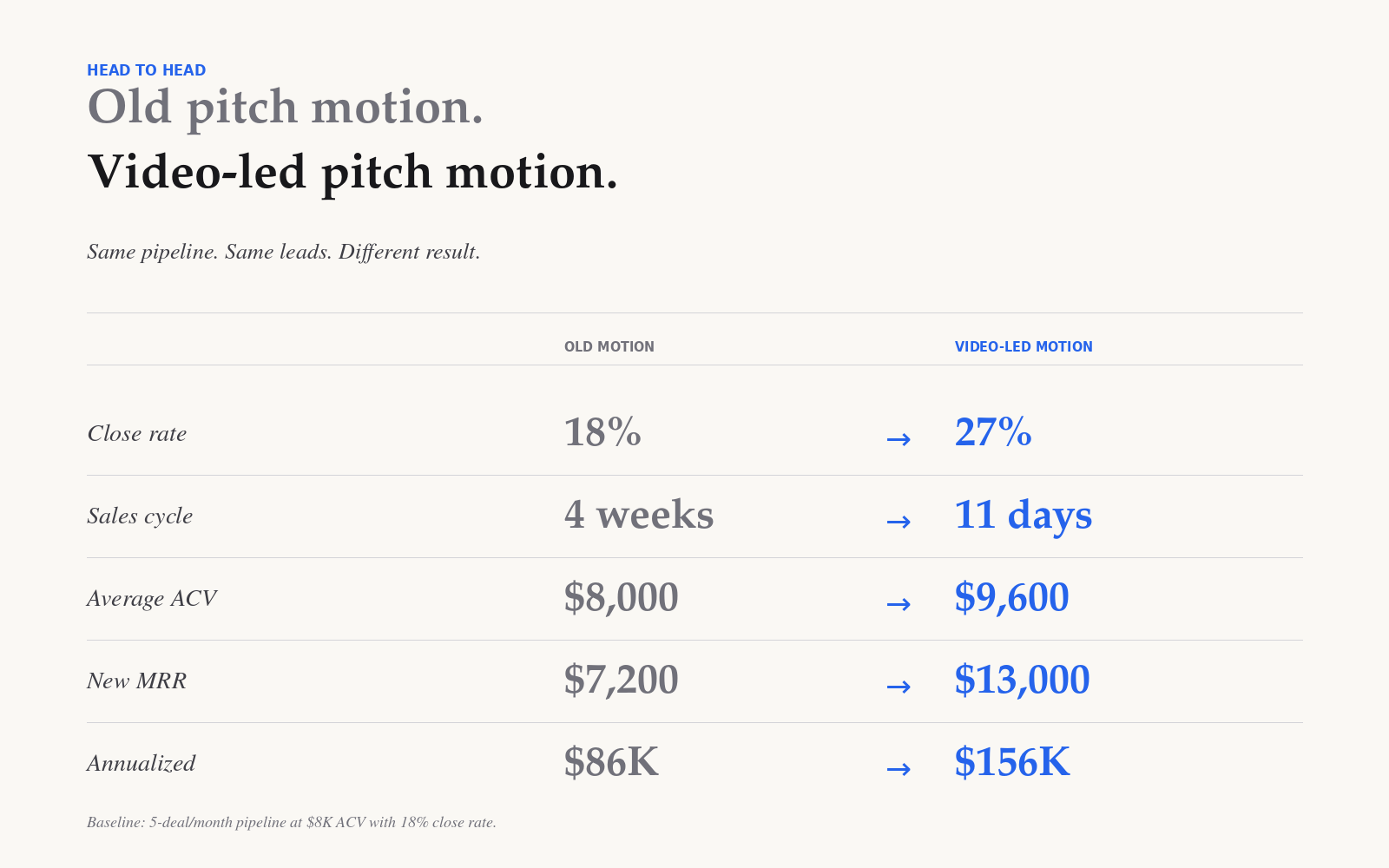
That is the unit economics shift. Not a marginal lift. A category change in what your agency is worth.
The Real Takeaway
The agencies winning $10K+ deals in 2026 are not necessarily better strategists than the ones stuck at $2K. They are better packaged ones. They've figured out that a senior buyer's trust is bought in 90-second increments, that async beats synchronously in a five-person committee, and that the cost of building this stack is small enough that not building it is the more expensive choice.
If you're sitting on a roster of $1-3K clients wondering why the bigger ones keep ghosting after the second call, the answer is almost never the strategy. It's the pitch motion. Fix the motion. The deals follow.



.svg)


.svg)
.svg)
.svg)
.svg)
.svg)