

.svg)

.svg)
.svg)
.svg)
.svg)
.svg)
Most agencies don't have a data problem — they have a relevance problem. The contact lists are long, the spreadsheets are full, but the prospects rarely fit, and the outreach rarely lands. Smart prospect data strategies exist precisely to close that gap between volume and value.
Smart prospect data isn't about having more records. It's about having the right signals: a prospect's industry, company size, recent growth indicators, decision-maker role, and how closely they match an agency's ideal customer profile (ICP). When those fields are accurate and current, prospecting becomes a targeting exercise rather than a guessing game.
Relevance, freshness, and fit consistently outperform raw volume in client acquisition. A CRM filled with outdated contacts creates noise, not pipeline. Data enrichment changes that by layering context onto basic records, turning a name and email into an actionable lead profile. Agencies that build their outreach around enriched, well-qualified records make faster decisions, waste less time on poor-fit conversations, and convert at meaningfully higher rates.
What Smart Prospect Data Looks Like?
The distinction between a bloated contact list and genuinely useful prospect data comes down to a few core traits. Raw lead lists typically contain a name, a company, and an email address. Smart prospect data goes further by including ICP fit criteria, firmographic signals, role-based context, and freshness indicators that tell you whether the record is still worth pursuing.
At a minimum, a usable prospect record should include the following:
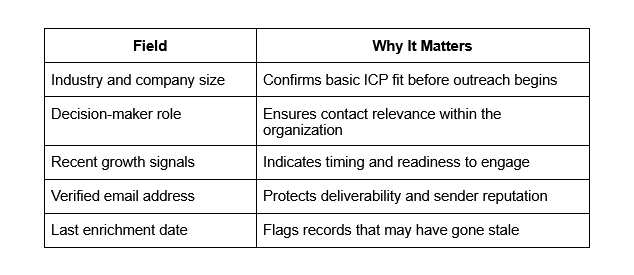
Volume without these signals produces activity, not results. When data enrichment is applied consistently, each record carries enough context to support a real prospecting decision rather than a cold guess.
Build One Data Strategy Across Every Channel
Channel fragmentation is one of the most common reasons outbound marketing stalls. When cold outreach, LinkedIn prospecting, and CRM activity are managed as separate systems, teams duplicate effort, miss follow-up windows, and lose the context that took time to build. A unified data strategy prevents that waste by treating every channel as part of the same operating model.
1. Use One Prospect Record for Email, LinkedIn, and CRM
A unified prospect record solves the fragmentation problem by anchoring every touchpoint to the same source of truth. That record should include ICP fit criteria, firmographic data such as company size and industry, and any behavioral signals collected across channels. When a prospect opens a cold email and later engages with a LinkedIn post, both events belong to the same record, not two separate logs.
Agencies that rely on client acquisition strategies to grow their pipeline benefit most from this structure when prospect data feeds directly into a single, shared record rather than a channel-specific import. Building from accurate records, then layering verification, ICP filtering, and channel-specific signals inside the agency’s own system, is what makes the unified approach effective in practice.
2. Prioritize Signals That Change Outreach Timing
Not all data points carry the same weight. Firmographic fields like headcount or location describe a prospect, but buyer intent signals such as recent job changes, hiring activity, or technology adoption actually indicate when a prospect is ready to engage.
Timing-sensitive signals should trigger outreach, not just inform it. A company that recently posted three new sales roles represents a very different conversation than one that hasn't changed its team in a year. When engagement data and intent signals feed into the same CRM record, the handoff into the sales pipeline becomes a natural next step rather than a scramble to reconstruct context.
The Workflow That Keeps Prospect Data Usable
Good data doesn't maintain itself. The agencies that get consistent results from prospecting treat their data as a repeatable operating model, one with defined steps for sourcing, cleaning, and closing the loop after every campaign.
1. Start with ICP and Source Standards
Before pulling any contacts, agencies need a clear ICP definition and a standardized set of required fields. That means agreeing on which firmographic criteria qualify a prospect, including industry, company size, region, and tech stack, and applying those filters at the source rather than after the fact.
Skipping this step turns every import into a cleanup project. When field requirements are set before sourcing begins, tools like Apollo can be configured to return records that already meet the baseline, keeping noise out of the pipeline from the start.

2. Clean, Verify, and Enrich Before Outreach
Raw contact data is rarely campaign-ready. Before any sequence launches, records should go through email verification to reduce bounce rates, data enrichment to fill gaps in firmographic or role-based fields, and deduplication to prevent the same prospect from entering multiple workflows simultaneously.
These steps protect sender reputation, improve targeting precision, and make predictable lead generation systems possible. Without them, even well-sourced lists degrade quickly once outreach begins.
3. Sync Outcomes Back into Your System
What happens after a campaign launches matters as much as what happened before it. Reply status, meeting outcomes, and disqualification reasons should all feed back into the CRM so that each record reflects the full history of a prospect's engagement.
Automated pipelines can handle much of this sync without manual input, but human oversight still matters for categorizing ambiguous outcomes. Over time, this feedback loop transforms individual prospect records into a compounding agency asset rather than a one-time lead list.
Where Better Data Changes Agency Economics
The operational case for cleaner data is straightforward, but the commercial case is what moves agencies to act. When prospect records are accurate, enriched, and matched to a defined ICP, conversion rates improve, the sales pipeline fills with better-fit opportunities, and time spent on poor-fit outreach drops considerably.
That shift has a direct effect on customer acquisition cost. Fewer touchpoints wasted on unqualified contacts means each closed client costs less to win. Enrichment techniques statistics consistently point to this relationship between data quality and efficiency across outbound programs.
The practical move is to track a small set of before-and-after metrics rather than broad vanity numbers. Response rate per campaign, meetings booked per hundred contacts, and cost per qualified conversation give a clearer picture of whether data enrichment is actually improving client acquisition outcomes. Agencies that monitor these figures over time develop a feedback loop that connects data investment directly to pipeline performance, making the case for high data standards self-reinforcing rather than theoretical.
Prospect Data Mistakes That Stall Growth
Even agencies with solid tools and active outbound marketing programs hit invisible ceilings. Often, the problem isn't effort; it's the data underneath the effort.
Stale records are one of the most common culprits. Contacts change roles, companies restructure, and decision-makers move on. A CRM full of outdated entries doesn't just underperform; it creates clutter that distorts reporting and wastes budget on prospects who no longer fit.
Weak ICP definitions compound the issue. When the criteria for a qualified prospect aren't clearly set, sourcing standards drift, and lists fill with poor-fit contacts that look valid on the surface. Skipping email verification is another pattern that quietly erodes results, since high bounce rate damages sender reputation and reduces deliverability across the entire domain, not just one campaign.
Single-channel thinking creates its own blind spots. Agencies that treat email, LinkedIn, and CRM as separate systems miss the cross-channel context that sharpens prospecting decisions. Over-automation makes these problems harder to catch. When sequences run without human review, poor data quality stays hidden until it shows up as lost meetings, inflated costs, or a pipeline that never converts.
How Prospect Data Supports Retention Too?
The same data discipline that drives client acquisition doesn't stop being useful once a contract is signed. Agencies that apply enrichment practices to their existing accounts, not just their pipeline, tend to spot expansion opportunities well before a renewal conversation becomes necessary.
Refreshed firmographic data and updated engagement signals give account teams a clearer view of where a current client stands. When those signals flow into the CRM alongside Google Analytics behavior data, patterns emerge: shifting team sizes, new product lines, or market moves that point toward unmet needs.
That context is what turns a standard check-in into a proactive strategy conversation. Rather than waiting for a client to raise a new need, agencies can arrive with relevant observations already framed, which builds the kind of trust that extends relationships naturally.

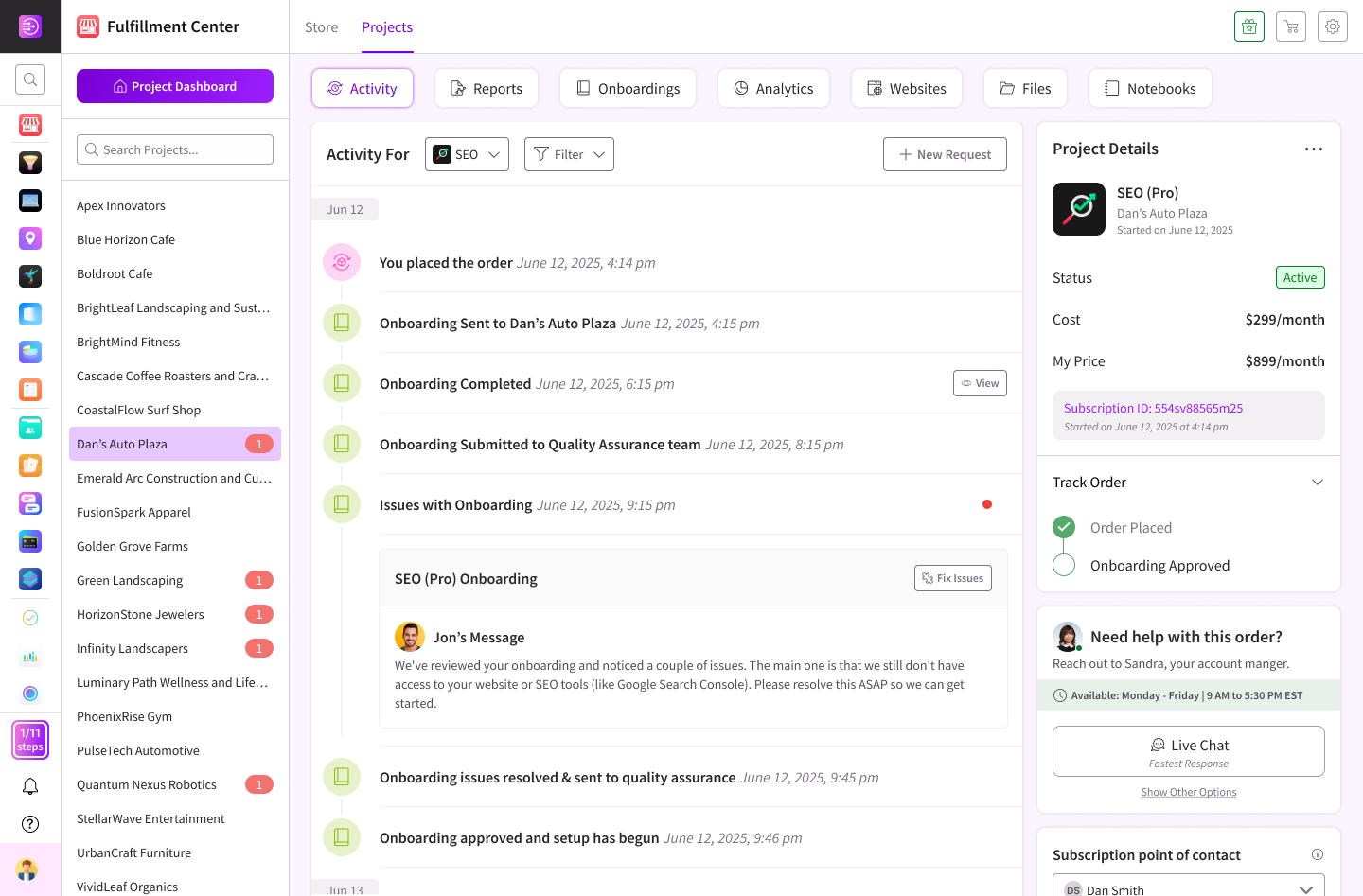
Image Source: AI Ark
Turn Prospect Data into an Operational System
Even well-enriched prospect data becomes difficult to manage when outreach activity is spread across disconnected tools and spreadsheets. As agencies scale their outbound efforts, maintaining a centralized system for prospect tracking becomes essential for keeping data usable and actionable over time.
This is where DashClicks’ CRM Software fits naturally into a smart prospect data strategy. The platform allows agencies to organize prospect records, track conversations, manage follow-ups, and maintain a clearer view of pipeline activity from a single workspace.
A centralized CRM structure helps agencies avoid one of the biggest prospecting issues: fragmented context. When email interactions, notes, follow-up tasks, and lead status updates live in separate systems, prospect records lose clarity quickly. Keeping those touchpoints connected inside one CRM creates a more complete view of every lead and reduces operational gaps during outreach.
For agencies managing high-volume prospecting campaigns, this kind of visibility improves several core areas:
- Lead Organization: Prospect records remain structured, searchable, and easier to prioritize based on ICP fit and engagement history.
- Follow-up Consistency: Teams can track outreach stages and reduce the chances of qualified leads slipping through unnoticed.
- Pipeline Clarity: A centralized dashboard makes it easier to monitor movement from first contact to booked meetings and closed clients.
- Workflow Efficiency: Sales activity, communication history, and contact management stay connected instead of scattered across multiple tools.
- Scalable Outreach Operations: As prospect volume increases, structured CRM workflows help maintain process consistency without adding unnecessary manual work.
When paired with strong data enrichment and verification practices, contacts management software becomes more than a storage system for contacts. It turns prospect data into an operational framework that supports more organized outreach, stronger pipeline management, and more predictable agency growth over time.
Turn Better Prospect Data into Steady Growth
Agencies that treat prospecting as a one-time list purchase tend to plateau. Those that build a living data strategy, one that feeds outreach, tracks outcomes, and refines over time, compound those gains across every campaign.
The improvements don't need to happen all at once. A single workflow fixed, whether that's adding email verification or syncing reply data back into the CRM, creates a cleaner foundation for the next one. Over time, that compounding discipline is what separates agencies with inconsistent pipelines from those where client acquisition becomes a predictable, measurable function of the business.



.svg)


.svg)
.svg)
.svg)
.svg)
.svg)